







 Accor Plans €1.6bn Ennismore Stake Buyout
 Batumi New Boulevard Beach Nourishment: New 2.5 Million GEL Tender and the Coastal Protection Challenge
 Inner London House Prices Fall 7.2%, Sharpest Since 2009
 Swissôtel Kobuleti Beach Resort: $300M Investment in Kobuleti
 Georgia Plans to Build 600 km of Highways in 5–7 Years: Is Local Business Ready for Large-Scale Projects?
 IBTM World Barcelona 2026: Georgia at the International Business Tourism Exhibition
Spain Concludes Migrant Regularisation: 1.27M "New Spaniards"
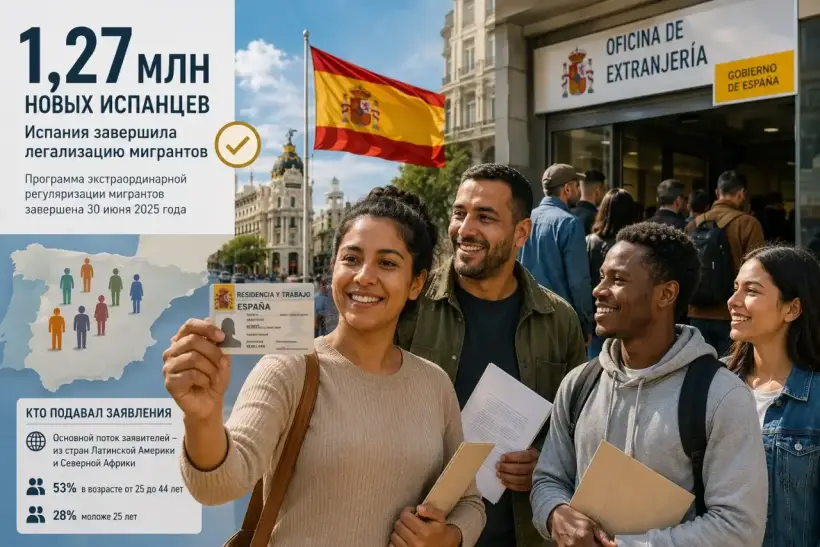
On 30 June, the deadline for submitting applications under Spain's extraordinary migrant regularisation programme expired. According to the immigration service staff union, approximately 1.27 million applications had been submitted by 26 June—more than double the government's initial forecast of 500,000-700,000 people.
Conditions of Regularisation
The programme was launched under Royal Decree 316/2026, approved by the Council of Ministers on 14 April and taking effect the following day. Electronic application submissions opened on 16 April, with in-person submissions at social security offices, immigration services, and post offices starting on 20 April. In total, more than 370 Correos post office branches and 60 social security offices accepted applications.
Eligible for regularisation were individuals who arrived in Spain before 31 December 2025 and lived in the country continuously for at least five months, with no criminal record in Spain or in their country of origin over the past five years. Payment of a 38.28 euro fee was mandatory. Approved applicants receive a residence permit with work authorisation for a period of one year, with an option to renew. Children of migrants included in the application receive a five-year permit.
Who Applied
Prime Minister Pedro Sánchez called the programme "an act of justice and a necessity," stressing that regularisation is not only a human rights issue, but also an economic imperative for an ageing Spain. According to him, without the contribution of migrants, the country risks losing up to 19% of GDP by 2050 and up to 22% by 2075.
According to Spanish media, the primary flow of applicants came from Latin America and North Africa, predominantly from Colombia, Venezuela, and Morocco. More than half of all applications (53%) were submitted by individuals aged 25 to 44, with another 28% younger than 25.
Criticism of the Programme
The current regularisation marked the first mass programme of its kind in Spain in 21 years: between 1986 and 2005, the country carried out six such legalisation campaigns under governments across different political spectrums. The catalyst for the current programme was a citizens' legislative initiative that gathered over 700,000 signatures.
The government's decision did not escape criticism. The opposition People's Party stated that the measure would place an additional burden on public services, while the right-wing party Vox announced plans to challenge the decree before the Supreme Court, pointing out that the matter should have been resolved through parliament rather than by presidential decree.
System Strain
At the same time, human rights organisations and several left-wing parties—Podemos, Sumar, EH Bildu, ERC, and BNG—demanded an extension of the application window due to long queues and difficulties in obtaining criminal record clearance certificates from applicants' home countries; however, the government insisted that the 30 June deadline was codified in the decree and non-extendable.
Between April and June, immigration authorities issued around 360,000 temporary work permits—about 40% of the total applications received. The official processing time for each case is three months, though lawyers predict significant delays; meanwhile, the temporary work permit issued upon application registration remains valid throughout the review period.
Despite the broader European trend towards tightening migration policy, Spain maintains the opposite stance: the share of foreign-born residents has grown to nearly 10 million in recent years—roughly one in every five residents in the country, reports International Investment.