







 Inner London House Prices Fall 7.2%, Sharpest Since 2009
 Swissôtel Kobuleti Beach Resort: $300M Investment in Kobuleti
 Georgia Plans to Build 600 km of Highways in 5–7 Years: Is Local Business Ready for Large-Scale Projects?
 IBTM World Barcelona 2026: Georgia at the International Business Tourism Exhibition
 Spanish Home Sales Drop 13.4% in September
 10 Former Sanatoriums in Tskhaltubo Go Unsold Again: Why Is the Resort Failing to Attract Investors?
Passenger Traffic at Georgian Airports Rose by 6.1%: Key Trends in Q3 Statistics

In the third quarter of 2026, Georgia's airports served over 3 million passengers, up 6.1% compared to the same period last year. At the same time, cargo and mail throughput at airports grew by nearly 30%. However, growth in the air transport sector does not extend across all segments. The number of passengers carried by airlines registered in Georgia dropped by 14.4%, and the volume of cargo transported declined by 26%. The data thus demonstrates diverging trends in Georgia's aviation market: overall airport activity is expanding, while the performance of Georgian-registered carriers is declining.
Airport Passenger Traffic Reaches a New High
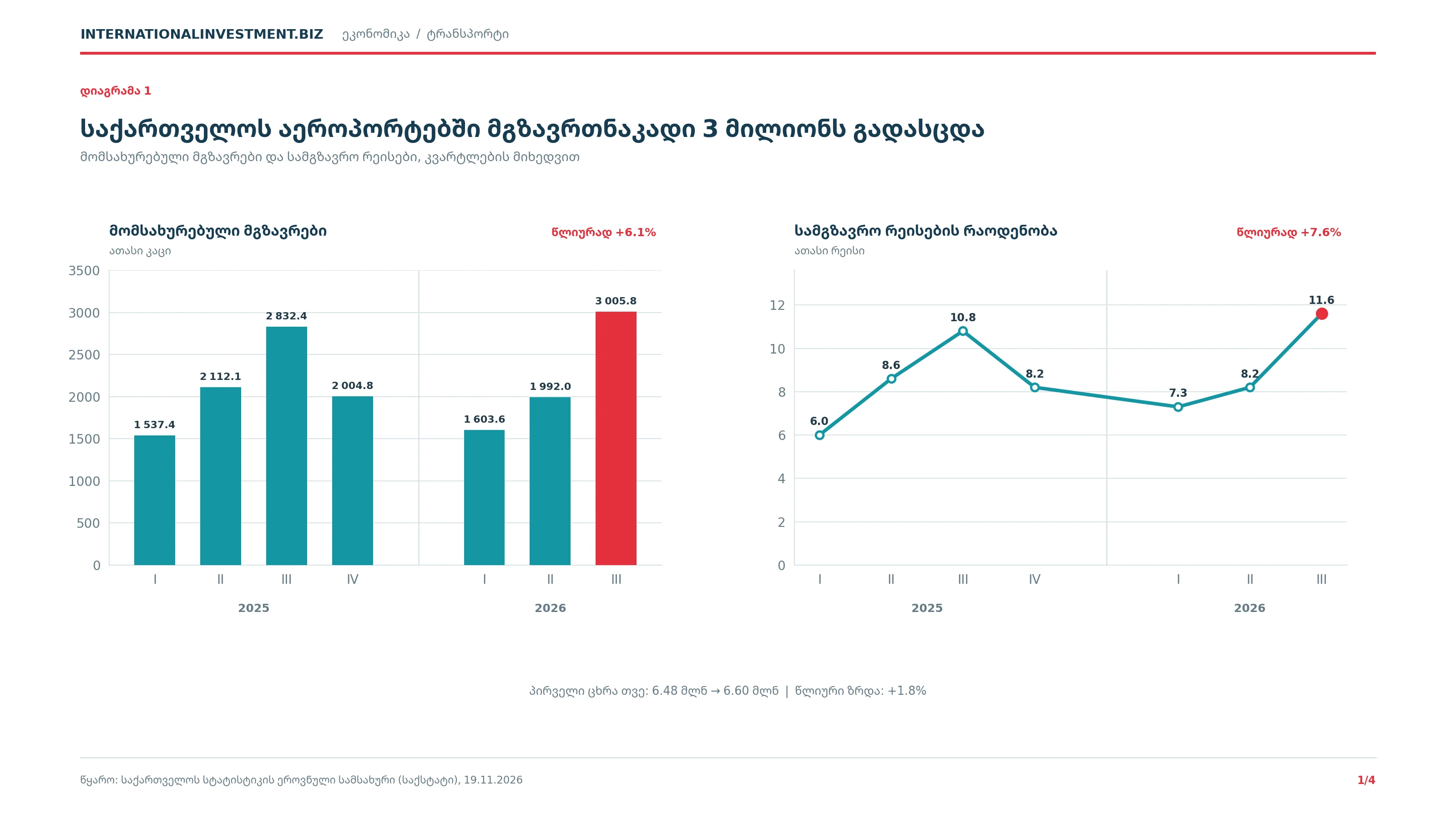
According to the National Statistics Office of Georgia, in Q3 2026, Georgian airports handled 3 million passengers (3 005.8 thousand), which exceeds the figure for the corresponding period of 2025 by 173.4 thousand passengers.
During the reporting period, 1.5 million passengers departed from the airports (an annual increase of 6.0%), and approximately 1.5 million passengers arrived as well, representing an increase of 6.2%.
Quarterly dynamics show that the third quarter is a period of particularly high activity for passenger air travel. In Q3 2025, Georgian airports handled 2.83 million passengers, while in the same period of 2026 this figure exceeded 3 million.
At the same time, a more moderate growth is evident when comparing figures for the first nine months of the current year. In the first three quarters of 2025, the number of passengers served by airports was around 6.48 million, reaching 6.60 million in the same period of 2026. Accordingly, cumulative growth over nine months stood at approximately 1.8%.
The difference is especially noticeable when comparing quarterly figures. Specifically, in the first quarter of 2026, passenger traffic grew year-on-year, in the second quarter it decreased, and in the third quarter higher growth rates were recorded. Thus, the strong performance of the third quarter offsets the comparatively sluggish dynamics of the first half of the year.
This circumstance is important when assessing the aviation and tourism sectors, as judging the overall state of the market solely on the basis of the peak summer season data can provide an incomplete picture.
Scheduled Flights Still Dominate, but Non-Scheduled Share Is Growing
In Q3 2026, 94% of passenger traffic at Georgian airports came from scheduled flights, and 6% from non-scheduled flights.
Despite the clear prevalence of scheduled flights, in the same period of the previous year their share was 95.4%. Accordingly, it contracted by 1.4 percentage points over the year, while the share of non-scheduled flights increased.

During the same period, the number of passenger flights operated from Georgia's airports amounted to 11.6 thousand, up 7.6% year-on-year.
Notably, the number of passenger flights is growing faster than passenger traffic itself. This disparity in itself does not allow for a definitive assessment of aircraft load factors, yet it indicates that the increase in served passenger numbers is accompanied by an expansion of the flight network.
Cargo and Mail Flow Up Nearly 30%
In parallel with passenger traffic, positive dynamics are also observed in the cargo segment. In Q3 2026, the flow of cargo and mail at Georgian airports reached 12.3 thousand tons, compared to 9.5 thousand tons in the same period of 2025. Accordingly, year-on-year growth stood at approximately 29.5%.
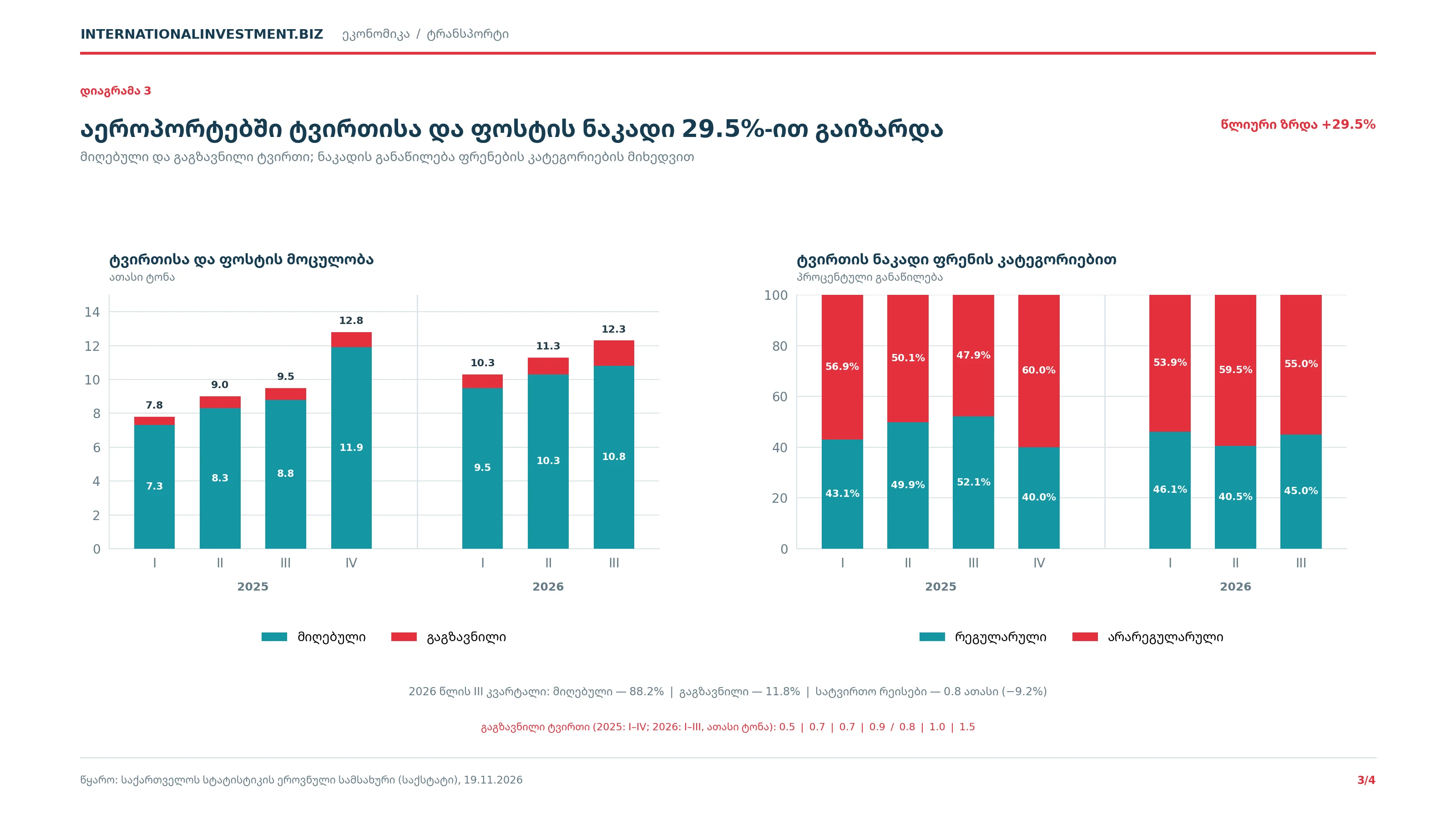
As the chart shows, of the total volume, 10.8 thousand tons accounted for incoming cargo and mail, and 1.5 thousand tons for outgoing.
In terms of dynamics, the volume of incoming cargo and mail increased by approximately 22.7% year-on-year, while the volume of outgoing cargo, according to rounded quarterly data, roughly doubled.
Despite the faster growth of outgoing cargo, a sharp imbalance persists in the traffic structure: incoming cargo and mail represent 88.2% of total volume, with outgoing accounting for only 11.8%.
This reflects one of the key features of Georgia's air cargo market: cargo and mail flow at airports is concentrated primarily in the inbound direction, although outperforming growth in outbound traffic points to certain structural changes.
Another notable difference concerns the breakdown of cargo by flight category. In Q3 2026, 55% of the cargo and mail flow was transported on non-scheduled flights, while scheduled flights accounted for 45%. In Q3 2025, the situation was reversed: scheduled flights accounted for 52.1%, and non-scheduled for 47.9%.
Thus, in the cargo segment, the share of non-scheduled flights increased to form the majority of total volume for the reporting period.
At the same time, in Q3 2026, the number of cargo flights operated at the airports was 0.8 thousand, which is 9.2% lower than the figure for the previous year.
From an analytical standpoint, the concurrent growth in cargo volume and decrease in cargo flights represents a notable trend. However, available data does not allow for identifying the exact driving factors; additional information on flights, routes, and freight capacities is required.
Performance of Georgian-Registered Airlines Declines
In contrast to the overall positive dynamics of the airports, operating metrics of airlines registered in Georgia paint a more complicated picture.
In Q3 2026, the number of passengers carried by these airlines stood at 211.5 thousand, compared to 247.2 thousand in the same period of 2025. As a result, passenger transport dropped by 14.4% year-on-year.
A sharper decrease was recorded in freight transportation. In particular, Georgian-registered airlines carried 25.9 thousand tons of cargo during the reporting period, down from 35.0 thousand tons in Q3 of the prior year. Accordingly, the decline reached 26.0%.
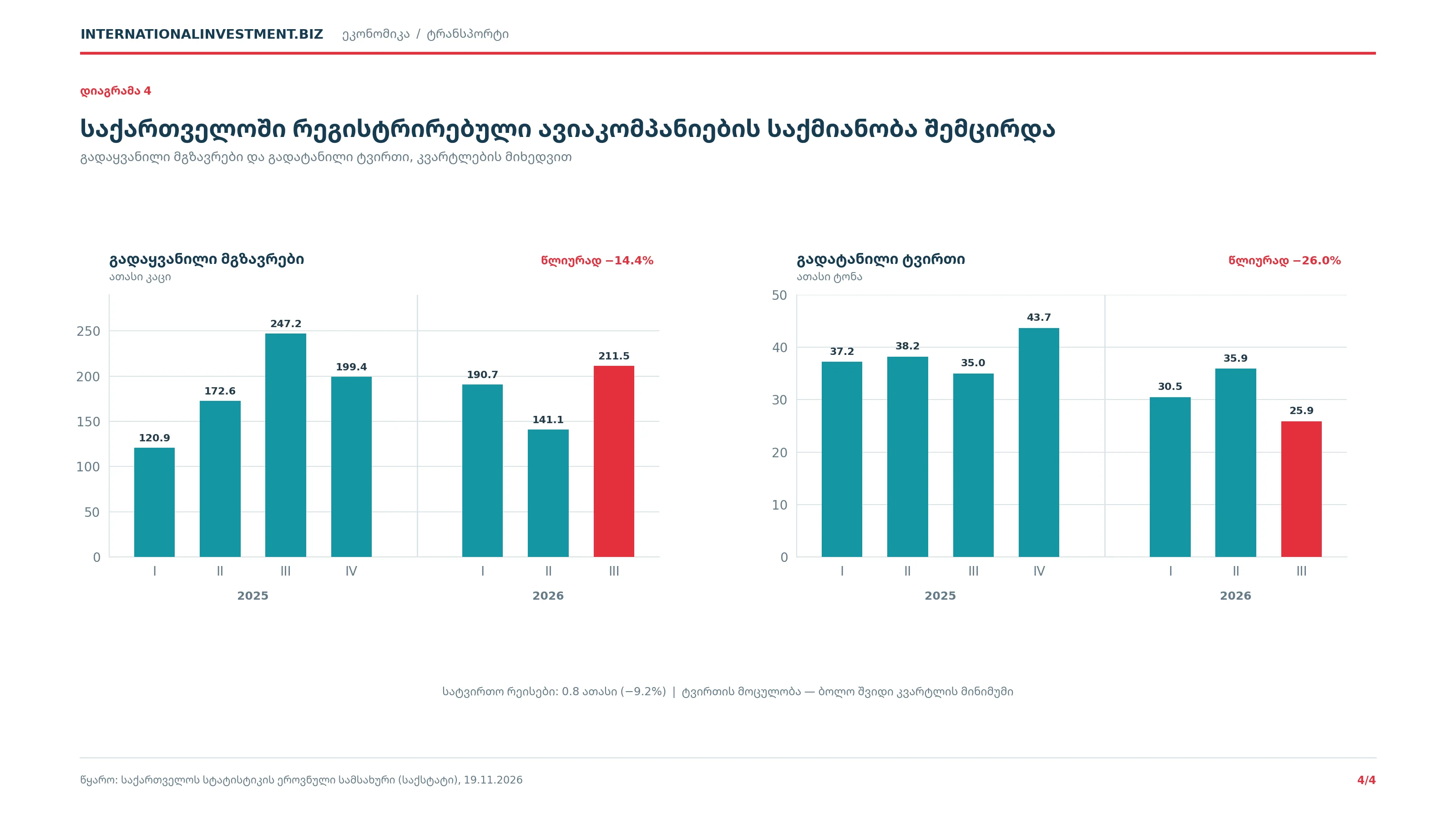
It is especially indicative that the volume of cargo transported in Q3 2026 was the lowest over the past seven quarters.
Regarding passenger traffic, some quarter-on-quarter improvement was observed. In Q2 2026, the number of passengers transported by Georgian-registered airlines was 141.1 thousand, rising to 211.5 thousand in Q3. However, this gain does not offset the year-on-year decline.
In air cargo, the trends draw even more attention. In the first quarter of 2026, these carriers transported 30.5 thousand tons, in the second quarter 35.9 thousand tons, and in the third quarter just 25.9 thousand tons of cargo.
Thus, for Georgian-registered airlines, the third quarter of this year was marked by weakening cargo activity both year-on-year and compared to the previous quarter.
Domestic Airlines Decline Amid Broad Sector Growth: The Core Contrast
A comprehensive assessment of data from the National Statistics Office of Georgia reveals significantly divergent trends in the country's aviation sector.
On one hand, passenger and cargo/mail traffic handled by Georgian airports is growing; on the other hand, passenger and cargo volumes carried by domestic Georgian airlines are contracting.
It should be clarified that these metrics reflect different statistical cuts. Airport data reflects the total volume of passenger and cargo traffic passing through Georgia's gateways, whereas airline statistics reflect the performance of carriers registered in the country. Consequently, directly conflating them or comparing them to estimate market shares would be incorrect.
Nevertheless, this divergent dynamic raises important questions regarding the structure of Georgia's aviation market. In particular: to what extent does overall airport growth translate into financial results for national airlines, and what is the contribution of foreign carriers to this broad upturn?
The published statistics do not provide a definitive answer to these questions. Doing so requires additional data on the breakdown of passenger and cargo traffic by individual carrier, carrier market shares, route developments, and operational scale.
Growth and Challenges in Georgia's Aviation Market
The Q3 2026 data thus illustrates both new growth opportunities and notable challenges for Georgia's aviation sector.
Specifically, the rise in passenger numbers and cargo throughput at airports represents a positive trend. However, evidence shows that this growth is distributed unevenly among sector participants. The decline in freight volume carried by Georgian-registered airlines deserves particular attention.
Considering these developments, future sector evaluations must not only monitor total airport passenger and cargo traffic, but also examine the underlying structure of that growth: who exactly operates the flights, how the role of scheduled versus charter flights is evolving, and what positions Georgian carriers hold in the broader market.
Only an integrated analysis of these indicators will show whether the rising workload of Georgia's airports translates into a strengthening of the domestic aviation industry.
Source: National Statistics Office of Georgia — "Main Indicators of Air Transport (Q3 2026)", November 19, 2026.
InternationalInvestment.biz - English Edition