












Immigration Index 2026: the most attractive countries for relocation
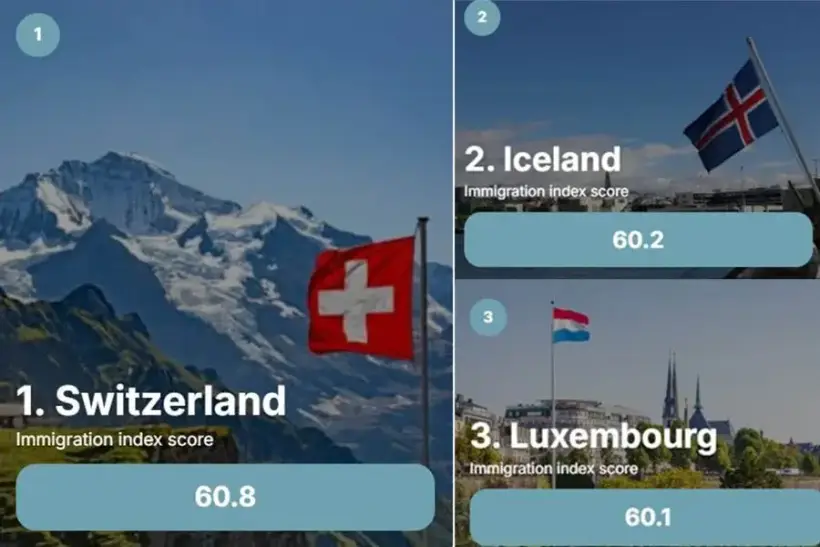
Global mobility in 2026 remains high. Economic pressure, shifts in migration policy, and personal circumstances are reshaping attitudes toward moving abroad, as highlighted in the Remitly study. The attractiveness of 82 countries is assessed in the Immigration Index 2026 across 34 indicators; European countries dominate the top 10.
Researchers compiled the dataset using authoritative international sources, including the World Bank, Yale and Columbia universities, and the OECD, among others. Data collection was completed before the outbreak of the conflict in the Middle East, so current developments in the region are not reflected.
Top 3 immigration destinations
Switzerland moved up from second place in 2025 to first in 2026. It stands out for exceptional earning potential—ranking first globally on this measure—alongside strong healthcare access, high safety standards, and solid income performance.
Its attractiveness is also linked to a well-established immigrant community and advanced public infrastructure. Additional strengths include high scores in new indicators such as international schooling availability and energy security. Discussions around limiting the population to 10 million were raised domestically, but the proposal was rejected.
Iceland drops from first to second place but continues to deliver strong results in income levels and safety, while leading the index in environmental performance. The decline is partly explained by a lower availability of international schools compared to other countries. Strong family-oriented policies and one of the world’s highest happiness levels remain key features, with the country offering a high standard of living within a small, close-knit society.
Luxembourg maintains its position as one of Europe’s most resilient small states, combining high income levels with an efficient public transport system and a strong immigrant community. Safety, environmental performance, and high life satisfaction further strengthen its appeal for professionals and families seeking stability and quality of life in the heart of Europe.
Top 10 countries for relocation
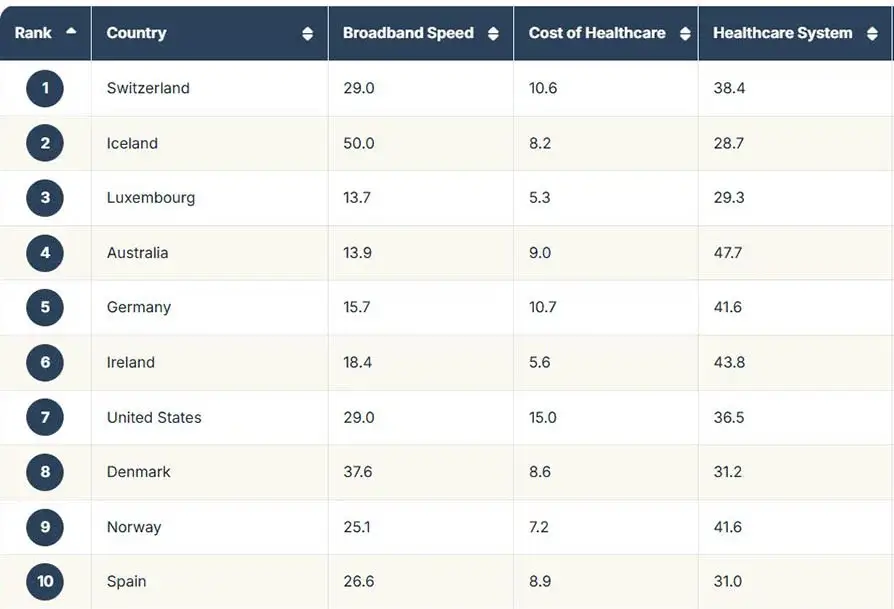
Australia ranks fourth, supported by strong performance in healthcare, happiness, and environmental quality. A robust labour market and solid income levels add to its appeal, alongside an open migration environment and strong demand from families seeking long-term opportunity and quality of life.
Germany takes fifth place. Its strength lies in a well-developed infrastructure and social systems. High scores in healthcare, environmental policy, and energy security reinforce its position as one of Europe’s key migration destinations. Stable labour conditions and long-term career prospects in its largest economy add further weight.
The remaining top 10 includes Ireland, the United States, Denmark, Norway, and Spain.
Other countries in the ranking
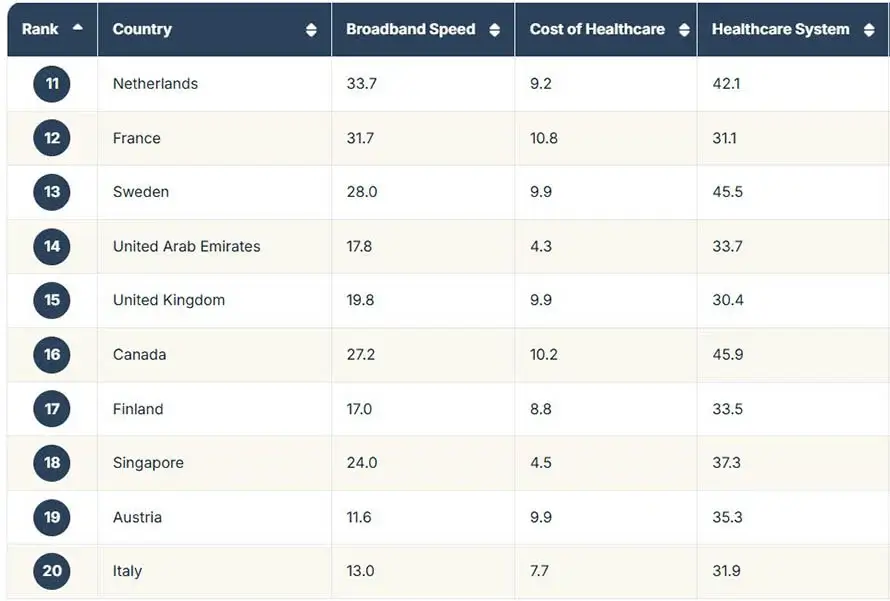
The second tier begins with the Netherlands, which stands out for a strong economic base and solid infrastructure. At 12th place, France shows stability in its social system but weaker momentum in certain economic indicators. High living standards and environmental performance support Sweden in maintaining a strong position. At 14th place, the United Arab Emirates demonstrates strong economic results and institutional efficiency, though weaker scores in some economic dimensions.
Other attractive destinations include the United Kingdom, Canada, Finland, as well as Singapore, Austria, and Italy. Many European countries appear in the next tier alongside South Korea, New Zealand, and Japan.
Further down the ranking, Greece sits at 32nd place, Cyprus at 36th. Between Thailand (37th) and China (39th) is Bulgaria (38th).
Serbia ranks 49th despite relatively simple residency pathways, followed by Argentina (50th). Albania holds 55th place, India 60th. Indonesia and Georgia are close at 61st and 63rd; Georgia stands out for particularly flexible entry conditions, including visa-free stay of up to one year without registration. Lower positions include Azerbaijan and the Philippines. Armenia ranks 74th, while the Iraq (81st) and Cuba (82nd) close the list.
Conclusion
The Vice President of Marketing for Europe, the Middle East and Africa, and Asia-Pacific, Ryan Riley, noted that choosing a place to live abroad remains one of the most significant life decisions. The 2026 Immigration Index reflects the broad range of factors people consider when relocating internationally.
Rising positions for Switzerland, Spain, Germany, and Australia reflect conditions where multiple factors align more effectively. These countries typically combine strong employment opportunities with high living standards. However, there is no single optimal destination; the right choice depends on individual priorities, family needs, and long-term goals.
Analysts at International Investment highlight that final rankings are shaped by a combination of economic conditions, institutional quality, safety, and social infrastructure. Countries that lead the index tend to combine income levels, quality of life, and access to essential services within a relatively coherent framework. The index overall reflects a shift away from isolated advantages toward broader systemic resilience.