









Residence Permit Fees in Turkey for Russians Rise Nearly 15-Fold
Turkish authorities have sharply increased the cost of short-term residence permits for Russian citizens, according to RIA Novosti. Fees have risen nearly 15 times, and the new amounts are already reflected in application systems. Experts note that the changes also affect nationals of many other countries.
New Fees for Russians in Turkey
At the end of 2025, an adult applicant paid a minimum of $42 (₺1875), rising to $45 (₺2000) by January. A one-year residence permit now costs $620 (₺28,000), while a two-year permit has increased from $144 (₺6500) to $1284 (₺57,899) for adults. For minors, the fee is about 25% lower. A child’s residence permit now costs over ₺29,400 ($637).
This information is confirmed by Turkey’s Directorate of Migration Management, which has published updated requirements on its official website. The calculation rules were formally changed on January 1, 2026, although the new tariffs began to be applied in practice at the end of April.
In January 2023, more than 154,000 Russian citizens lived in Turkey under various types of residence permits, making them the largest group of foreign residents. In 2025, over 11% of Russians with permanent residence left the country, according to RIA Novosti. As of April 24, more than 74,000 Russians still held valid residence permits.
Turkey Residence Permit Reform: Countries and Categories
According to Ikamet, a new system for calculating residence permit fees in Turkey came into force on April 29, 2026, significantly increasing the cost of legal residence for foreign nationals. The changes apply not only to Russians but to most foreign citizens, including applicants from the EU, the United States, the United Kingdom, Canada, China, India, Ukraine, and others.
There are exemptions. University students, certain long-term residents, and citizens of several countries—including the Czech Republic, Denmark, Ireland, Kosovo, Syria, Turkmenistan, Palestine, and Northern Cyprus—are exempt from the main residence permit tax.
The increase affects the main categories of short-term residence permits, typically issued to foreigners without employment contracts. This type is often referred to as a “tourist residence permit,” although officially it is classified as a short-term residence permit and includes a broader range of grounds, from renting property to family residence.
How the Price Is Formed: Increase of Up to 930%
International experts estimate the increase at up to 930%, describing the reform as one of the most significant in recent years.
Key Components of the Fees
The residence permit fee in Turkey consists of two mandatory components. The first is the government tax (harç), regulated by Law No. 492 and dependent on the duration of stay and the applicant’s nationality. This component accounts for the main increase.
The second is a fixed fee for the residence permit card (belge bedeli). It does not depend on nationality and is set annually by the Ministry of Finance. In 2026, it amounts to ₺964 ($21). The total cost is calculated by combining these two components, with the harç making up the bulk of the expense.
Tariffs and Total Cost
Following the changes, the total cost of a residence permit in Turkey depends on its duration and has increased significantly. A six-month permit costs ₺17,717.70 ($392), a one-year permit ₺31,111.50 ($690), a two-year permit ₺57,899.10 ($1284), and a three-year permit ₺84,686.70 ($1875).
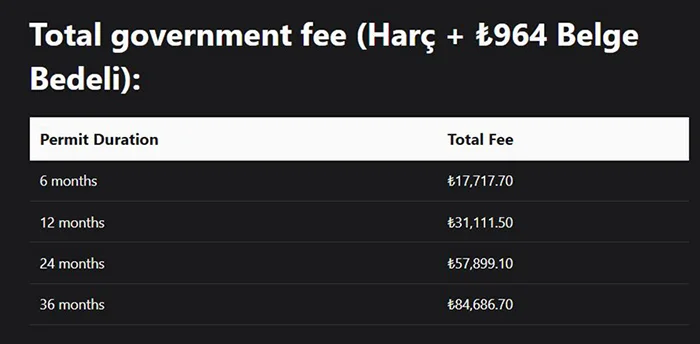
The calculation is based on a unified formula that includes a fixed rate for the first month and additional monthly charges for each subsequent month, plus the residence permit card fee.
Timing and Additional Costs
The final cost may depend on both the application date and the date of the appointment with migration authorities. Due to processing delays, applicants who submitted documents before the new tariffs took effect may still be charged the updated rates if their applications are processed after April 29.
In addition to government fees, applicants must also pay for health insurance, document translation and notarization, and, in some cases, intermediary or consultancy services. As a result, the total cost of living legally in Turkey can significantly exceed the official government fees.
Conclusion
Analysts at International Investment note that the increase is part of an ongoing revision of Turkey’s migration policy. In recent years, the country has been steadily tightening requirements for foreign nationals. Changes have affected not only residence permits but also citizenship rules, including investment-based programs linked to real estate purchases.
The pressure on long-term foreign residents is increasing, impacting both financial costs and the overall attractiveness of Turkey as a destination. The new regulations have already led to an outflow of some migrants and a decline in foreign investor interest. The real estate market shows weak performance, with foreign investment declining for several consecutive years and reaching a negative 20% in March 2026.
FAQ
How much does a residence permit in Turkey cost now?
The cost depends on the duration. A one-year permit costs ₺31,111.50 ($690), a two-year permit ₺57,899.10 ($1284), and a three-year permit ₺84,686.70 ($1875).
What is included in the residence permit cost?
The total includes the government tax (harç) and the fixed residence permit card fee (belge bedeli), which is ₺964 ($21) in 2026.
Who is affected by the changes?
The increase applies to most foreign nationals, including applicants from Russia, the EU, the United States, the United Kingdom, Canada, China, India, Ukraine, and others.
What is the difference between a “tourist” and a short-term residence permit?
There is no official “tourist residence permit” in Turkish law. The correct term is short-term residence permit, which covers various grounds such as renting property, living without employment, or family reasons.
Are there any exemptions?
Yes, certain categories are exempt from the main tax, including university students, long-term residents, and citizens of specific countries such as the Czech Republic, Denmark, Ireland, Kosovo, Syria, Turkmenistan, Palestine, and Northern Cyprus.