


Compare two properties by net yield: long-term rent, short-term lets, a hotel room and a commercial unit, with costs and tax taken into account.
Property Yield Calculator
The calculator shows what the owner keeps after costs, vacancy and tax.
- Three popular formats of investment property. An apartment for long-term rent, an apartment rented by the night, or a hotel room with an operator’s share or a fixed rate.
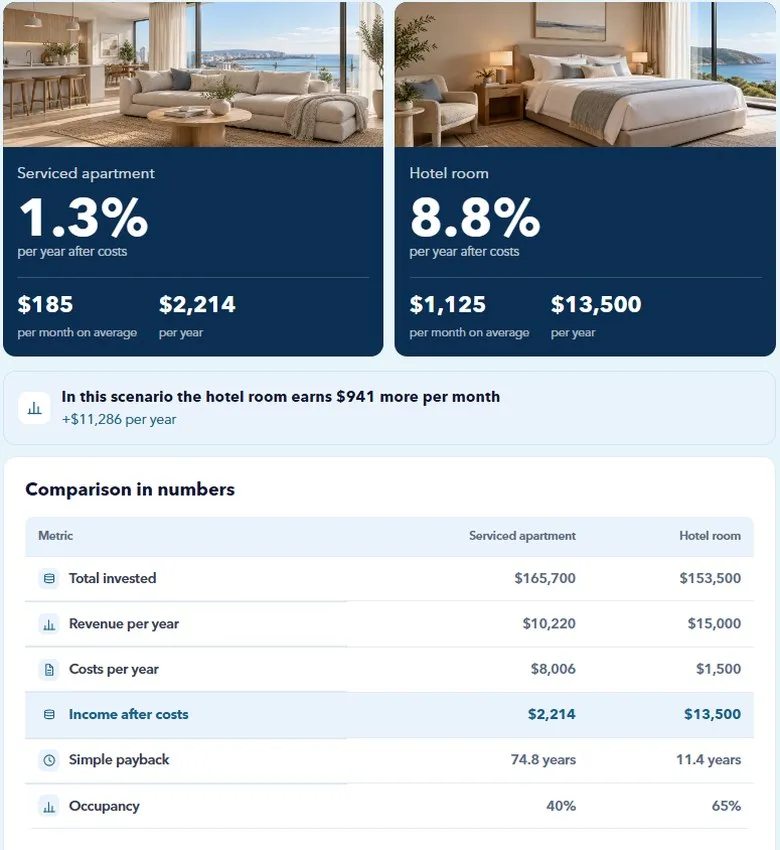
- Two properties compared at the same budget. The calculator shows the difference in money and the occupancy at which the two options yield the same.
- Dollars, euros or lari. Exchange rates are pulled automatically from the European Central Bank and the National Bank of Georgia.
- Results you can share. The link opens the same figures for the other person, with buttons to save as PDF or as an image.
How to verify these figures in practice
Occupancy
Open five to ten apartments of your class in neighbouring buildings on Airbnb and scroll the calendars three months forward and back: booked dates are visible. On Booking, check how many listings stay free on peak dates. If half the city is free in August, 85% annual occupancy is out of reach on that market.
Rental rate
myhome.ge and ss.ge show asking prices, not deals. Real rates are discussed in Telegram chats of landlords and tenants of a specific building: people write what they finally let for and how much they conceded in negotiation. The gap between listing and deal is usually 5–15%.
Management company fee
Ask for the contract, not the presentation. See what the percentage is calculated from — revenue or income after costs — who pays for cleaning, linen, consumables and advertising, and whether the fee is charged in vacant months.
Operator’s share in a hotel
Find out what the share covers and what is paid on top: building fees, insurance, replacing furniture and textiles. Ask in the owners’ chat whether payouts arrive on time and whether actual occupancy matches what was promised at the sale.
Costs people usually leave out
Utilities in vacant months, service charges, internet, replacing appliances every two or three years, tax, fees for transferring money abroad. Short-term rentals add consumables and minor repairs after guests.
The price of the property itself
Look at closed deals, not the developer’s price list. On the secondary market the gap between asking and deal reaches 10%, while in new builds the price is kept high on paper and offset with discounts, instalments and furnishing.
What the figures in the result mean
Gross yield
Annual rental revenue divided by the property price, before costs. This is what developers usually show in presentations — it is always higher than net.
Net yield
Income after management, upkeep, tax and reserve, divided by the total amount invested including purchase and set-up costs. This is what the owner really keeps.
Simple payback
The amount invested divided by net annual income. Capital growth, inflation and mortgage are not included, so the term is indicative.
Occupancy
The share of the year when the property is occupied and earning. For long-term rent it is the months between tenants, for short-term the booked nights in the calendar.
Operator’s share
The percentage of revenue the hotel’s management company keeps for management, cleaning and sales. In Georgia it is usually 30–50%.
Break-even point
The occupancy at which the second property matches the first in yield. Anything below this mark favours the first option.
Frequently asked questions
What yield counts as normal
Gross yield in Batumi and Tbilisi usually falls within 6–9% a year: lower for long-term rent, higher for short-term. Net yield after management, utilities, tax and a repair reserve comes out more modest — typically 3 to 6%. A claimed 12% net most often means some costs were left out of the calculation.
Why the result differs from the developer’s presentation
Usually for three reasons. Presentations show gross yield, not net. They take summer occupancy and apply it to the whole year. And they almost never include a reserve for repairs and replacing furniture, although a short-term apartment wears out in two or three years.
Is a fixed return from the operator reliable
A fixed rate is an obligation of the management company, not a property of the building. It lasts exactly as long as the company stays solvent, and is usually set for three to five years, after which income switches to a revenue-share scheme. Before buying, find out what amount the percentage is calculated from and ask in the owners’ chat whether payouts arrive on time.
Short-term or long-term
Short-term letting at occupancy above 60% usually beats long-term even after commissions, but it needs management and gives unstable seasonal income. Long-term rent earns less but is predictable. The difference is visible in comparison mode: put the same property in as two options.
How much does the management company take
In Georgia short-term management costs 15–25% of revenue, long-term 8–10%. Look at the contract, not the percentage: what it is calculated from, who pays for cleaning, linen and consumables, and whether the fee is charged in vacant months. A below-market rate usually means extra charges as separate lines.
What tax does a foreign owner pay
In Georgia, rental income from residential property is taxed at 5% for individuals, and the owner’s citizenship does not affect it. Short-term letting through platforms may fall under a different regime, and above 100,000 lari of annual turnover VAT is added. Other countries have their own rates — check locally.
Which currency to calculate in
The one the income arrives in. If rent is paid in dollars while costs and tax are in local currency, the exchange difference quietly eats part of the profit. The calculator converts amounts at the European Central Bank and National Bank of Georgia rates but does not model currency risk.
Should capital growth be included
Not in a yield calculation. Price growth depends on the market, not on rental flow, and merging them into one figure inflates the result. Count the rent separately and treat price growth as a possible bonus.
The calculation is for reference only and is not investment advice. Rental terms, taxes and fees depend on the country and the specific contract.