











Best Passports in 2026: Security Overtakes Mobility

Geopolitical conflicts and economic uncertainty are reshaping attitudes toward citizenship. In the past, affluent individuals often assessed a passport’s value primarily through travel freedom. Today, greater importance is placed on security, quality of life, access to education and healthcare, and the strength of public institutions, according to research by CS Global Partners. Second citizenship is increasingly viewed as a tool for investment diversification.
How the Ranking Was Compiled
The ranking is based on statistical data from international organizations, including the World Bank, the United Nations, and other global institutions, as well as a survey of 546 high-net-worth respondents from around the world. Participants were asked which citizenship benefits they consider most important and which factors influence their decision to obtain a second passport.
The World Citizenship Report 2026 covers 188 countries and territories evaluated across five key criteria. Survey respondents identified quality of life as the most important factor at 27.3%. This category includes healthcare and education standards, overall well-being, and environmental conditions. It is followed by safety and security at 25%, economic opportunity at 18.9%, global mobility at 18.7%, and financial freedom at 10.1%.
Combining objective indicators with respondent preferences allows citizenship to be assessed more broadly than traditional passport rankings, which typically focus primarily on visa-free access.
Key Factors for High-Net-Worth Individuals
Previous editions of the Citizenship Index highlighted periods of disruption, while the 2026 results reveal a different pattern. A majority of respondents (71.6%) said they are more likely to consider an additional citizenship in response to global events. Only 2.7% reported being less inclined to do so.
Citizenship planning has become a form of structured survival. Respondents assess the strategic value of a second passport in future scenarios, with family safety and generational protection ranking first. Emergency planning follows, while asset protection ranks third.
Around 15% of respondents already hold dual citizenship, and a further 5% hold three or more. Many increasingly view second citizenship as a way to diversify investment portfolios and expand business opportunities.
Top 20 Passports in 2026
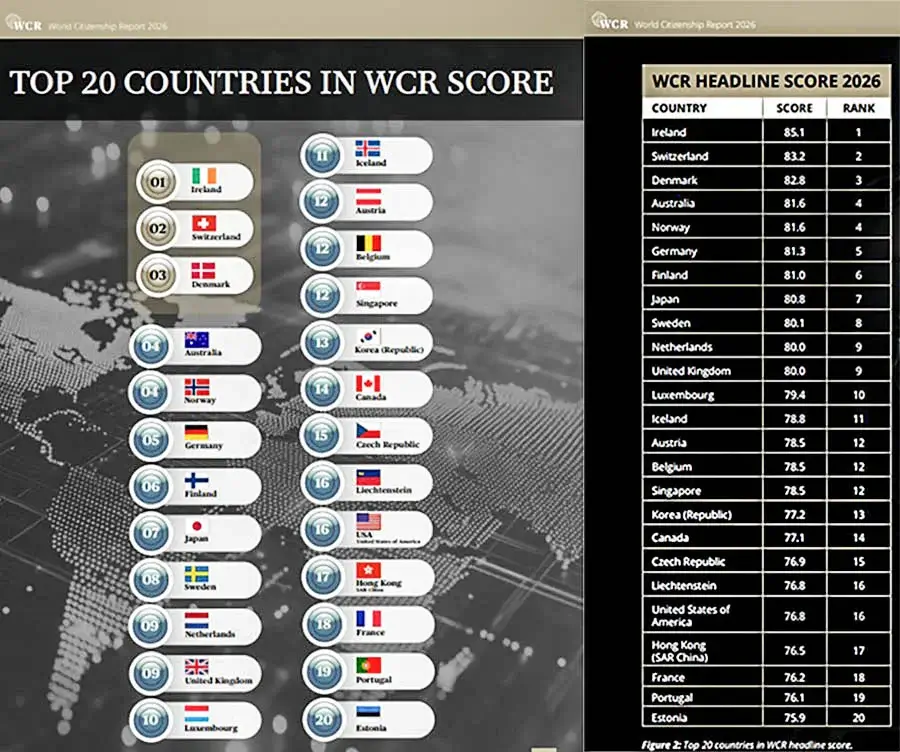
Ireland tops the World Citizenship Report 2026 with a score of 85.1. The country retains its leading position thanks to strong institutions, high quality of life, and a balanced mix of economic and social factors.
Switzerland (83.2) ranks second. Its performance is driven by institutional stability, a high level of security, and predictable economic conditions. The gap remains narrow, highlighting strong competition at the top.
Denmark (82.8) completes the top three, reinforcing the dominance of the Northern European model, where social trust, public service quality, and environmental standards play a central role.
The top 10 also includes Australia, Norway, Germany, Finland, Japan, Sweden, the Netherlands, and the United Kingdom. The second tier shows broad geographic diversity, ranging from Luxembourg, Iceland, and Austria to the United States, Singapore, and South Korea. This reflects the emergence of two stable groups: countries with maximum institutional stability and those with high economic and technological competitiveness.
Quality of Life and Economy
Germany ranks first in the 2026 quality of life index with a score of 90.6, driven by advanced infrastructure, efficient public services, and strong environmental standards. Norway follows closely, showing one of the highest levels of social infrastructure and life expectancy (89.7). Switzerland maintains consistently high performance across all key indicators (89.6), while Finland stands out for strong healthcare and education systems (89.5). Sweden completes the group with high scores in social trust and environmental performance (89.5).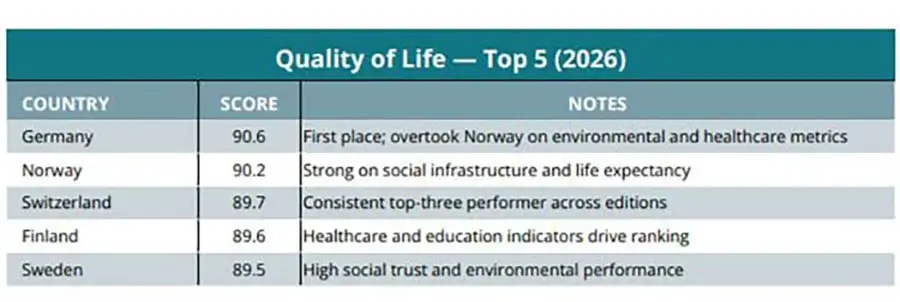
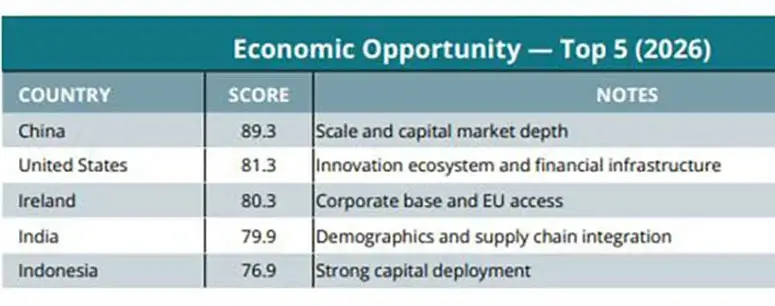
In terms of economic opportunity, China (89.3), the United States (81.3), and Ireland (80.3) lead, forming key global capital hubs and some of the fastest-growing markets.
Safety and Security
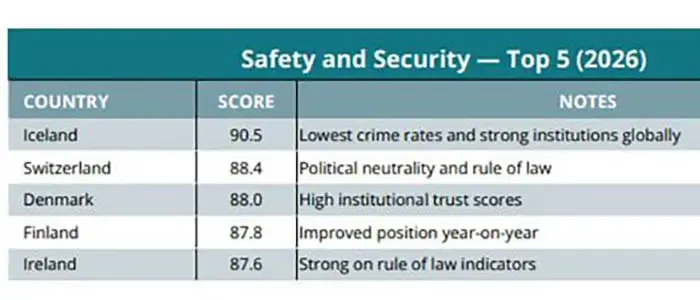
Iceland ranks first in the 2026 safety index with a score of 90.5, reflecting extremely low crime rates and strong institutional resilience. Switzerland (88.4) maintains its position due to political neutrality and strong rule of law. Denmark (88.0) stands out for high institutional trust, while Finland (87.8) improved its position compared to the previous year. Ireland (87.6) completes the top five with strong rule-of-law indicators.
Notable shifts include Luxembourg improving its position in 2026, while several large European economies experienced relative declines. Germany recorded a deterioration in certain safety indicators amid rising domestic socio-political tensions linked to migration and social cohesion.
Global Mobility
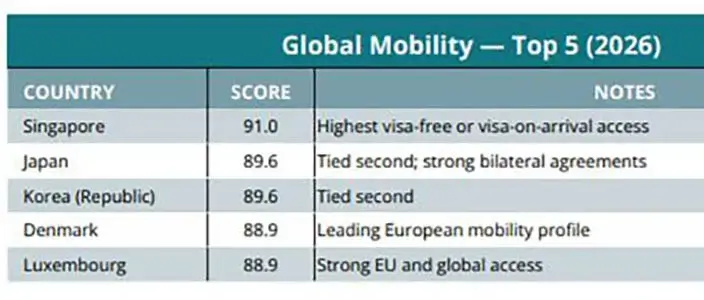
Singapore ranks first in the 2026 global mobility index with a score of 91.0. Japan and South Korea share second place (89.6), followed by Denmark (88.9). The top of the ranking remains stable, reflecting the slow evolution of visa agreements, which typically change through targeted bilateral arrangements.
China expanded short-term visa-free access for several European countries in 2025, including trial exemptions for France, Germany, and Italy, aiming to boost tourism and business travel. Gulf Cooperation Council countries continued to simplify entry requirements through visa-on-arrival systems and digital processes. At the same time, some states tightened entry rules and screening procedures.
Financial Freedom and Investment
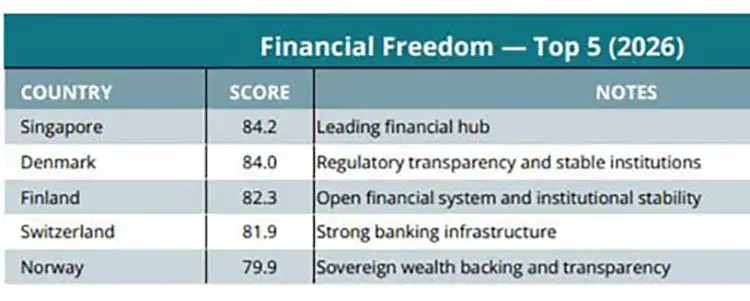
Singapore leads the 2026 financial freedom index, followed by Denmark and Finland, with Switzerland and Norway completing the top five. These countries combine transparent regulation, institutional stability, and open financial systems rather than relying solely on tax advantages.
Luxembourg and the Netherlands maintain strong positions due to deep integration into global financial networks. The United Arab Emirates and Hong Kong continue to function as major regional financial hubs.
Survey data shows that second citizenship is increasingly viewed as part of financial and professional planning rather than a defensive tool. Business and career opportunities rank first at 29.9%, followed by investment diversification at 24.5% and tax efficiency and wealth structuring at 22.3%. Estate planning accounts for 10.6%, while legal and regulatory advantages stand at 8.1%.
Emerging Economies and New Financial Hubs
Several countries outside traditional top-tier economic rankings hold strong positions in the financial opportunity segment. Indonesia ranks fifth, Saudi Arabia sixth, and Kazakhstan thirteenth. Vietnam (16), Nigeria (17), and Uzbekistan (20) also stand out. These economies combine structural reforms, long-term growth potential, and increasing integration into global financial systems.
Indonesia and Vietnam benefit from favorable demographics, rapid industrial growth, and deeper participation in global supply chains. Kazakhstan strengthens its position through its role as a leading global uranium producer, accounting for more than 40% of global supply, and its strategic function within the Middle Corridor trade route.
Georgia stands out at 57th place with a score of 62.3. The economy shows steady GDP growth despite geopolitical and regional challenges. Services expansion, tourism activity, and its growing role as a transit and investment hub in the South Caucasus support overall momentum. A relatively small domestic market is offset by openness and strong integration into regional trade flows.
Conclusion
Analysts at International Investment note that the 2026 ranking confirms Europe’s continued dominance, particularly Northern and Western Europe, which form the core of global demand for “quality citizenship.” At the same time, the report highlights a structural shift in how citizenship is perceived.
The traditional logic, where mobility was the primary advantage, is gradually being replaced by a broader framework centered on security, quality of life, and institutional stability.
Citizenship is increasingly seen not as a mobility tool, but as a long-term strategy for managing risk and life opportunities, including business and investment planning.
At the same time, global differentiation is increasing. Developed economies maintain leadership at the top of the ranking, while several emerging markets gradually strengthen their positions through reforms, demographic potential, and deeper integration into the global economy. Some also stand out due to simplified entry and residence rules, property access, and relatively high returns, as in the case of Georgia. This is shaping a more multipolar map of financial and social opportunity.