







 Australia’s Spring Auctions Rise but Remain Well Below 2025
 Number of Foreigners Holding Turkish Residence Permits Exceeds 1.27 Million
 Demand from Russian Tourists for Holidays in Georgia Rises by 20–25%
 Montenegro Property Buying Costs in 2026
 Four in Ten Companies Would Not Choose Slovakia
 Gulf Countries Prepare Unified Tourist Visa
What Tourists Really Cannot Do in Albania
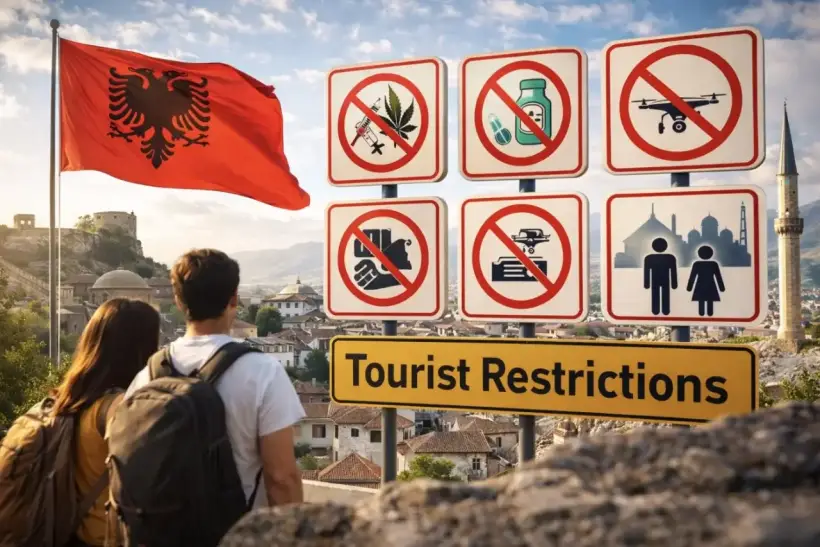
Checking Albania’s tourist restrictions in 2026
Claims that tourists in Albania are banned from almost everything, from scooters to medicines and drones, do not always reflect the actual rules. A review of official and semi-official sources shows a more measured picture. Albania does enforce strict rules on drugs, certain medicines, cultural goods and road conduct, but some popular travel tips online are either framed too categorically or are not clearly supported by open legal sources. Albania’s tourism law explicitly states that the sector should develop in a safe and sustainable environment for both visitors and host communities.
Drugs and psychotropic substances remain a zero-tolerance area
The clearest part of the rules concerns drugs and controlled substances. The U.S. State Department’s Albania travel information says Albanian law prohibits the import and export of narcotic medicines and psychotropic substances. That means tourists should not expect an informal or relaxed approach to substances that may be regulated more lightly in other countries. For standard prescription medicines, official advice says travellers should carry them in their original packaging and bring the doctor’s prescription. The practical conclusion is straightforward: legal medicines can be carried, but only with clear documentation.
Medicines are not freely unrestricted but conditionally allowed
This is exactly where many travel blogs oversimplify the issue. Saying that tourists “cannot bring strong medicines into Albania” is too broad. A more accurate version is that some narcotic and psychotropic medicines are prohibited, while regular prescription drugs should be carried in original packaging with supporting documents. For a factual article, that distinction matters because it separates a real documentary requirement from a misleading idea of an almost total ban on medicines.
Cultural and archaeological items cannot be treated as ordinary souvenirs
Another high-risk area concerns cultural property. The U.S. State Department explicitly warns that Albanian customs authorities strictly regulate the export of certain items, while European rules on cultural goods require export licensing and focus on verifying the lawful origin and removal of such objects. In practice, that means archaeological finds, antiques and potentially valuable heritage objects should never be treated as ordinary souvenirs. For tourists, the takeaway is simple: buying and especially exporting old objects from Albania without full documentation creates a real legal risk.
Road rules apply to tourists exactly as they apply to everyone else
Driving in Albania is regulated by the country’s road code, and that code is binding on all persons using roads in the country, regardless of nationality. That matters in the context of blog advice about scooters, rental cars and mopeds. There is no evidence for claims that foreigners are informally excused from certain requirements. On the contrary, the road code is built on general compliance obligations for everyone in traffic. That means licence requirements, helmets, insurance, vehicle legality and safe road conduct should be treated as legal duties rather than optional tips for cautious tourists.
Drone rules in Albania are less clearly codified than many blogs suggest
One of the most disputed issues is drone use. Open sources do not reveal a simple, well-structured official rulebook confirming many of the sweeping claims found in travel blogs. At the same time, specialist summaries that cite the Albanian Civil Aviation Authority say Albania does not currently have a fully developed standalone drone regime and advise users to follow local restrictions and general aviation principles. That does not mean anything is allowed. It means something more limited: a claim that Albania has a fully codified universal tourist drone ban is not clearly supported by the open evidence. For publication, it is safer to say that the rules remain fragmented and that flights near sensitive sites or clearly restricted zones require extra caution.
The claim of a new blanket wild-camping ban is not clearly verified
A popular online claim says Albania introduced new strict environmental bans in 2026 against unauthorized wild camping in certain national parks and dune areas. The open legal material available does not clearly verify that as a single nationwide rule. Albania does have an updated framework covering tourism, marine tourism and protected areas, but the phrase “new 2026 blanket ban” is too vague without a specific act, area and protection regime attached to it. For a fact-based article, it is better not to present that as an established national prohibition. The more accurate framing is that protected and environmentally sensitive areas may have their own restrictions, which need to be checked locally.
The real issue is not the number of bans but the precision of the claims
The main problem with many travel blogs is not that they invent risks out of nothing, but that they mix common-sense advice, administrative practice and black-letter law. For example, the advice not to travel with questionable medication without a prescription is reasonable and supported by official guidance. The warning not to buy antiques for export is also well grounded. But louder claims about sweeping new camping bans or a fully formalized drone-control system look much weaker when checked against primary sources. For tourists, that distinction matters. In Albania, it is more important to respect the genuine legal risk zones than to rely on dramatic “things tourists must never do” lists.
As International Investment experts report, the key issue for tourists in Albania is not an unusually large number of bans, but the correct interpretation of the rules that are actually in force. A strict approach to drugs, caution with prescription medicines, restrictions on exporting cultural goods and the binding nature of road laws are all verifiable and practically important. By contrast, loud claims about new universal bans on wild camping or a fully codified drone-control regime still require additional checking by location and legal act. For travellers, that means official sources and documentation remain more reliable than generalized travel-blog summaries.
FAQ
What is really prohibited for tourists in Albania?
The clearest confirmed restrictions concern drugs, psychotropic substances, some medicines, cultural-property exports and compliance with road law.
Can tourists bring medicines into Albania?
Yes, regular prescription medicines can be carried, but they should be in original packaging and accompanied by a prescription. Narcotic and psychotropic medicines face stricter restrictions.
Can tourists take antiques or archaeological items out of Albania?
Doing so without proper documentation is risky. Albanian customs and European cultural-goods rules support strict control of such items.
Is there a strict official drone ban for tourists in Albania?
Open sources do not show a simple universal ban. The safer conclusion is that regulation is fragmented and local restrictions matter.
Did Albania fully ban wild camping in 2026?
The available open sources do not clearly confirm that as a nationwide fact. Restrictions may depend on the specific protected area and local regime.
Do Albania’s road rules apply to foreign tourists?
Yes. The road code applies to all persons using roads in the country.