










Poland Targets Oil Windfall Profits
Poland is preparing a windfall tax on oil, gas and fuel companies to help finance cuts in fuel taxes, contain household energy costs and shift part of the burden of the latest energy shock from the state budget to companies benefiting from higher prices.
Warsaw seeks money for cheaper fuel
Poland is preparing one of the European Union’s most forceful fiscal responses to the latest surge in oil and fuel prices. Reuters reported that Warsaw plans to propose a windfall tax on oil and gas company profits generated by higher energy prices linked to the Iran conflict. The aim is to help cover the cost of fuel-tax cuts and reduce pressure on households, transport companies and businesses.
A windfall tax is an additional levy on unusually high profits that are judged to result from external shocks rather than ordinary business efficiency. Those shocks can include war, energy crises, sudden price spikes or supply shortages. For Poland, the measure is both fiscal and political: the government does not want taxpayers alone to fund cheaper pump prices while refiners and fuel traders earn stronger margins.
The draft focuses on the fuel sector
The government bill targets extraordinary profits from the production of certain liquid fuels and their trade in 2026. Polish government materials frame the measure as a response to rising fuel prices that had already led to a cut in value-added tax on petrol and diesel to 8% and a reduction in excise duty on motor fuels to the legal minimum.
Value-added tax is an indirect tax included in the final price of goods. Excise duty is a separate tax applied to specific products, including fuel, alcohol and tobacco. When the state cuts those rates, consumers may see lower pump prices, but the budget loses revenue. The new tax is designed to recover part of that loss from companies that benefited from expensive oil and fuel.
The rate could be unusually high
According to PAP Biznes, the draft envisages a 75% tax on the tax base for the March–December 2026 period. Expected revenue is about PLN 5 billion, including PLN 4.75 billion in 2026 and PLN 250 million in 2027 as an advance payment for December.
That makes the measure significant for investors. A 75% rate does not mean the state takes three quarters of a company’s total profit. It applies to a specially calculated windfall-profit base. But the scale matters: markets see a risk that the state can capture a large share of unexpected profit if it becomes socially and politically unacceptable.
Orlen sits at the center of the impact
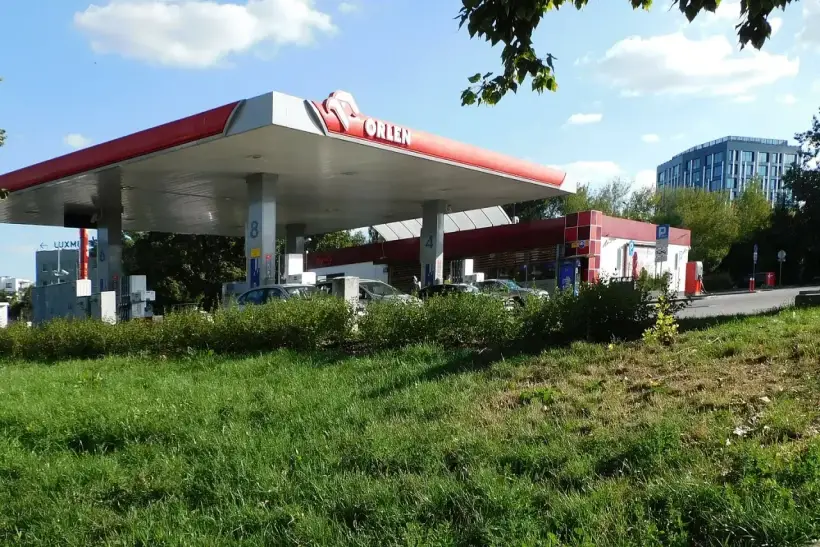
The main focus is Orlen, Poland’s largest refiner and energy group, controlled by the state. WBJ reported that State Assets Minister Wojciech Balczun estimated the potential impact on Orlen at about PLN 6 billion, with parliamentary approval possible before the end of June.
Orlen matters not only as a company but as a systemic asset for Poland. It operates refining, fuel stations, fuel trading, parts of the energy sector and plays a role in energy security. The windfall tax is therefore also an internal redistribution mechanism: the state, as shareholder and regulator, captures part of corporate earnings to fund consumer protection.
Poland already cut VAT and excise duties
Poland’s Finance Ministry previously announced a tax package aimed at lowering fuel prices. The authorities linked the move to the Middle East conflict and a sharp rise in pump prices. The package included temporary reductions in value-added tax and excise duty on motor fuels.
The Energy Ministry presented the measures under the “Lower Fuel Prices” program. The package included cutting VAT on petrol and diesel from 23% to 8%, reducing excise duties and introducing a maximum retail fuel price. A maximum price is a legal ceiling above which fuel stations cannot sell a given type of fuel.
Budget support has become expensive
Fuel-tax relief can quickly become an expensive budget program. Reuters cited Poland’s state secretary for energy as saying the cost of national fuel-tax reductions was estimated at about PLN 1.5 billion a month. That is a material burden for a budget already facing high defense spending, social obligations and deficit pressure.
If the government keeps lower fuel taxes for several months, the bill grows quickly. In that structure, the windfall tax becomes a way to make the policy fiscally and politically sustainable. Without it, lower pump prices are funded by all taxpayers through lost budget revenue.
The government wants to limit inflation
Fuel affects inflation directly through driver costs and indirectly through transport, logistics, food delivery, construction materials, agriculture and services. When petrol and diesel become more expensive, the effect gradually moves through the entire economy.
For Poland, that matters because inflation remains above pre-crisis norms. Trading Economics, citing a flash estimate, reported annual inflation at 3.1% in May 2026, down from 3.2% a month earlier. That is far below recent peaks but still close to the upper end of the National Bank of Poland’s target range.
The European Commission sees an energy risk
The European Commission expects Poland’s harmonized inflation to rise to 3.6% in 2026. It attributes the increase to a sharp rise in energy inflation, only partly mitigated by fixed electricity and gas tariffs for households and fiscal measures adopted at the end of March.
That explains the urgency of Warsaw’s move. If fuel again becomes the main driver of price growth, the government must choose between an inflation shock for consumers, a worse budget balance and capturing part of energy-company profits. Poland is effectively choosing the third option, but it comes with risks for investment and capital markets.
Price caps change how fuel stations operate
Polish authorities have already published maximum retail prices for certain fuels. The Energy Ministry said those prices are binding limits at all fuel stations in the country, and petrol and diesel cannot be sold above the announced ceiling. This is not ordinary tax regulation, but direct intervention in the final consumer price.
For consumers, the mechanism is easy to understand: the price board should not exceed the official limit. For companies, it is more complex. If wholesale prices, logistics, taxes and margins do not fit under the cap, profitability falls or pressure is shifted elsewhere. The windfall tax and price ceiling together create a strict control model for the sector.
Investors see policy risk
Investors tend to dislike windfall taxes because they make rules less predictable. A company may operate legally, accept market risk, invest in refining, logistics and inventories, and then face retroactive profit capture if earnings turn out to be too high.
For refining, that is especially sensitive. These assets require large capital expenditure, modernization, environmental compliance and long investment horizons. If investors do not know how much profit can be captured during the next price shock, they demand a higher risk premium or reduce investment.
The tax may reach beyond Orlen
Although Orlen is the headline case, the draft applies to a broader group of companies involved in liquid-fuel production and trading. Public estimates also referred to traders and smaller players, for whom a smaller absolute levy could still be painful relative to capital and turnover.
That raises a question of competitive neutrality. If the large state-controlled group absorbs the tax because of scale while smaller companies face heavier pressure, the result could be market concentration. Short-term consumer protection could therefore increase long-term dependence on a few dominant players.
Gas remains a possible extension
Polish officials have also left open the possibility that the mechanism could cover natural gas. That would significantly broaden the reform. Gas affects heating, industry, electricity and utility bills, and its price is also sensitive to geopolitics and infrastructure constraints.
If the tax is extended to gas companies, the fiscal effect may grow, but risks to the energy sector would rise as well. Gas infrastructure requires investment in storage, contracts, networks and supply diversification. Aggressive profit capture could weaken incentives to invest precisely when energy security remains a political priority.
Europe returns to crisis-era taxes
Poland’s plan fits a wider European pattern. After the 2022 energy shock, EU countries used solidarity contributions and windfall taxes on the energy sector. Tax Foundation noted that in October 2022 the Council of the EU agreed on an EU-wide mechanism for companies in oil, gas, coal and refining.
The current episode shows that such tools did not disappear after the previous crisis eased. Governments are ready to revive them when energy shocks threaten consumers and public finances. For companies, the message is that crisis profits are increasingly treated not as purely private income, but as politically contestable resources.
Consumers get short-term protection
For Polish households, the measure may be popular. Fuel is a visible cost for drivers, especially outside major cities where public transport is weaker. Expensive diesel also raises the cost of delivery, food and services. Lower VAT, lower excise duty and a price ceiling therefore provide tangible short-term relief.
But the benefit depends on how quickly tax cuts are reflected in retail prices. The government has noted that previous tax reductions did not always reduce final prices for customers. That is why Warsaw is combining price caps with a plan to tax windfall profits.
The budget gets a temporary bridge
From a fiscal perspective, the windfall tax is a temporary bridge between two goals: keeping prices down for citizens and avoiding a sharper deterioration in the deficit. But the bridge works only if windfall profits exist. If global prices fall, refining margins decline and the tax base disappears.
That makes the measure an unstable revenue source. It cannot be treated as a permanent substitute for ordinary taxation. It works in a crisis, but poorly as a long-term fiscal strategy. The government will therefore need a clear duration, calculation formula, advance-payment rules and exit conditions.
Fuel prices remain politically visible
In Poland, as in much of Central Europe, fuel prices are a politically sensitive indicator. They are visible every day, affect households and businesses directly and are easily linked to government action. Fuel-sector intervention therefore has electoral as well as economic logic.
During an external energy shock, the government wants to show that it protects consumers and forces large companies to share unexpected gains. But the longer intervention lasts, the more questions investors, competitors and regulators will ask about the predictability of market rules.
The main risk is replacing reform with subsidy
Poland’s package reduces immediate pain, but it does not solve structural dependence on oil and petroleum products. If the country wants to be less exposed to price shocks, it needs investment in public transport, electrification, energy efficiency, rail logistics, charging infrastructure and energy diversification.
A windfall tax can help fund crisis relief, but it cannot replace long-term policy. If all proceeds go only to keeping retail prices low, Poland gets short-term relief while remaining exposed to the next oil spike. If part of the money is used to reduce oil dependence, the tax could become part of a transition strategy.
As International Investment experts report, the critical conclusion is that Poland’s windfall tax is politically understandable but economically risky. It helps close the fiscal gap created by VAT and excise cuts and reduces pressure on consumers, but it also weakens rule predictability for energy companies. For investors, the main risk is not only the size of the levy but the precedent: if the state regularly captures crisis profits, the cost of capital for Polish energy will rise. For consumers, the key risk is that temporary price protection may delay, but not replace, reforms that actually reduce the economy’s dependence on expensive fuel.