









Tirana Tower Apartments Near €1 Million as Demand Weakens
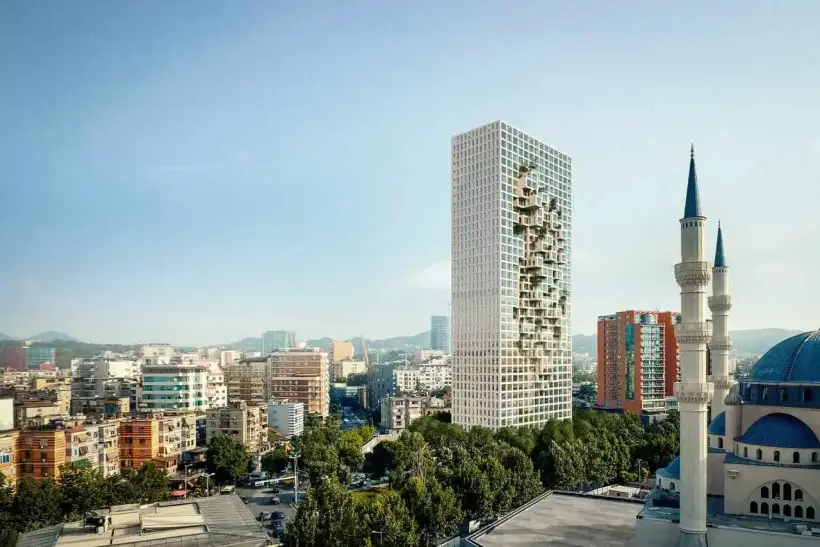
Prices for selected apartments in Tirana’s residential towers are approaching €1 million, but the market is beginning to lose momentum. Units remain available, buyers are becoming more cautious and construction companies are reporting weaker order books. Official figures do not show equally rapid appreciation across the capital: completed-sale prices in Tirana were nearly unchanged during the second half of 2025 even as premium asking prices continued to climb.
Downtown One Apartment Listed at €950,000
A furnished 154-square-metre apartment in the Downtown One tower has been listed for €950,000, equivalent to approximately €6,200 per square metre. The figure is an asking price rather than the confirmed value of a completed transaction.
Agents said several never-occupied furnished units were still available in the building and were being marketed as some of the final apartments offered for sale.
When Downtown One was nearing completion in 2021, units were being marketed at approximately €3,200–€3,400 per square metre. The latest asking level is 82% to 94% higher, meaning the nominal value of selected apartments has almost doubled within five years.
The comparison does not necessarily involve identical properties. Floor level, view, size, furniture, parking and contractual conditions can materially change the price.
The Premium Segment Has Separated From the Wider Market
Central Tirana towers form a distinct real estate segment. Their value reflects height, panoramic views, architectural profile, security, shared facilities, parking and the limited number of units in prestigious projects.
Potential buyers include affluent Albanians, members of the diaspora, foreign business owners and investors using property as a store of wealth. Their demand is less directly connected to Albania’s average wage, allowing luxury prices to rise even as housing becomes less affordable for ordinary households.
The €6,200-per-square-metre asking price is several times higher than mainstream Tirana values. Selected new projects near the artificial lake and the city centre have reportedly marketed units at up to €10,000 per square metre. These figures represent the top of the advertised market and are aimed at a narrow group of international and domestic buyers.
Reported Property Sales Fell by 35%
The Bank of Albania’s market survey presents a more restrained picture than premium listings. The second-half 2025 study received responses from 159 construction companies and real estate agencies.
Respondents reported 1,273 completed property sales, down from 1,960 during the first half of the year. The decline was approximately 35%, while the average number of sales per respondent fell from 11 to eight.
Tirana’s completed-sale price index was almost unchanged from the previous six months and increased by 4.4% year over year. The nationwide index rose by 11.7% from the first half and 28% annually, primarily because of price growth in coastal markets rather than the capital.
The average time required to sell a Tirana home fell from 11.1 to 8.1 months. The apparent contradiction may reflect a concentration of transactions in the most liquid properties while weaker units remained unsold.
Bank financing was used in approximately 61% of reported residential and commercial purchases. Non-residents accounted for around 25% of transactions, with buyers from European Union countries representing about half of that group.
Asking Prices Can Rise While Transactions Fall
A real estate market can simultaneously record record listings and lower sales. Owners of premium apartments may be willing to wait for months when they do not need to sell urgently.
Published prices can therefore remain elevated even as market turnover contracts. The actual value becomes clear only when a purchase agreement is completed, and the discount from the original asking price can be substantial.
About 46% of sales covered by the central bank survey were completed at the asking price or with a discount of no more than 5%. Other sellers accepted reductions of between 5% and 20%, while a small group agreed to larger cuts.
The €950,000 listing does not prove that a buyer will pay the full amount. The continued availability of several units in a completed building also suggests that seller expectations may be running ahead of effective demand.
Household Income Is Not Keeping Up
Albania’s average gross monthly wage reached 90,119 lek in the first quarter of 2026, an increase of 9.6% from a year earlier. The rise partly reflected an increase in the minimum wage from 40,000 to 50,000 lek.
Even strong wage growth is far below the multi-year increase in premium property values. A €950,000 apartment is inaccessible to a household earning the national average without substantial accumulated wealth, income from abroad or business assets.
Affordability has also deteriorated in the mainstream market. Industry estimates suggest that a couple earning average wages would require the equivalent of 15 to 19 years of combined income to purchase an apartment in Albania, compared with an estimated 10 to 12 years in the European Union.
Such calculations depend on apartment size, taxes and income methodology, but they illustrate the growing gap between earnings and residential prices.
A separate affordability comparison placed Tirana’s price-to-income ratio at approximately 18 years in 2025, up from 15.3 years, making the capital one of Europe’s least affordable markets relative to local purchasing power.
Buyer Demand Is Weakening Without Price Cuts
Real estate agencies report fewer prospective buyers than in 2025. Some market participants associate the retreat with greater investor caution and intensified investigations by Albania’s special anti-corruption prosecution service, SPAK.
This remains an industry interpretation rather than a statistically established causal relationship. Demand may also be weakening because of high prices, saturation in the investment segment and expectations that sellers will eventually offer better terms.
Reduced activity has not yet produced broad price declines. Owners often delay reductions, particularly when properties were acquired without large mortgages and there is no urgent need to sell.
The result can be a low-liquidity market in which published prices appear stable while relatively few transactions are completed. This risk is greater in luxury towers because the potential buyer pool for apartments valued at €600,000 to €950,000 is limited.
Construction Companies Report Weaker Orders
Albania’s construction confidence indicator declined by 0.8 percentage points in June 2026. The deterioration was driven mainly by weaker assessments of order books, while current activity remained broadly unchanged.
Companies also lowered their expectations for future selling prices. Confidence was still about 11 percentage points above its long-term average, so the survey does not indicate an industry collapse. It points to a more cautious phase following years of rapid expansion.
Weaker order books are particularly important for tower projects, which can depend on advance sales and large instalments from buyers during construction.
Developers facing slower sales may delay project phases, change apartment layouts, increase the proportion of smaller units or grant private discounts without formally cutting advertised prices.
The Development Pipeline Continues to Expand
Albania approved 322 permits for new buildings in the first quarter of 2026, an increase of 24.8% from the previous year. The expansion means that additional property supply will continue to enter the pipeline, although a permit does not guarantee immediate construction or completion.
During 2025, authorities approved 1,158 permits covering more than 1.3 million square metres. Residential projects accounted for 890 permits and approximately 845,000 square metres.
Tirana remains the country’s main construction centre. The capital region accounted for 72 permits and more than 201,000 square metres in the first quarter of 2025, followed by 93 permits and 252,000 square metres in the third quarter.
A large development pipeline increases the risk of excess inventory when effective demand slows. The risk will not be distributed evenly: smaller, moderately priced homes may remain liquid, while large premium apartments could require longer marketing periods.
Rapid Appreciation Does Not Prove a Bubble
The divergence between prices and wages, combined with the number of proposed towers, creates signs of possible overvaluation. It does not by itself prove the existence of a speculative bubble.
A firmer conclusion would require comprehensive information on completed transactions, vacant apartments, household debt, buyer funding, rental yields and the number of units purchased solely for resale.
Albania’s housing statistics remain limited. The Bank of Albania’s index is based on a survey of developers and agencies rather than a complete national database of notarised transactions. The central bank explicitly warns that the methodology cannot determine whether observed property-price growth is normal or excessive.
Survey expectations also remain resistant to a downturn. About 54% of agents expected prices to increase in the following six months, while 40% forecast stability and only 1% expected a decline.
Optimistic seller expectations can keep asking prices elevated even when the number of willing buyers is falling.
Liquidity Has Become the Main Risk
The more likely short-term outcome is market fragmentation rather than a uniform citywide collapse. Moderately priced apartments with clear ownership, good locations and reliable rental demand can remain liquid.
Large units in towers will depend more heavily on diaspora capital, foreign buyers and wealthy domestic investors. In this segment, the gap between advertised and achievable prices may widen.
Buyers need to examine more than the purchase price per square metre. Service charges, parking, legal title, management quality, furnishing costs and achievable rent can materially change the investment result.
A €950,000 apartment must generate substantial net rental income to justify the capital committed. When rent fails to increase at the same rate as the purchase price, yields decline and the investment becomes increasingly dependent on future resale gains.
As International Investment experts report, listings close to €1 million show how far Tirana’s premium housing segment has moved beyond the incomes of most residents. One Downtown One apartment does not represent the entire city, however. Official figures show moderate annual appreciation in completed Tirana transactions alongside a sharp decline in reported sales. The principal risk is therefore not an immediate collapse in nominal prices but a loss of liquidity: owners continue to maintain high expectations while the pool of buyers able to meet them is narrowing. Continued construction could eventually produce more unsold inventory and private discounts even when published prices remain unchanged.
FAQ
How much does the Downtown One apartment cost?
A furnished 154-square-metre unit has been listed for €950,000, or approximately €6,200 per square metre. This is an asking price rather than a confirmed transaction value.
How much have Downtown One prices increased?
Units were marketed at roughly €3,200–€3,400 per square metre in 2021. The current asking level is 82% to 94% higher, although individual apartments may differ.
Are Tirana property prices falling?
The Bank of Albania’s completed-sale index was almost unchanged during the second half of 2025 and increased by 4.4% year over year. No broad decline has yet been recorded.
Is demand for Albanian real estate declining?
Agents report fewer buyers, while the number of properties sold by survey respondents fell by around 35% between the first and second halves of 2025.
Why are sellers not cutting prices?
Many owners are not under immediate financial pressure and expect long-term appreciation. Lower demand initially produces fewer transactions rather than lower published prices.
Can local households afford Tirana property?
Affordability has deteriorated because prices have increased faster than incomes. Estimates suggest that an average-income couple may need the equivalent of 15 to 19 years of earnings to purchase a mainstream apartment.
Is Tirana experiencing a property bubble?
There are signs of overvaluation, but the available information is insufficient to confirm a bubble. More complete data on transactions, vacancies, debt and rental yields is required.
Is a tower apartment a safe investment?
The result depends on achievable rent, operating expenses and resale liquidity. Architectural prestige does not eliminate the risk of overpaying or waiting years for a buyer.