







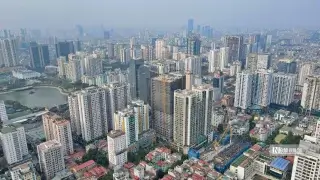
 Vietnam Mortgage Surge Pushes Homes Out of Reach
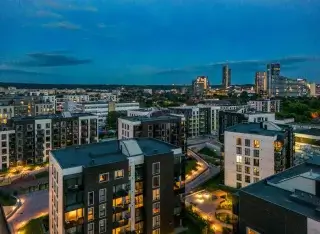 Lithuanian Apartment Prices Accelerate Across Major Cities
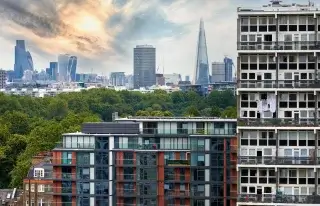 London Flats Lose Value Ahead of Leasehold Reform
 Construction of the Batumi–Sarpi Highway Begins in Georgia
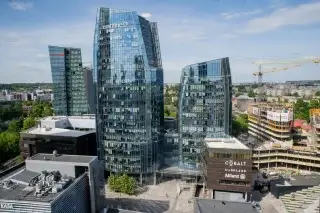 Baltic Property Investment Accelerates in 2026
 Hong Kong and Singapore Renew Their Expat Rivalry
Dubai Real Estate Market Slows Amid Middle East Conflict
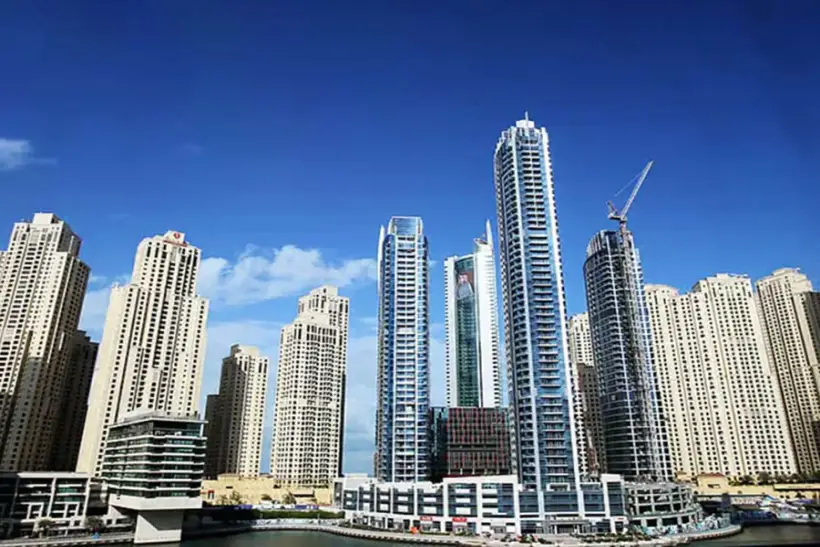
Khaleej Times
The military conflict between the US, Israel and Iran has reduced demand for residential property in Dubai. Buyers are postponing transactions, while companies are delaying decisions on relocating employees to the region. Real estate sales declined significantly in May and June, although there has been no major price collapse so far, according to analysts at Knight Frank and JLL.
Dubai Home Sales Decline
The hostilities began in February 2026 with strikes on Tehran and later developed into a broader regional conflict. Following the escalation, activity among Dubai property buyers began to slow.
According to Knight Frank, residential sales volumes in Dubai declined by 13.6% year-on-year in the first half of 2026. The most significant drops were recorded in May and June, when the number of transactions fell by 45% and 16.4%, respectively, compared with the same months in 2025.
According to property portal Juwai IQI, some buyers made “panic calls” in the first weeks of the conflict, seeking to assess risks to their investments.
“With the onset of the historically quieter summer months, we anticipate a further slowing in deal volumes,” said Faisal Durrani, partner at Knight Frank and head of Middle East and North Africa research.
Dubai Property Prices Decline
Knight Frank and JLL note that the slowdown in sales has not yet resulted in a sharp decline in property values, although prices have started to adjust.
“We observed a decline in home sales volumes and a moderate drop in transaction values rather than a broad collapse in core pricing. This was an underlying market trend that has arguably been accelerated by the current situation,” said Felix Cheung, head of international residential at JLL in Hong Kong.
He added that weekly transaction volumes had fallen significantly compared with pre-conflict averages as market participants adopted a wait-and-see approach. At the same time, the off-plan property segment showed greater resilience than the secondary market.
Since the beginning of the conflict, mainstream residential property prices in Dubai have declined by 5–20%, depending on the location, according to Knight Frank. By comparison, prices fell by an average of around 35% after the global financial crisis in 2008.
Challenges for Dubai’s Construction Sector
The Middle East conflict is also affecting the construction industry. Faisal Durrani said the cost of construction materials across the Gulf Cooperation Council (GCC) countries, including the UAE, has increased by more than 20% since January. This has put additional pressure on developers trying to meet construction deadlines.
“Ports are prioritising essential goods such as food, medicines and medical supplies. Importing construction raw materials could become challenging and financially unfeasible when taking into account current shipping costs and sea freight insurance premiums,” Durrani said.
Dubai Investment Activity Slows
Another sign of changes in the market structure is the decline in short-term resales. In 2025, only 4% of properties were resold within a year of purchase. By comparison, this figure was around 25% in 2008.
According to Durrani, this indicates a growing share of genuine end users — buyers purchasing property for residence rather than capital appreciation. He believes the current correction is linked to some owners and investors exiting the market, including sellers who need to sell quickly. However, many are still securing profits, as Dubai property prices have increased by an average of 82.9% over the past five and a half years.
Felix Cheung noted that some investors are using the current conditions as an opportunity to acquire assets at more attractive prices.
Who Is Investing in Dubai Real Estate
In 2025, buyers from more than 150 countries invested in Dubai’s residential property market. According to the Dubai Land Department, the largest foreign buyer groups were Indian nationals, accounting for 22% of transactions, followed by buyers from the UK (17%), China (14%), Saudi Arabia (11%) and Russia (9%).
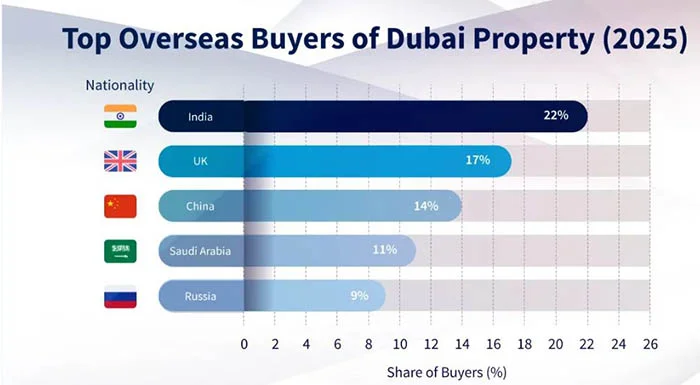
In the first half of 2026, Indian investors retained the top position, although their share declined to 20.6%. The UK’s share also changed, reaching 13.3%. According to Khaleej Times, the next largest buyer groups were Egypt (12.6%), the US (9%) and Pakistan (6.9%).
Saudi Arabia and Australia each accounted for 5.7% of transactions, Germany for 4.2%, France for 3.8% and Canada for 3%.
Areas Attracting Buyers
In the first half of 2026, Dubai Islands recorded the highest volume of apartment transactions, reaching AED 8.4 billion. Airport City ranked second with AED 7.2 billion in sales, followed by Business Bay with AED 6 billion.
In the villas and buildings segment, Al Yalayis 1 led with AED 10.6 billion in transactions. It was followed by Wadi Al Safa 3 and Saih Shuaib 1, each recording around AED 1.4 billion.
Among land plots, Me’aisem Second recorded the highest sales volume at AED 10.1 billion. It was followed by Al Yalayis 5 with AED 7 billion and Al Ruwayya 1 with AED 6.3 billion.
One-bedroom apartments were the most popular category, accounting for 27,590 transactions, or 34.9% of the market. Studios ranked second with 18,471 transactions (23.4%), followed by two-bedroom apartments with 16,399 transactions (20.7%).
Dubai Luxury Real Estate Market
Despite the slowdown in activity, Dubai remains one of the world’s most attractive luxury property markets. Between 2023 and 2025, the city outperformed major centres such as London and New York in the number of residential property sales above $10 million. According to Knight Frank, annual sales in this segment ranged from 426 to 499 properties.
In the 12 months to the end of March 2026, Dubai once again ranked as the world’s leading luxury residential market, with 581 properties sold for more than $10 million.
Key factors attracting foreign buyers include Dubai’s expat-friendly tax system and accelerated residency programmes.
Outlook for Dubai Real Estate Market
In 2026, more than 160,000 residential units are scheduled for delivery in Dubai, although the actual number of completed projects is expected to be significantly lower. Around 85% of future supply will consist of apartments, 14% of villas, and about 1% of hotel apartments and branded residential projects.
Dr Mohanad Alwadiya, CEO of Harbor Real Estate, believes Dubai’s property market is moving away from a speculative growth model toward fundamentals such as demographics, economic development and expanding business activity. He stressed that no market can remain in a state of accelerated growth forever and that end users and long-term investors are becoming the main drivers of activity.
At the same time, rising construction and shipping costs could naturally limit the launch of new projects.
Analysts at International Investment note that the Middle East conflict has significantly contributed to the slowdown in Dubai’s property market, although similar trends have occurred before. Investors sold properties in anticipation of falling prices, with this trend particularly visible among some Russian property owners.
Dubai’s real estate market has already experienced several periods of overheating followed by sharp corrections. This time, however, the transition to a more balanced market may be smoother.