












Central Banks Hold Rates as Inflation Risks Persist
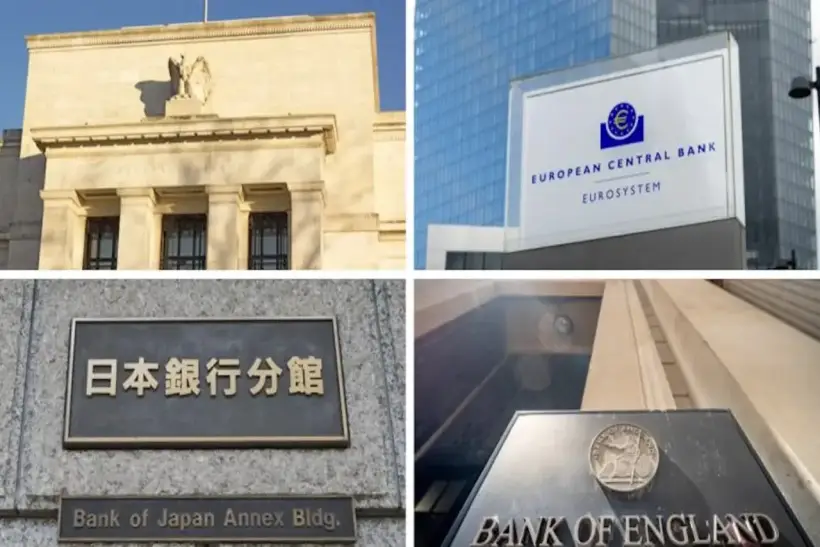
Several of the world’s largest central banks ended July without changing interest rates, but the pause did not signal that monetary easing was close. The Federal Reserve, Bank of England and Bank of Japan held borrowing costs steady while a combined seven voting officials supported increases. The European Central Bank also paused after tightening in June as the global economy confronted expensive energy, persistent inflation and increasingly uneven growth.
Global central banks shift from easing to waiting
The Federal Reserve maintained the federal funds target range at 3.5%–3.75%. The Bank of England kept Bank Rate at 3.75%, while the Bank of Japan held its target for the uncollateralised overnight call rate at around 1%.
The European Central Bank left its deposit rate at 2.25%, the main refinancing rate at 2.4% and the marginal lending rate at 2.65% on July 23. It had raised all three rates in June, making the July decision a pause after tightening rather than an extension of a long period of unchanged policy.
Similar decisions concealed different economic conditions. The Fed and Bank of England are debating whether further increases are necessary. Japan is assessing the impact of its June move, while the ECB is trying to determine whether an energy-price shock will spread into services and wages.
The International Monetary Fund expects global growth of 3% in 2026 and 3.4% in 2027. Worldwide headline inflation is projected to rise from 4.1% in 2025 to 4.7% in 2026 before declining to 3.9% in 2027. The institution said global disinflation had stalled and warned about renewed conflict and financial-market repricing.
Three Fed officials support higher rates
The Federal Open Market Committee voted 9–3 to maintain its target range. Cleveland Fed President Beth Hammack, Minneapolis Fed President Neel Kashkari and Dallas Fed President Lorie Logan preferred a quarter-percentage-point increase to 3.75%–4%.
The Fed described economic activity as expanding at a solid pace, supported by strong productivity and capital investment. Job gains remained low on average, unemployment changed little and inflation stayed above the 2% objective, partly because of supply shocks including higher energy prices.
The dissent matters independently of the unchanged headline rate. The three officials believe current policy may not restrain demand sufficiently or ensure that inflation returns sustainably to target.
A quarter-percentage-point move is also described as a 25-basis-point increase. One basis point equals one-hundredth of a percentage point.
US growth slows as core inflation stays elevated
Real US gross domestic product expanded at a 1.5% annualised rate in the second quarter after growing 2.1% in the first. The figure annualises the quarterly change and does not represent year-over-year growth.
Consumer spending increased 0.3% in June, while disposable personal income rose 0.2%. Inflation-adjusted expenditure advanced 0.4% and the personal saving rate declined to 2.7%.
The personal consumption expenditures price index fell 0.1% during the month but increased 3.7% from a year earlier. The core index excluding food and energy rose 0.1% monthly and 3.3% annually.
Slower growth combined with above-target inflation complicates the policy choice. Higher rates could further weaken investment, housing and employment, while a prolonged pause may allow resilient demand to sustain service-price inflation.
Bank of England records three votes for tightening
The Bank of England’s Monetary Policy Committee voted 6–3 to maintain Bank Rate at 3.75%. Megan Greene, Catherine Mann and Huw Pill preferred an increase to 4%.
UK inflation has declined to 2.6%, but the bank expects it to rise later in 2026 as higher energy costs feed into household bills and company expenses.
There is little evidence so far of material second-round effects in wages and broader prices. Labour-market slack and higher borrowing costs should gradually reduce inflation.
The three dissenters were less confident that underlying disinflation was secure. They cited inflation’s prolonged overshoot of the 2% target and the risk that higher energy prices would affect wage and price-setting behaviour.
Bank of Japan pauses after its June increase
The Bank of Japan kept the uncollateralised overnight call-rate target at around 1%. It had increased the rate from 0.75% in June, taking borrowing costs to their highest level in roughly three decades.
The July decision passed by an 8–1 vote. Board member Hajime Takata preferred an increase to 1.25%.
The central bank expects economic growth of about 0.6% in fiscal 2026. Its median forecast for inflation excluding fresh food is 2.5%. Oil, semiconductor costs, higher wages and yen depreciation are supporting price pressure.
A weaker yen supports exporters’ earnings but raises the cost of imported fuel, food, machinery and electronic components. The pause gives policymakers time to assess how the June increase affects credit and domestic demand.
ECB pauses amid energy-price uncertainty
The European Central Bank held its three policy rates as it assessed volatile energy prices and an inflationary impact that had yet to materialise fully.
The Governing Council retained a data-dependent, meeting-by-meeting approach and did not commit to a predetermined rate path.
Euro-area inflation accelerated to 2.9% in July from 2.8% in June. Energy prices increased 10%, services rose 3.3%, food, alcohol and tobacco gained 1.2%, and non-energy industrial goods increased 0.9%.
Euro-area GDP expanded 0.4% in the second quarter after a revised 0.2% contraction in the first. The earlier version of this article incorrectly described the first quarter as stagnation.
Renewed growth and firmer inflation reduce the case for immediate easing. Higher energy costs could nevertheless raise consumer prices while weakening manufacturing.
Canada records strong but preliminary growth
Canadian industry-based GDP increased 0.3% in May, with 13 of 20 major sectors expanding. Oil and gas, construction, real estate and manufacturing made important contributions.
An advance estimate points to a further 0.2% increase in June. Including that estimate, output grew 0.8% from the first quarter, equivalent to approximately 3.4% at an annualised rate using unrounded data.
The figure is not final. The official quarterly income-and-expenditure estimate will be published on August 28 and may differ because it uses a separate methodology.
The stronger result reduces the case for an urgent Bank of Canada rate cut but does not automatically support an increase. Labour conditions remain soft, and part of the expansion reflected energy-maintenance schedules and temporary public-sector activity.
China’s activity gauges move into contraction
China’s official manufacturing purchasing managers’ index fell to 49.2 in July from 50.3 in June. A reading below 50 indicates contraction from the previous month.
The production index declined to 49.9 and new orders fell to 48.5. The non-manufacturing index dropped to 49, the services measure to 49.3 and construction to 47. The composite output index stood at 49.3.
Weakness extended across manufacturing, services and construction. High-technology production continued to expand but did not offset cautious consumption, property stress and weaker broader demand.
China therefore faces a different policy problem from the US and Europe. Beijing needs to support activity without aggravating debt and property-market imbalances.
South Korea benefits from record chip demand
South Korean exports increased 62.8% from a year earlier to $98.89 billion in July, the second-highest monthly total after June’s $102.2 billion record.
Imports rose 26.5% to $68.56 billion, producing a $30.32 billion trade surplus. Semiconductor shipments approached $41 billion and nearly tripled from a year earlier.
Global demand for memory chips, servers and data-centre equipment drove the increase, making South Korea a major beneficiary of artificial-intelligence infrastructure investment.
The result highlights growing divergence between economies integrated into the semiconductor supply chain and those more dependent on domestic consumption or imported energy.
Australian inflation moderates but remains elevated
Australian annual inflation slowed to 3.8% in June from 4% in May. Trimmed-mean inflation, which removes the most extreme price changes, remained at 3.6%.
Both measures remain above the Reserve Bank of Australia’s 2%–3% target range. Housing prices rose 6.8%, while food and non-alcoholic beverages and recreation and culture each increased 3.3%.
The overall consumer price index declined 0.1% during June in both original and seasonally adjusted terms.
The softer headline figure reduces pressure for an immediate increase, but unchanged underlying inflation shows that price pressure has not disappeared.
Singapore tightens currency policy again
The Monetary Authority of Singapore was an exception to the sequence of pauses. It slightly increased the appreciation rate of the Singapore-dollar policy band on July 27, tightening for a second consecutive quarter.
Singapore conducts monetary policy mainly through the exchange rate rather than a conventional policy interest rate. Faster currency appreciation reduces import costs and helps limit inflation in an economy dependent on imported energy, food and industrial inputs.
The July adjustment was smaller than April’s. The width and centre of the nominal effective exchange-rate band were left unchanged. Most economists had expected no change.
The decision reflected the risk that higher fuel, electronics and food costs would lift imported inflation into early 2027.
A pause does not mean rate cuts are imminent
July marked a period of waiting rather than a return to cheap money. The Fed, Bank of England and Bank of Japan held rates, but seven voting policymakers across those institutions supported increases. The ECB paused after tightening in June, while Singapore strengthened its exchange-rate policy for a second consecutive quarter.
Economic conditions are diverging at the same time. US growth slowed, the euro area recovered from contraction, Canada posted strong preliminary momentum, Chinese activity moved below the expansion threshold and South Korea received an exceptional semiconductor-export boost.
As International Investment experts report, the sequence of unchanged rates creates a misleading appearance of stability. Central banks have not finished fighting inflation; they have gained time to assess energy and trade shocks. Tightening prematurely could deepen slowdowns and increase debt burdens, while waiting too long could allow higher energy costs to spread into services, wages and expectations. The central risk for investors is a prolonged period of expensive money, abrupt market repricing and widening differences between national monetary policies.
FAQ: global central-bank interest rates
Which central banks held rates in July?
The Federal Reserve, Bank of England, Bank of Japan and European Central Bank kept their main policy settings unchanged. The ECB and Bank of Japan paused after increases in June.
What is the Federal Reserve’s current target range?
The federal funds target range is 3.5%–3.75%.
Who supported a Fed rate increase?
Beth Hammack, Neel Kashkari and Lorie Logan preferred an increase to 3.75%–4%.
What is the Bank of England’s current rate?
Bank Rate is 3.75%. Three of nine committee members supported an increase to 4%.
What rate did the Bank of Japan maintain?
The overnight call-rate target remained at around 1%. One board member preferred 1.25%.
What are the ECB’s key rates?
The deposit rate is 2.25%, the main refinancing rate is 2.4% and the marginal lending rate is 2.65%.
Does the pause mean rate cuts are coming soon?
No. Seven officials across the Fed, Bank of England and Bank of Japan voted for higher rates, while inflation remains above target in many economies.
Why are central banks waiting?
They are assessing the duration of the energy shock and whether it spreads into wages, services and inflation expectations. Excessive tightening could unnecessarily damage growth and employment.
How do high rates affect property markets?
They raise mortgage, construction and refinancing costs, reducing housing affordability and potentially weakening investment demand.
Why does Singapore use the exchange rate?
Singapore is a small, highly open economy. Managing the currency against a trade-weighted basket allows the central bank to influence imported inflation more directly.
Which economies are showing stronger growth?
The euro area returned to quarterly expansion, Canada reported strong preliminary momentum and South Korea benefited from semiconductor exports. US growth slowed, while Chinese purchasing managers’ indexes moved below 50.