







 Covivio Hotels Revenue Grows 4.7% as European Markets Split
 Lithuanian Apartment Prices Accelerate Across Major Cities
 Georgia's Tourism Revenue Hits Record High
 Norway's Sovereign Fund Commits €1.5bn to European Warehouses
 Market Rout of October 2026: Can Branded Hotels Protect Capital?
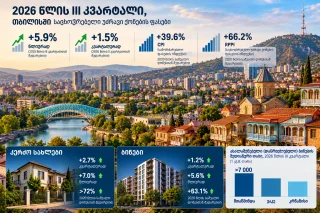 Residential Property Prices in Tbilisi Rise by 5.9% Year-on-Year
Georgia Ranks Among the World's Top Three for Economic Growth
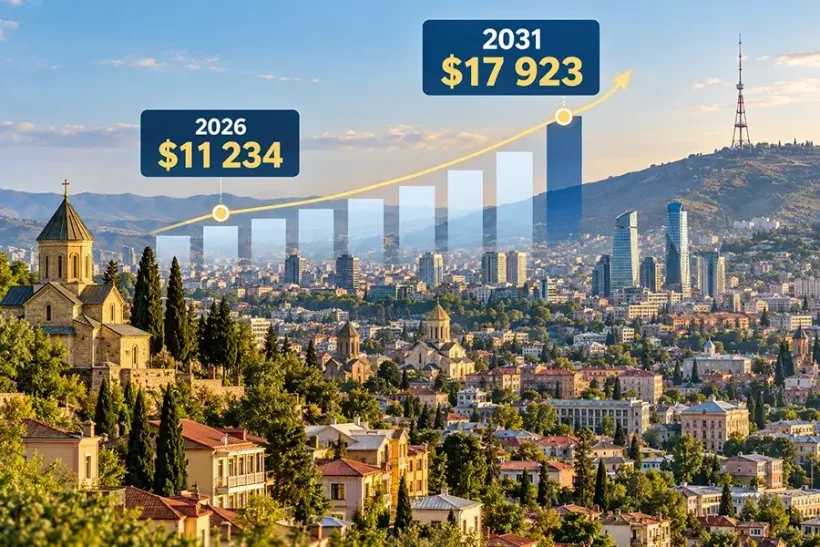
The International Monetary Fund (IMF) has updated its global economic forecasts through 2031. Georgia's GDP per capita at purchasing power parity (PPP) has recorded one of the three highest growth rates worldwide since 2012, placing the country first in Eurasia. By 2031, the PPP-adjusted indicator could be five times its 2012 level, bringing Georgia closer to high-income status.
Georgia's GDP per Capita
The IMF projects that Georgia's real GDP per capita will increase by 185% by 2031 compared with 2012. Growth from the 2022 level is projected at 85%. By the pace of increase, the country ranks among the world's top three and first in Eurasia. The estimates are calculated at constant prices, making it possible to assess economic expansion without the effects of inflation.
Nominal GDP per capita in 2026 is estimated at $11,234. It could reach $12,538 in 2027 and $13,694 in 2028. This would represent an increase of nearly $2,500 over two years.
In 2029, nominal GDP per capita could reach $14,975, followed by $16,383 in 2030 and $17,923 by 2031. The five-year increase would amount to 59.5%. Inflation and the exchange rate of the Georgian lari will influence its value in US dollars.
Georgia's GDP per Capita Forecast Through 2031
|
Year |
GDP per capita, USD |
|
2026 |
11,234 |
|
2027 |
12,538 |
|
2028 |
13,694 |
|
2029 |
14,975 |
|
2030 |
16,383 |
|
2031 |
17,923 |
Georgia's Purchasing Power
The IMF expects Georgia's GDP per capita at purchasing power parity to reach a record 32,700 international dollars in 2026. This is more than 215% above its 2012 level. Based on growth over 2012–2026, the country is expected to rank among the world's top three and first in Eurasia.
By 2031, the figure could rise to Int$46,800, 43% above the projected level for 2026. Across the entire period since 2012, the indicator would increase fivefold, and over 2022–2031 it would be 2.5 times higher.
Purchasing power parity allows comparisons between national economies by taking into account differences in the cost of goods and services. The calculations use a hypothetical monetary unit reflecting equivalent purchasing power. GDP at PPP measures economic output per resident, rather than an individual's personal income.
Georgia's Economy in 2026
Georgia's real GDP grew by 7.6% in January–August 2026 compared with the same period of 2025. The economy expanded by 6.3% in August. According to the National Statistics Office, the main contributors were manufacturing, information and communication services, the financial sector, and trade.
Georgia's foreign trade turnover reached $20.53 billion in January–September, 9.2% above the same period of 2025. Exports increased by 19.6% to $6.15 billion, while imports rose by 5.3% to $14.38 billion. The trade deficit amounted to $8.23 billion, or 40.1% of total trade.
Georgia's international reserves reached $8.17 billion in September, up 50.5% from a year earlier. Bank lending to the economy increased by 13.7% in August. Annual inflation stood at 5.6%, compared with the 3% target. Higher prices for goods and services are placing additional pressure on business and household budgets.
Key Indicators of Georgia's Economy in 2026
|
Indicator |
Period |
Value |
|
Real GDP growth |
January–August |
7.6% |
|
Foreign trade turnover |
January–September |
$20.53 billion |
|
Exports |
January–September |
$6.15 billion |
|
Imports |
January–September |
$14.38 billion |
|
International reserves |
September |
$8.17 billion |
|
Bank lending growth |
August |
13.7% |
|
Annual inflation |
September |
5.6% |
Georgia's Economic Outlook for Investors
Georgia could join the group of high-income countries as early as 2028. The IMF forecasts nominal GDP per capita of $13,694 by then and $17,923 by 2031. For comparison, the World Bank's threshold for fiscal year 2027 is $14,375. However, its classification is based on gross national income per capita, so any change in status will depend on actual results and subsequent revisions to the threshold.
International Investment analysts note that rapid economic growth is strengthening Georgia's investment appeal. Higher purchasing power among residents creates opportunities for businesses in consumer services, healthcare, education, and commercial real estate. This provides scope for international companies to expand their operations and pursue new projects.
Logistics and tourism offer further potential. Rising foreign trade turnover stimulates the development of warehouse and transport infrastructure, while expansion of the hotel sector creates opportunities for international operators and investors in resort real estate. The IMF's long-term forecast strengthens Georgia's position as a destination for capital investment and encourages new investment projects.
FAQ
Where does Georgia rank globally for GDP per capita growth?
Calculations based on the IMF forecast place Georgia among the world's top three for growth in this indicator since 2012 and first in Eurasia. The comparison includes historical figures and projections through 2031.
How much will GDP per capita rise by 2031?
Real GDP per resident is projected to grow by 185% compared with 2012. Nominal GDP per capita could reach $17,923, while the purchasing power parity figure may climb to Int$46,800.
What does GDP per capita at PPP mean?
It is an economic measure that adjusts for differences in the cost of goods and services across countries. It helps compare purchasing power, but it is not equivalent to wages or individuals' personal income.
When could Georgia become a high-income country?
2028 is considered a possible date. The World Bank determines official income categories using gross national income per capita, so the timing will depend on the actual figures and the applicable threshold.
Which sectors offer investment opportunities in Georgia?
Potential opportunities include commercial real estate, consumer services, logistics, and hospitality. Growth in domestic demand and foreign trade supports these sectors.