







 Covivio Hotels Revenue Grows 4.7% as European Markets Split
 Lithuanian Apartment Prices Accelerate Across Major Cities
 Georgia's Tourism Revenue Hits Record High
 Norway's Sovereign Fund Commits €1.5bn to European Warehouses
 Market Rout of October 2026: Can Branded Hotels Protect Capital?
 Residential Property Prices in Tbilisi Rise by 5.9% Year-on-Year
Europe Taxes 2026: Where Investors Pay More

Marek Slusarczyk, Wikimedia Commons, CC BY 3.0.
Comparing European taxes through a single headline rate is rarely useful. A top personal income tax rate says a great deal about taxation of high earnings but much less about the bill faced by a property owner, a non-resident seller or an investor holding several assets.
In 2026, the highest top statutory personal income tax rates among major European countries include Denmark at 60.5%, France at 55.4%, Austria at 55%, Spain at 54%, Belgium at 53.5% and Portugal at 53%. Bulgaria and Romania remain at 10%, Hungary at 15% and Georgia at 20%. Tax Foundation’s measure combines central and, where applicable, sub-central income taxes and surtaxes but excludes social security contributions.
The ranking changes once recurring property taxes, disposal taxes and wealth taxes are added. France and Spain become more expensive for large property portfolios, while Germany and Italy offer advantages to long-term private holders. Georgia stands out for a 5% residential rental rate, no separate purchase transfer tax and an exemption on residential gains after more than two years; Cyprus and Malta have no general national recurring property tax but still impose taxes when an investment is sold.
Income and recurring property taxes
|
Country |
Top personal income tax |
Recurring property ownership |
|---|---|---|
|
France |
55.4% |
taxe fonciere; second homes may face an additional local charge |
|
Spain |
54% |
IBI: generally 0.4–1.1% for urban property |
|
Portugal |
53% |
IMI: 0.3–0.45%; AIMI may apply to larger holdings |
|
Netherlands |
49.5% |
municipal property tax; investment property generally enters Box 3 |
|
Germany |
47.5% |
local Grundsteuer; no single nationwide rate |
|
Italy |
47.2% |
IMU: basic rate around 0.86% for second and investment property |
|
Greece |
44% |
ENFIA by property characteristics; extra charge may apply above €500k portfolio value |
|
Switzerland |
39.7% |
rules vary by canton and municipality; wealth tax applies separately |
|
Cyprus |
35% |
national recurring property tax abolished; local charges remain |
|
Malta |
35% |
no general national recurring property tax |
|
Georgia |
20% |
property other than land is exempt if family income is up to GEL100k; above it — 0.8–1% of market value |
The table shows headline maximum personal income tax rates and broad recurring rules for investment property. It is not an effective tax rate for an individual investor. Residence, municipality, property value, exemptions and ownership structure can all change the result.
High income tax does not equal high investor taxation
Denmark has Europe’s highest top income-tax rate in the 2026 comparison, but that does not automatically make it the most expensive property market for an investor. The reverse is also true: a low headline PIT rate does not guarantee light taxation of capital.
Property investors need to separate at least three stages. The first is ownership, including recurring property taxes, rental income tax and sometimes wealth taxation. The second is acquisition, where transfer and registration taxes apply. The third is disposal, where a country may tax the gain or the transfer value itself.
That is why France looks considerably more expensive for a high-value property portfolio than for the owner of a single modest apartment. Germany combines high income taxation with a very different rule for private property held for more than ten years.
Property disposal and wealth taxes
|
Country |
Property disposal |
Wealth taxation |
|---|---|---|
|
France |
19% + 17.2% social charges; full relief after 22/30 years |
IFI: net taxable real estate above €1.3m; rates 0.5–1.5% |
|
Spain |
resident gains up to 30% in savings base; non-resident generally 19% |
regional wealth tax plus solidarity tax on large fortunes, up to 3.5% |
|
Portugal |
generally 50% of the gain enters the progressive tax base |
no general net wealth tax; AIMI applies to larger property holdings |
|
Netherlands |
generally handled through Box 3 rather than a separate classic property CGT |
Box 3 deemed return; 36% tax rate, €59,357 personal exemption |
|
Germany |
within 10 years gains may face PIT; after 10 years private sales generally exempt |
none |
|
Italy |
PIT or 26% may apply; many private sales exempt after five years |
no general domestic wealth tax; IVIE 1.06% on foreign property of Italian residents |
|
Greece |
property capital-gains tax suspended through the end of 2026 |
no general wealth tax; ENFIA applies separately |
|
Switzerland |
cantonal real-estate gains tax |
cantonal/municipal wealth tax; maximum overall rate roughly 0.1–0.87% |
|
Cyprus |
20% CGT; 0.4% levy on disposal proceeds in qualifying cases |
none; national recurring property tax abolished |
|
Malta |
commonly 8% or 10% of transfer value rather than the gain |
none |
|
Georgia |
taxable gain on a home — 5%; generally exempt after more than two years |
no general net wealth tax |
These are broad rules for private investors. Principal-residence exemptions, holding period, professional-dealer status, corporate structures and tax treaties can produce different outcomes.
France taxes large real-estate portfolios
France applies a dedicated real-estate wealth tax, IFI, once net taxable real estate exceeds €1.3 million. Rates start at 0.5% and rise to 1.5%; once the entry threshold is crossed, the calculation begins on the portion of taxable wealth above €800,000. French tax authorities distinguish between residents, whose worldwide real estate can enter the calculation, and non-residents, who are generally concerned by French property.
A taxable gain on a second home or investment property is generally subject to 19% income tax plus 17.2% social charges. Holding-period relief progressively reduces the bill: full exemption from the income-tax component is reached after 22 years and from social charges after 30 years. Social-charge rules differ for some non-residents, so the combined 36.2% headline should not be treated as universal for every foreign seller.
For a high-value investor, annual IFI exposure and exit taxation therefore need to be modelled together.
Spain combines local and wealth taxation
Spain’s annual IBI is based on cadastral value and the municipality. The general statutory range for urban property is 0.4–1.1%, with additional adjustments possible under the legal framework.
Large fortunes face a more complex system. Wealth tax is partly shaped by autonomous communities, so rates and allowances vary by region. Spain also has a permanent solidarity tax on large fortunes. The relevant taxable base above €3 million is subject to rates of 1.7%, 2.1% and 3.5%. Interaction with wealth tax prevents the two headline scales from simply being added together.
For residents, gains on asset transfers enter the savings tax base, where rates reach 30% in 2026. A non-resident’s gain on Spanish property is generally taxed at 19%, while the buyer withholds 3% of the sale price as a payment on account of the seller’s tax.
For a large portfolio, the region of purchase can therefore matter almost as much as the property value.
Portugal taxes property separately from net wealth
Portugal’s top resident personal income tax rate is 48%. Higher incomes also face a solidarity surcharge of 2.5% and 5%, taking the top marginal burden to roughly 53%.
Urban property is subject to municipal IMI, generally 0.3–0.45% of the tax registration value. Larger residential portfolios can also face AIMI. Individuals receive a €600,000 deduction from the taxable base, or €1.2 million for couples opting for joint assessment, followed by progressive rates.
Portugal does not impose a general net wealth tax. AIMI nevertheless creates an additional recurring charge specifically for larger qualifying property holdings.
On disposal, 50% of a real-estate gain is generally taken into account. Since 2023, non-residents broadly follow the same 50% inclusion approach, with worldwide income considered when determining the applicable progressive rate.
Germany and Italy favour longer holding periods
Germany has no current general net wealth tax. Owners pay local Grundsteuer, whose post-2025 calculation depends on the federal state, municipal multiplier and property characteristics. There is no single nationwide percentage.
The key issue for private investors is the holding period. A gain on property sold within ten years of acquisition can be taxed at the individual’s progressive rate. A private sale after more than ten years is generally exempt, with separate rules for owner-occupied homes.
Italy uses a similar concept with a shorter period. Investment and second homes generally face municipal IMU; the basic rate for other property is around 0.86%, although municipalities can adjust it. A gain may be taxed progressively or, in qualifying cases, under a 26% substitute rate, but many private sales are exempt once the property has been held for more than five years.
Italian tax residents also need to consider foreign real estate. IVIE applies at 1.06%, with foreign property taxes potentially creditable when the conditions are met.
Greece keeps a temporary disposal window
Greek property owners pay ENFIA, which depends on location, size, use, age and other property characteristics. Individuals with total property value above €500,000 can face an additional charge.
From 2026, rental income is taxed at 15%, 25%, 35% and 45%. At the same time, capital-gains taxation on transfers of immovable property remains suspended through the end of 2026.
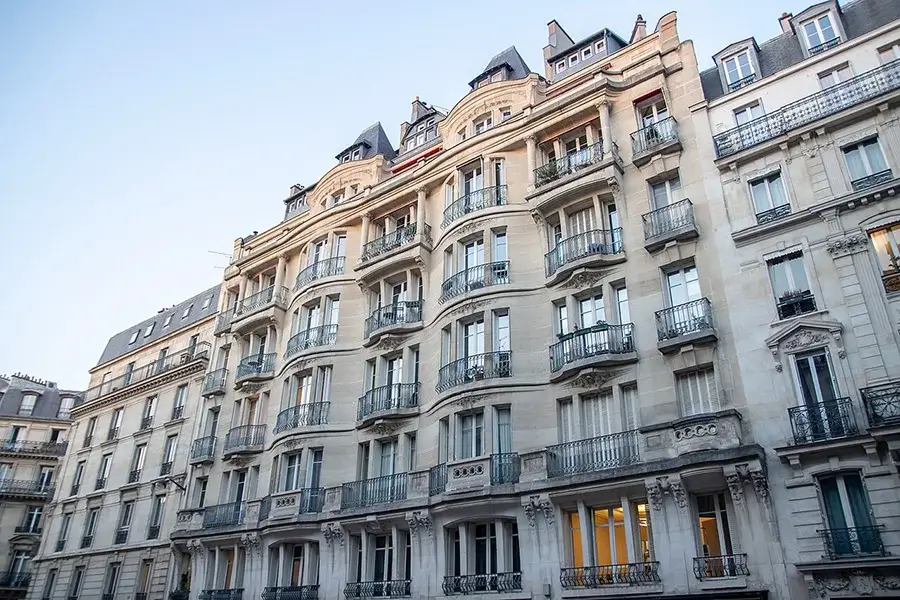
European residential property can be taxed during ownership, on disposal and as part of a large fortune. Apartment building on rue Gay-Lussac, Paris. Photo: Wikimedia Commons.

For investors, the suspension is a temporary 2026 feature rather than a permanent characteristic of the Greek tax system. A sale planned after 2026 needs to be modelled under the rules in force at the transaction date.
Georgia: 5% rental tax and a legal brake on sharp tax increases
The Georgian Tax Code sets the standard personal income tax rate at 20%, but residential rental income has a separate regime: an individual who claims no deductions against that income can pay 5%. A taxable gain on the sale of a residential apartment or house and its attached land is also taxed at 5%. If the home has been owned for more than two years, the gain is exempt from personal income tax.
Georgia has no separate real-estate transfer tax or stamp duty on acquisition. International Investment’s Georgia investment overview also highlights the 5% residential rental rate and the absence of a purchase tax as part of the country’s relatively light tax burden for private investors. This matters to returns because taxation does not add several percentage points to entry cost, as it can in a number of European markets.
From 30 September 2026, the property-tax regime for individuals became lighter. An amendment to the Tax Code raised the full exemption threshold from GEL40,000 to GEL100,000 of family income in the preceding year for taxable property other than land. Above GEL100,000, the statutory rate is 0.8–1% of market value. Land is taxed separately. The new exemption also applies to property tax due to be declared in 2026.
Georgia also has a legal constraint on sharp increases in national taxes. It is sometimes described as a tax-hike moratorium, but the legal mechanism is more precise. The Organic Law on Economic Freedom requires a referendum to introduce a new national tax or raise the upper limit of an existing national tax rate, except for excise tax. A change within an existing rate ceiling does not require a referendum, and the government may seek a temporary tax increase for up to three years without one. Property tax is regulated separately under the Tax Code.
For a property owner, the combination is more important than the 20% headline income-tax rate alone: 5% on residential rent, no separate transfer tax on purchase, a disposal exemption after more than two years, a higher property-tax exemption threshold and no general net wealth tax. This does not make the tax burden zero, but over the full ownership cycle Georgia is materially lighter than France, Spain or Portugal.
Cyprus and Malta are lighter on recurring national property tax
Cyprus abolished its national immovable-property tax in 2017. Local charges remain, but there is no national equivalent of France’s IFI or Spain’s wealth tax.
A gain on Cyprus immovable property is taxed at 20%. From 2026, lifetime individual exemptions were increased and the threshold for indirect real-estate ownership through a company fell from 50% to 20% of share value. A 0.4% levy on disposal proceeds also applies to qualifying property sales.
Malta has no conventional recurring property tax and no general wealth tax. Instead, transfers of Maltese real estate commonly face a final tax based on transfer value rather than the gain. The standard rate is 8% in many cases and 10% for certain older properties, with special rates and exemptions available.
A zero recurring-property-tax line therefore does not mean a zero tax cost over the investment cycle.
Switzerland and the Netherlands use different models
Switzerland taxes net wealth at cantonal and municipal level rather than federally. Maximum combined rates vary sharply by location, roughly from 0.1% to 0.87%. Real estate enters the wealth calculation and debt is allocated and deducted under the relevant rules.
Gains on Swiss real estate are also taxed at cantonal level, meaning two otherwise similar properties in different cantons can produce materially different outcomes.
The Netherlands does not formally levy a conventional net wealth tax. Instead, private investment assets enter Box 3, the system for taxing deemed returns on savings and investments. The 2026 personal exemption is €59,357 and the calculated benefit is taxed at 36%. The transitional system remains in place alongside Supreme Court case law that allows taxpayers to demonstrate a lower actual return where applicable.
Dutch investment property normally falls within Box 3 in a private investment scenario. From 2026, property purchased for investment or as a second home is also subject to an 8% transfer tax.
Where do investors pay more?
There is no single answer because the result changes with the asset and the investor.
For very high active income, Denmark, France, Austria, Spain, Belgium and Portugal have the highest headline marginal rates. For large real-estate portfolios, France and Spain stand out because recurring property taxation can be combined with taxes targeting wealth. Switzerland taxes net wealth at cantonal level, while Portugal uses AIMI for larger qualifying property holdings.
For private investors with long holding periods, Germany and Italy can be lighter on disposal because of their holding-period exemptions. Georgia is also among the lighter regimes, with a 5% residential rental rate, no separate purchase transfer tax, a disposal exemption after more than two years and a new GEL100,000 property-tax exemption threshold. Cyprus and Malta are lighter in terms of national recurring property tax, but disposal remains taxable. Greece stands apart in 2026 because its real-estate capital-gains tax is temporarily suspended.
The question “which European country has the highest taxes?” therefore has several correct answers. The ranking for salary income is different from the ranking for a large property portfolio, and both differ from the tax cost of selling an asset after five or ten years.
Residents and non-residents face different outcomes
Tax residence can change the calculation completely. Residents are commonly taxed on worldwide income and, in some jurisdictions, worldwide assets. Non-residents are more often taxed on domestic-source income and local property, but disposal rules can follow a separate regime.
Double-tax treaties add another layer by allocating taxing rights over rental income and capital gains and determining how tax already paid abroad is credited.
Two owners of identical €500,000 apartments can therefore receive different net returns even with the same rent if they are tax residents of different countries.
Property investors need the full cost of ownership
Comparing one income-tax or capital-gains rate is not enough. A property model needs to include acquisition taxes, recurring property charges, rental-income tax, any wealth-related charge, municipal costs and the tax payable on disposal.
That full cost explains why the same gross rental yield in Germany, Portugal, Cyprus or France can translate into different net returns.
A more useful comparison is not the lowest tax rate in Europe but the tax system that fits a specific scenario: the owner’s residence, property value and type, expected rental income, holding period and exit route.
FAQ: European taxes in 2026
Which European countries have the highest personal income taxes?
In Tax Foundation’s 2026 comparison, Denmark, France, Austria, Spain, Belgium and Portugal have some of Europe’s highest top statutory personal income tax rates. Social security contributions are excluded from that measure.
Which European countries levy wealth taxes?
Spain and Switzerland operate broad net-wealth taxation, although their systems differ substantially. France applies IFI specifically to large real-estate holdings. Portugal does not have a general net wealth tax but imposes AIMI on larger qualifying property portfolios.
Which countries have no national annual property tax?
Cyprus abolished its national immovable-property tax, while Malta has no conventional recurring national property tax. Local charges and acquisition or disposal taxes can still apply.
Where can long-term property investors reduce capital-gains tax?
In Germany, private real estate is generally exempt after a holding period of more than ten years. In Italy, many private property sales are exempt after more than five years.
Is Greek property subject to capital-gains tax in 2026?
Taxation of capital gains on transfers of Greek immovable property remains suspended through the end of 2026. Other taxes and transaction charges still apply.
Are non-residents taxed the same as residents?
No. Residents are often taxed on worldwide income and assets, while non-residents are usually taxed on domestic-source income and local property. Tax treaties can further change the result.
What taxes does a property owner pay in Georgia?
Residential rental income can be taxed at 5% for an individual who claims no deductions. A taxable gain on a home is also taxed at 5%, while a gain is generally exempt after more than two years of ownership. From 30 September 2026, property other than land is exempt when preceding-year family income does not exceed GEL100,000; above that threshold the statutory rate is 0.8–1% of market value. Georgia has no separate real-estate transfer tax or stamp duty on acquisition.
Can Georgia raise taxes without a referendum?
Not in every case. Introducing a new national tax or raising the upper limit of an existing national tax rate generally requires a referendum. Excise tax is excluded, the government can seek a temporary increase for up to three years without a referendum, and rates can be changed within an existing ceiling. Property tax is regulated separately.