







 Foreign Investment in Indian Real Estate Rises 17%
 Finland Misses Residence Permit Processing Deadlines
 Europe Living Investment Reaches €44.6bn
 Urban Homes Cost 27% More Across OECD
 Georgia to Boost Transit Potential with $7 Billion in Investments: Key Projects to Complete by 2031
 Ambassador Island Batumi: An Island Ahead of Its Time
Adjara Overtakes Tbilisi: How Georgia's Regional Hotel Sector Structure Is Shifting
In 2006–2025, the number of hotels and hotel-type establishments in Georgia increased 7.4-fold. Adjara became the country's largest regional market, while Kakheti emerged as one of the fastest-growing destinations. At the same time, data from the last four years indicate a gradual slowdown in the sector's expansion rate.
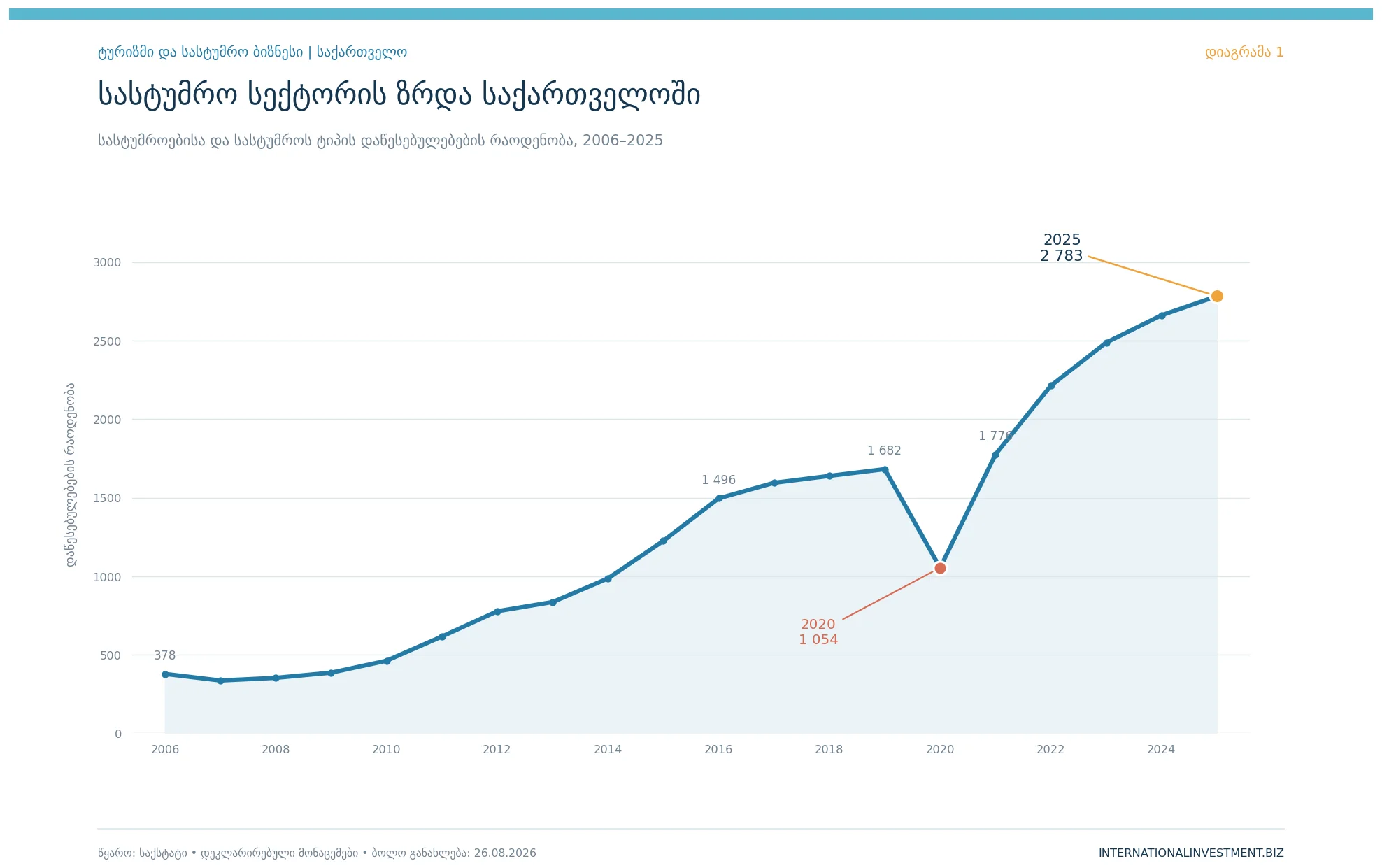
Over the past two decades, Georgia's sector of hotels and hotel-type establishments has undergone substantial quantitative and structural transformations. While in 2006 the country counted only 378 such facilities, by 2025 their number had climbed to 2 783. This represents a 636.2% growth, reflecting a significant shift in the geography and regional distribution of the accommodation sector.
However, one of the most compelling outcomes of this process is not merely the rising number of properties. The figures demonstrate that hotel sector development is spreading across an increasingly wide geographic footprint. Alongside historical leaders — Tbilisi and Adjara — prominent positions are now occupied by Kakheti, Imereti, Samegrelo-Zemo Svaneti, and other regions.
An analysis of data from the National Statistics Office of Georgia shows that in 2025, for the first time during the observed period, Adjara surpassed Tbilisi to top the ranking by the number of hotels and hotel-type establishments in the country.
Adjara Leads as Tbilisi Concedes Ground
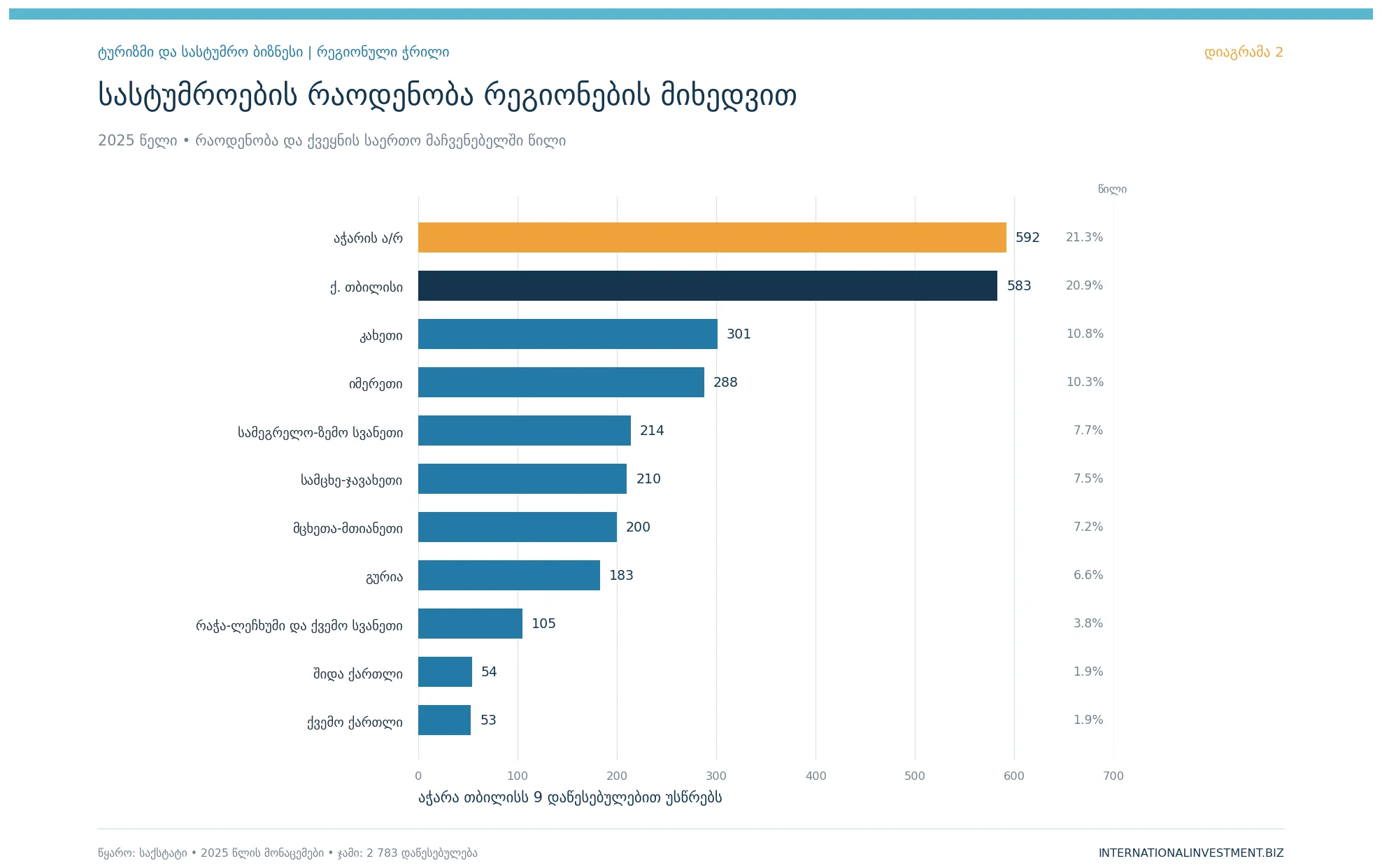
In 2025, 592 hotels and hotel-type establishments were registered in Adjara, compared to 583 in Tbilisi. Although the difference is just nine properties, this shift reflects an important turning point in the structure of the regional hotel market.
For comparison, in 2024 Tbilisi held first place with 599 properties, while Adjara had 547. Thus, over the course of a single year, the number of accommodation facilities in Adjara increased by 45, whereas Tbilisi recorded a drop of 16. As a result, Adjara not only bypassed Tbilisi but also increased its share in the national total.
In 2025, Adjara accounted for 21.3% of all hotels and hotel-type establishments in Georgia, while Tbilisi's share stood at 20.9%.
This dynamic is particularly striking in the context of long-term trends. In 2006, Tbilisi had 125 properties, while Adjara had 70. Back then, the capital held a decisive lead. Over the past two decades, however, hotel sector expansion in Adjara proved considerably more intense. Specifically, between 2006 and 2025, the number of properties in Adjara grew by 522, compared to 458 in Tbilisi.
Based on these figures, Adjara has clearly established itself as one of the primary regional hubs of Georgia's accommodation market. Yet quantitative leadership alone does not mean the region outperforms others across every metric. A comprehensive assessment requires evaluating room inventory, guest numbers, occupancy rates, and yield levels.
Kakheti: One of the Fastest-Growing Regional Hospitality Markets
Kakheti serves as another vivid example of regional transformation within the hotel sector.
In 2006, the region had only 14 hotels and hotel-type establishments operating. By 2025, that number had reached 301, representing an approximate 21.5-fold increase over 19 years. With this result, as of 2025 Kakheti ranks third nationwide, accounting for 10.8% of all accommodation properties.
Notably, Kakheti's surge is not merely a phenomenon of recent years. The region's hotel sector expanded gradually and, following the pandemic period in 2021, staged a sharp recovery. In 2021 alone, the number of properties in Kakheti surged from 77 to 176, posting a 128.6% annual increase. In 2025, the region recorded 23 more facilities than in the previous year.
Kakheti's rising prominence is also vital for the regional diversification of Georgia's tourism product. Expanding the hotel base builds substantial accommodation infrastructure across the region. However, evaluating the genuine economic impact of this growth requires examining it alongside tourist flows, hotel occupancy, and revenues.
Samegrelo-Zemo Svaneti and Guria: New Expansion Frontiers
Regional data clearly illustrate that hospitality development is not confined solely to the country's two largest tourism hubs.
In Samegrelo-Zemo Svaneti, the number of hotels and hotel-type establishments increased from 13 to 214 between 2006 and 2025 — roughly 16.5 times the baseline figure. In 2025 alone, the region registered a 12% annual increase, significantly outstripping the national growth rate of 4.5%.
Guria's metrics are equally noteworthy. In 2006, it had 14 hotels and accommodation properties, compared to 183 in 2025 — an approximate 13.1-fold expansion. In 2025 alone, Guria posted annual growth of 5.8%.
Meanwhile, expansion continues in Mtskheta-Mtianeti, where the number of hotels and hotel-type establishments rose from 19 to 200 between 2006 and 2025.
In absolute terms, these regions still lag behind Adjara and Tbilisi, but their long-term trajectory cements their status as key growth frontiers for the hospitality industry.
Regional Concentration Is Declining
One of the most significant structural shifts in Georgia's hotel sector has been the decline in regional concentration.
In 2006, Tbilisi and Adjara together accounted for 51.6% of all recorded facilities in the country. By 2025, their combined share had decreased to 42.2%.
A similar pattern is evident among the top five regional markets. In 2006, Tbilisi, Adjara, Samtskhe-Javakheti, Imereti, and Mtskheta-Mtianeti collectively represented 83.9% of the national market, whereas by 2025 the share of the top five regions had fallen to 71.1%.
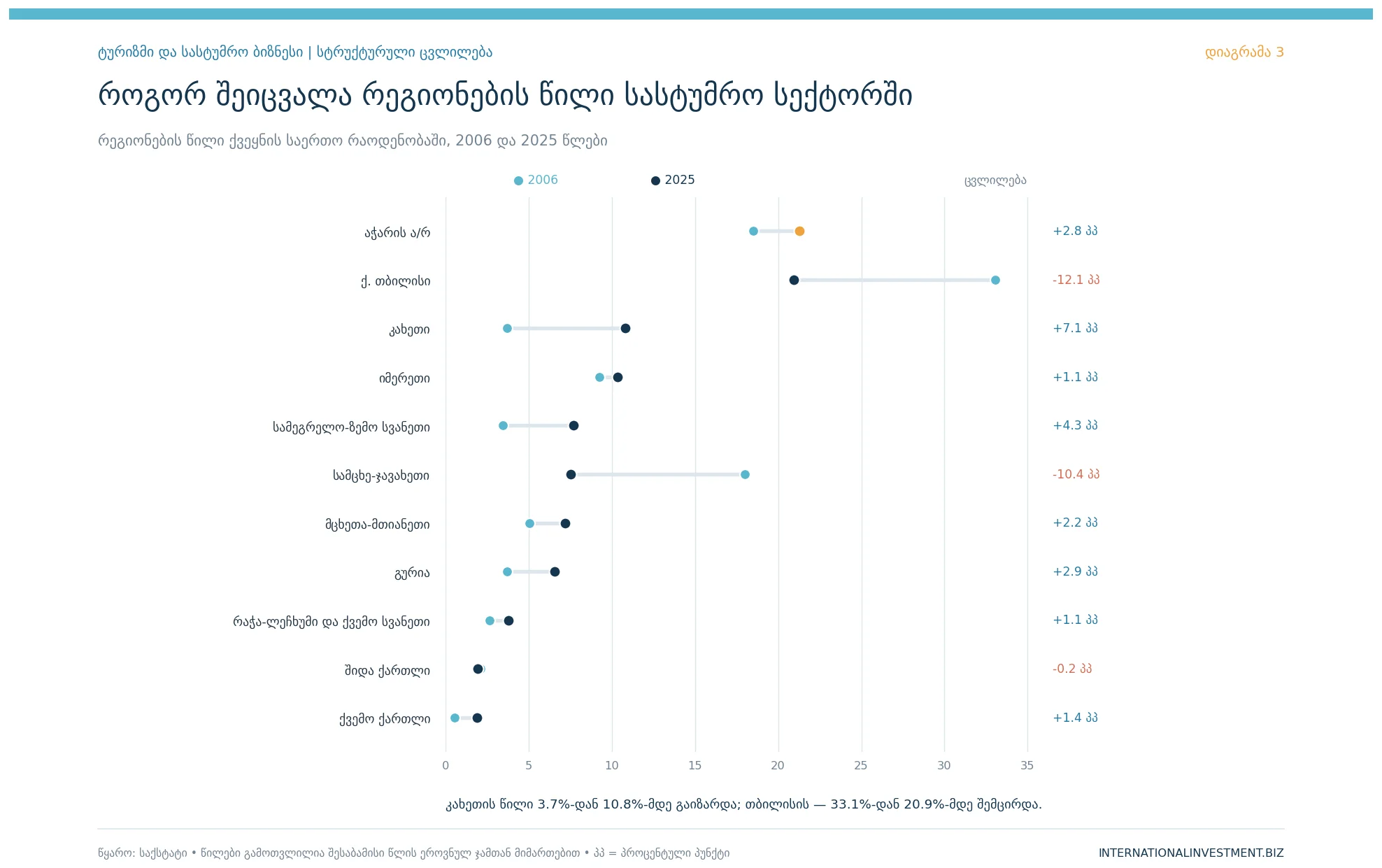
The primary driver behind this redistribution has been the outpaced growth of Kakheti, Samegrelo-Zemo Svaneti, and Guria.
In this context, the trajectory of Samtskhe-Javakheti is revealing. In 2006, the region hosted 68 properties and stood as one of the country's largest regional markets. By 2025, its facility count had risen to 210, yet its share of the national total shrank from 18% to 7.5%.
This does not signal a downturn within the region itself — on the contrary, properties increased, but growth rates in other regions proved considerably higher.
Consequently, Georgia's accommodation industry is becoming far less reliant on just a handful of major regional centres.
Pandemic Shock and Market Recovery
The year 2020 marks an exceptional episode in the hotel industry's trajectory. While in 2019 Georgia had 1 682 hotels and hotel-type establishments, by 2020 this figure plummeted to 1 054 — a drop of 628 properties, or 37.3%.
The contraction affected every single region. The sharpest decline took place in Mtskheta-Mtianeti at 45.1%. In Imereti, the decline was 39%, in Guria 38.7%, and in Tbilisi 38.5%.
However, 2021 saw a dramatic turnaround. Across the country, the number of hotels and hotel-type establishments climbed to 1 776, marking a 68.5% year-on-year increase and surpassing pre-crisis 2019 levels.
Recovery progressed unevenly across regions. Particularly strong annual gains were registered in Kakheti, Racha-Lechkhumi and Kvemo Svaneti, Shida Kartli, and Guria.
By 2025, the number of hotels and accommodation facilities in every region exceeded 2019 figures.
Nonetheless, pandemic-period statistics must be interpreted with caution, as these records do not distinguish between permanent business closures, resumed operations, and brand-new openings.
Quantitative Growth Moderates: 2025 Trends
Even though the overall number of accommodation facilities continues to rise, trends over recent years point to a steady moderation in growth rates. Annual growth was 24.6% in 2022, 12.4% in 2023, 7% in 2024, and 4.5% in 2025. In absolute terms, the country registered 121 more facilities in 2025 than in 2024.
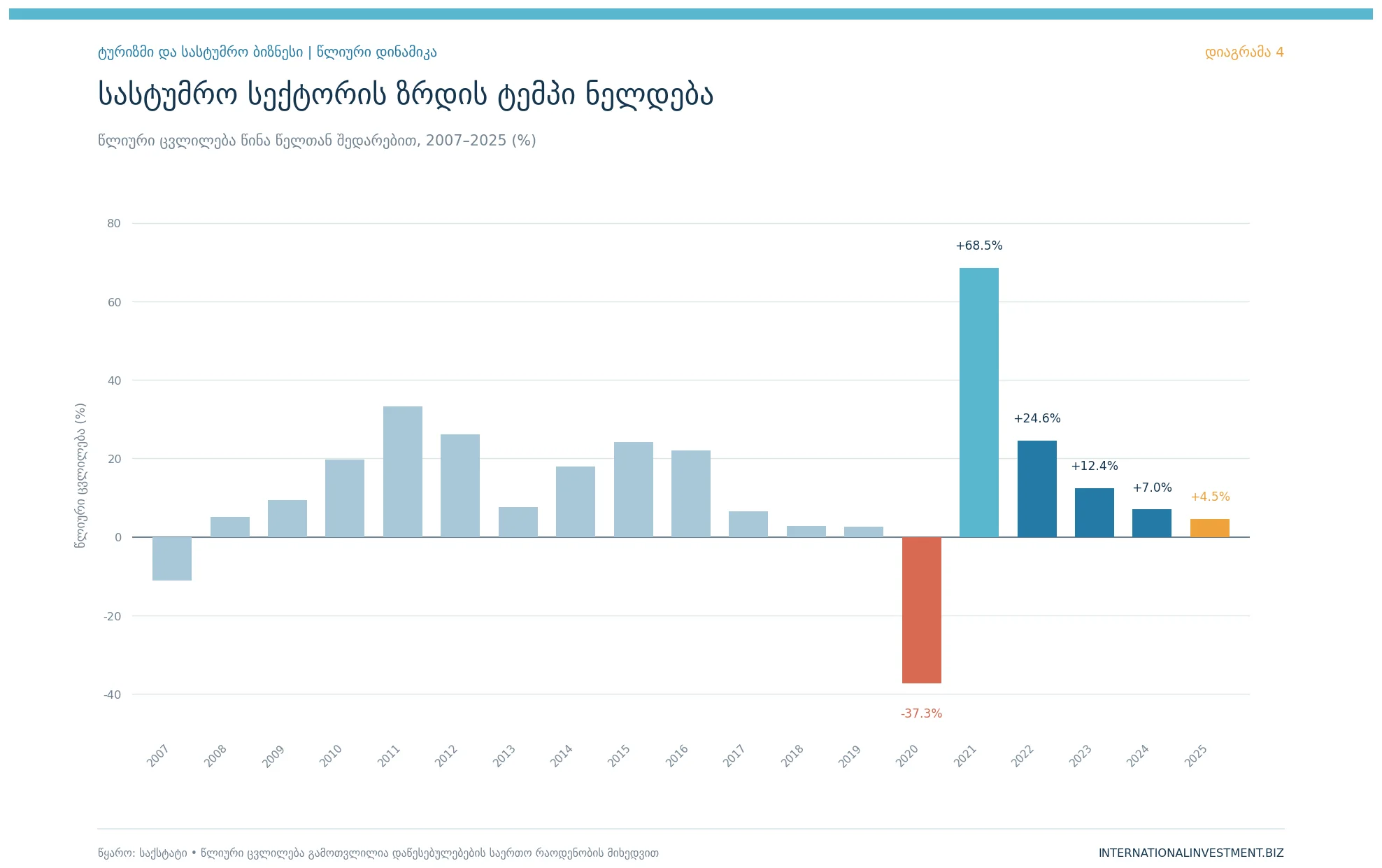
A regional breakdown indicates that the bulk of net additions came from a few destinations. Adjara added 45 properties, while Kakheti and Samegrelo-Zemo Svaneti each gained 23. Together, these three regions accounted for roughly 75% of total net additions across the country.
Over the same period, Tbilisi recorded a net decline of 16 properties, while Imereti remained unchanged.
Interestingly, the highest relative growth in 2025 — 17.8% — occurred in Kvemo Kartli. However, this high percentage stems from a low baseline, as the number of establishments grew from 45 to 53.
Therefore, analyzing current dynamics requires weighing percentage gains alongside actual quantitative additions.
The deceleration in expansion rates may signal a transition into a more mature development phase. At the same time, drawing definitive conclusions about market saturation or investment pullbacks solely from these numbers would be premature.
Quantitative Expansion Leaves Core Investment Questions Open
Georgia's hospitality statistics illustrate that over the past two decades, the geographical spread of accommodation infrastructure has expanded substantially, creating a more diverse set of regional hubs.
Yet for investors, counting hotels and hotel-type properties alone is insufficient for sound decision-making.
Gauging the sector's investment appeal demands an analysis of multiple complementary indicators: regional room capacity, occupancy rates, guest turnover, average daily rates, and sector-wide revenue generation.
Seasonality plays a critical role. A growing number of hotels does not guarantee that operational capacity is utilized efficiently throughout the entire year.
It should also be noted that official statistics encompass legal entities and individual entrepreneurs registered under Georgian law, including separate divisions and branch offices. Accordingly, these figures cannot be equated directly with the number of unique hotel brands.
When assessing the next stage of Georgia's hotel sector evolution, the fundamental question is no longer how many new properties enter the market. What matters far more is how effectively existing and new capacities are deployed, how sustainable regional business models prove to be, and what real economic returns this expansion delivers.
Taking all factors into account, the 2006–2025 figures substantiate a defining trend: Georgia's hotel sector has expanded quantitatively, diversified regionally, and formed new growth poles. Going forward, unlocking its full investment potential will depend less on sheer numbers and far more on economic performance.
Source: National Statistics Office of Georgia (Geostat); Study Period: 2006–2025; Last Data Update: 26 August 2026
InternationalInvestment.biz - Russian editorial desk