







 "Georgia's Tourism Must Shift from Quantitative Growth to Qualitative Development" — Maia Sidamonidze
 More Than 800 Construction Companies Fail in Israel
 Foreign Investors in Georgia’s Real Estate Market: Where Is the International Share Highest?
 Housing protests in Spain: tenants demand reforms
 The artificial intelligence bubble: Why global markets are in turmoil
 Georgia Named Strategic Tourism Destination of the Year by Trip.com Group
Georgian Railway Freight Turnover Increases by 16.8%
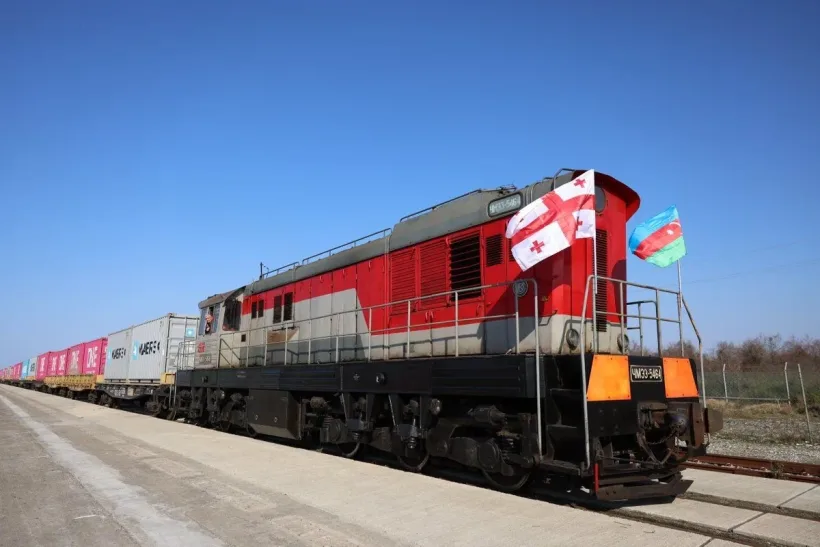
Capacity utilization of railway transport in Georgia is on the rise. In the third quarter of 2026, the volume of freight transported by rail increased by 16.8% year-on-year, reaching 4.1 million tons. Alongside this growth, figures indicate that transit continues to dominate the shipping structure, accounting for 62.1% of the total volume. During the same period, both passenger traffic and passenger turnover also grew.
Transit remains the primary component of railway freight turnover
According to the National Statistics Office of Georgia, out of the 4.1 million tons of freight carried by rail in the third quarter of 2026, domestic shipments accounted for 5.7%, international shipments (excluding transit) stood at 32.1%, and transit made up 62.1%.
Within international shipments, the largest share of freight entered Georgia. Specifically, under this category, 77.9% of rail-transported goods constituted imports, while 22.1% accounted for exports.
Russia and Azerbaijan are the primary countries of origin for rail freight
According to Geostat, during the reporting period, the largest share of goods imported into Georgia by rail came from Russia at 22.2%. Azerbaijan recorded an almost identical figure at 22.1%. Shares of other sending countries individually accounted for less than 10%, while their combined share reached 55.7%.
The main destination country for exported goods was Armenia, holding a 24.4% share. It was followed by Kazakhstan at 8% and Russia at 7%. The combined share of other nations reached 60.6%.
What types of cargo are transported by Georgian Railway
In terms of commodity breakdown, coke and refined petroleum products took the largest share at 34.7%. Chemicals, chemical products, artificial fibers, rubber, and plastic products took second place at 21.5%, while food products, beverages, and tobacco ranked third at 11.5%.
For domestic shipments, the pattern was different. Metal ore and other mining and quarrying products dominated with a 61.4% share. Transport equipment accounted for 15.8%, followed by coke and refined petroleum products at 14.8%.
Petroleum products lead in imports, while food and chemicals top exports
Detailed figures on international transportation indicate that among goods brought into Georgia by rail, coke and refined petroleum products held the largest share at 47.3%.
They were followed by other non-metallic mineral products at 13.7%, food, beverages, and tobacco at 7.9%, and metal ore and other mining and quarrying products at 7.8%. The group of coal, lignite, crude oil, and natural gas accounted for 7.7%, while basic metals accounted for 6.5%.
In the export structure, food products, beverages, and tobacco took first place with 25.8%. Second place went to chemicals, chemical products, and artificial fibers at 24.9%. The share of other non-metallic mineral products was 16.4%, metal ore and other mining products stood at 12.6%, and basic metals at 12.5%.
Railway passenger traffic grows by 20.2%
Along with freight turnover growth, a positive trend was also seen in passenger transport. In the third quarter of 2026, Georgian Railway transported 708 thousand passengers, which is 20.2% higher compared to the same period last year. During this time, passenger turnover reached 164.5 million passenger-kilometers, reflecting an annual increase of 13.6%.
Most passengers traveled on domestic routes. Specifically, 619.8 thousand passengers traveled domestically, representing 87.5% of the total volume and surpassing the Q3 2025 figure by 8.1%.
A particularly notable increase was recorded in international traffic. Along this route, 88.2 thousand passengers traveled by rail, approximately 5.6 times more than in the same period last year.
Among international passenger flows, the Azerbaijan route captured a significant share: 35.5% of passengers arrived from Azerbaijan, while 36.8% departed for this country. Passengers arriving from Armenia accounted for 12.6%, and those traveling to Armenia comprised 15.1%.