







 Egypt Prepares New Law for Property Developers
 Young Japanese Buyers Turn to 50-Year Mortgages
 Argentina Narrows Tourism Gap as Arrivals Rise
 Seattle Luxury Housing Loses Its Former Momentum
 The World’s Strongest Passports for Travel, Living and Investment
 Russian Developers’ Debt Nearly Doubled in a Year
China’s Property Slump Enters Another Phase
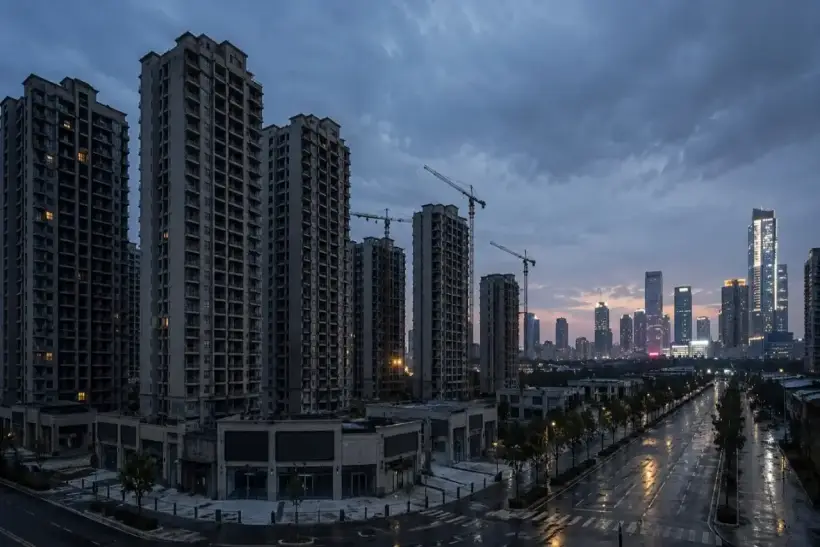
China’s real estate downturn has entered its sixth year with little evidence of a fast recovery, as official data show renewed declines in investment, sales, construction starts and developer financing, while economists increasingly compare the adjustment with Japan’s long post-bubble correction.
Property remains China’s weakest growth engine
Brookings, summarizing research by Kenneth Rogoff and Yuanchen Yang, said real estate and infrastructure account for nearly one-third of Chinese economic demand, while housing represents about 70% of household assets. That turns the property slump into more than a developer crisis: when apartment values fall, households feel poorer and reduce spending. The authors described the sector as being in the middle stages of a multi-year correction and warned that, if China follows a path similar to Japan’s, the transition may not yet be halfway complete.
The main transmission channel is not only developer debt or bank stress. It is the wealth effect, meaning the link between asset values and household spending. In China, that channel is unusually strong because household wealth is heavily concentrated in housing and because alternative financial assets play a smaller role than in the United States or Japan.
Official data point to a deeper contraction
China’s National Bureau of Statistics reported that real estate development investment fell 13.7% year on year in January–April 2026 to 2.3969 trillion yuan, while residential investment declined 13.1%. Floor space under construction dropped 12.1%, newly started floor space fell 22%, and completed floor space declined 24%. Sales floor area of newly built commercial buildings decreased 10.2%, with residential sales area down 12.2%; sales value fell 14.6%, including a 15.7% fall in residential sales. Developer funding declined 18.4%, with domestic loans down 25.9% and individual mortgage loans down 31.7%.
These figures show why the downturn is difficult to stabilize. Fewer new starts mean developers either lack demand or funding. Fewer completions increase pressure on buyers who have already paid deposits. Falling mortgage lending signals both weaker household demand and tighter risk assessment by banks.
Prices split between core cities and weaker markets
Official price indices for 70 large and medium-sized cities show a fragmented market. In April 2026, new-home prices in Beijing were 2.3% below a year earlier, Shanghai was 3.7% higher, Guangzhou was 7.9% lower and Shenzhen was 6.5% lower. The second-hand market was weaker: prices were down 7.4% in Beijing and 5.6% in Shanghai from a year earlier.
This divergence matters. Resilience in selected districts of Shanghai or Hangzhou does not offset structural pressure in less prosperous cities. So-called tier-three cities are not small towns; in China they can have millions of residents. They tend to have weaker labor markets, larger population outflows and higher dependence on land sales for local government revenue.
The downturn predates the developer crackdown
The crisis is often linked to the “three red lines” policy introduced in 2020 to curb excessive developer leverage. The rules set financial limits for property companies and made refinancing harder for highly indebted builders. Yet the deeper causes had been building earlier: overconstruction, slower urbanization, population aging and local governments’ reliance on land-transfer revenue.
That is why defaults by major developers acted less as the original cause than as an accelerator. Once home sales weakened, developers lost advance payments, local governments lost land income, banks lost a reliable flow of mortgage and corporate borrowers, and households began questioning whether housing was still the safest store of wealth.
Beijing’s support has not reset the cycle
China’s State Council reported that the People’s Bank of China created a 300 billion yuan relending facility to support purchases of completed unsold homes by local state-owned enterprises, with the units to be converted into affordable housing. The program formed part of broader stabilization measures, including mortgage easing and support for completing unfinished projects.
The scale of the inventory problem remains large. At the end of April 2026, commercial housing available for sale stood at 778.01 million square meters, while residential inventory was still 1% higher than a year earlier. Reducing that stock requires more than official purchases; it also requires restored buyer confidence, stronger household income expectations and credible financing for project completion.
The IMF flags demand and deflation risks
The International Monetary Fund said in its 2025 consultation on China that the prolonged property-sector adjustment and spillovers to local government finances continue to weigh on domestic demand and add to deflationary pressure. Deflationary pressure refers to the risk of broad price declines that can reinforce weak spending, delayed purchases and lower corporate revenues.
The global impact is significant because China’s housing chain is vast. Construction demand reaches steel, cement, energy, machinery, furniture, finance and transport. A weaker property cycle affects domestic employment and local fiscal revenue, while also hitting commodity exporters and economies tied to China’s investment cycle.
Japan is the comparison investors cannot ignore
The Japan comparison is not based on identical institutions. It is based on the sequence: a long investment boom, excessive construction, aging demographics and a sharp reassessment of real estate as a growth engine. Japan’s property bust after the late-1980s bubble became part of the “lost decade,” a period marked by weak growth, cautious consumers and slow balance-sheet repair.
China still has advantages: stronger administrative capacity, a controlled financial system, high savings and the ability to direct credit. But those tools do not eliminate the physical surplus of housing in cities with weaker job creation, softer demographics and lower demand from young families.
Exports cannot quickly replace housing
Beijing is pushing electric vehicles, solar panels, batteries, nuclear power and advanced manufacturing. These sectors are strategically important, but they are smaller than the property-construction complex in employment intensity and domestic-demand impact. Modern factories are more automated than construction sites, and export growth is increasingly constrained by trade barriers in the United States, the European Union and other markets.
The property crisis is therefore a growth-model issue. For years, China relied on exports, investment, infrastructure and housing construction. Now part of that model is weakening, while a shift toward household consumption would require stronger social protection, higher incomes and fewer reasons for families to save defensively.
As International Investment experts report, China’s main risk is not a single dramatic financial crash but a slow erosion of demand: households spend more cautiously, developers build less, local governments lose land revenue and industry tries to offset the drag through exports. Such a scenario can look manageable in quarterly data, but its danger lies in duration. The longer housing stops functioning as a reliable household asset, the harder it becomes to restore confidence without deeper reforms to income distribution, social protection and local government finance.