







 Egypt Prepares New Law for Property Developers
 Young Japanese Buyers Turn to 50-Year Mortgages
 Argentina Narrows Tourism Gap as Arrivals Rise
 Seattle Luxury Housing Loses Its Former Momentum
 The World’s Strongest Passports for Travel, Living and Investment
 Russian Developers’ Debt Nearly Doubled in a Year
China Draws More Tourists, but Spending Stays Modest
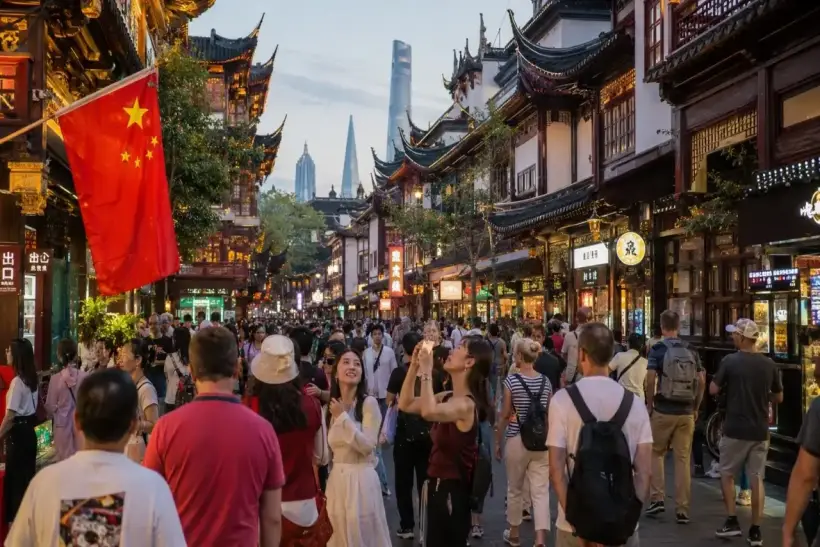
China is experiencing its strongest inbound-travel recovery since the pandemic. Foreign nationals made 22.91 million entries in the first half of 2026, up 20.4% from a year earlier, and almost 17.82 million of those entries were visa-free. Yet the surge is delivering a larger reputational payoff than macroeconomic one. China received $33.3 billion from non-residents under the balance-of-payments travel category during the first six months, while Chinese residents spent $120.2 billion abroad under the same heading. The resulting $86.9 billion deficit shows why the tourism boom is strengthening China’s international appeal faster than it is changing the economic structure of the world’s second-largest economy.
Foreign entries into China rise by 20%
China’s National Immigration Administration recorded a record 369 million inbound and outbound border crossings in the first half of 2026, 10.8% more than a year earlier. Mainland Chinese residents accounted for 176 million trips, residents of Hong Kong, Macao and Taiwan for 147 million, and foreign nationals for 45.91 million.
Foreign-national entries alone reached 22.91 million, an increase of 20.4%. Visa-free foreign entries rose 30.6% to 17.82 million and represented 77.7% of all foreign entries.
South Korea, Russia, Malaysia, Vietnam, Thailand, Singapore, the United States, Japan, Mongolia and Australia were the 10 largest source countries, collectively accounting for 62% of foreign entries.
The figures should not be interpreted as a count of unique foreign tourists. They measure border entries and can include repeat travelers as well as visitors arriving for business, education, family visits and other purposes.
China now offers visa-free entry to 50 countries
Visa liberalization has become one of the main engines of the recovery. Nationals of 50 countries holding ordinary passports can currently enter China without obtaining a visa in advance for purposes including tourism, business, visits to relatives and friends, exchanges and transit.
The list includes France, Germany, Italy, Spain, the Netherlands, Switzerland, Australia, New Zealand, Japan, South Korea, Brazil, Argentina, Russia, Canada and the UK. In most cases, eligible visitors can remain for as long as 30 days.
Canada and Britain joined the unilateral visa-waiver program on February 17, 2026. China has also expanded its separate 240-hour visa-free transit system, which covered 65 entry ports by mid-2026.
The result has been a substantial reduction in the administrative friction associated with short trips to the country.
Tourism is spreading beyond Beijing and Shanghai
Bloomberg’s report, which provided the starting point for this article, highlights a change in what foreign visitors want to experience. Travelers are increasingly looking beyond the Great Wall, the Forbidden City and the Terracotta Warriors toward cities made popular through social media.
Chongqing has emerged as one of the clearest examples. Its steep terrain, layered roads, rail lines running through buildings, dense skyline and illuminated nightscape have made it a highly recognizable online image of modern China.
Shenzhen, Chengdu, Harbin, Yunnan and Xinjiang are also drawing more international attention. Visitors are increasingly interested in high-speed rail, robotaxis, electric vehicles, digital retail, Chinese consumer brands and ordinary urban life alongside traditional sightseeing.
Figures cited in the Bloomberg reporting put foreign tourist arrivals at around 35 million in 2025. Average inbound spending was estimated at about $2,240 per visitor, roughly 40% of the comparable US level.
Social media is becoming a tourism channel
China’s inbound recovery has coincided with a rapid expansion of traveler-generated content showing daily life in Chinese cities.
Foreign visitors publish videos of metro systems, high-speed trains, delivery services, restaurants, shopping centers, hotels and technology as well as historic attractions. That produces a form of international promotion different from a conventional government advertising campaign.
The trend is relevant to the concept of soft power: a country’s ability to influence others through the attractiveness of its culture, society, technology, education and lifestyle rather than coercion.
That does not mean tourism alone is responsible for improving perceptions of China. Public opinion is also shaped by geopolitics, trade, security concerns and changing attitudes toward other global powers.
International views of China have improved
The latest Pew Research Center survey provides wider context. The organization interviewed 45,658 adults in 37 countries between February 8 and May 13, 2026.
A median of 51% expressed a favorable view of China, compared with 39% who held an unfavorable one. In several countries, positive attitudes were at or near record highs.
In Italy, 51% viewed China favorably, compared with 45% in 2025 and 31% in 2022. In Spain, favorability reached 54%, up 17 percentage points in a year.
Views were also at or near historic highs in Colombia, Greece, Hungary, Indonesia, Malaysia, Mexico, Nigeria, Peru, Singapore, Sri Lanka and Turkey.
The picture remains sharply divided. Only 11% of Japanese adults held a favorable view, and attitudes remain less positive across many wealthy European, North American and East Asian countries than in emerging economies.
China receives $33.3 billion from international travel
The clearest measure of the economic limitation comes from the balance of payments. China’s foreign-exchange regulator released preliminary first-half data on August 14.
Travel credits — spending in China by non-residents recorded under the international travel category — totaled 229.2 billion yuan, or $33.3 billion.
Chinese residents spent 829 billion yuan, or $120.2 billion, abroad under the same category. The travel deficit therefore reached 599.8 billion yuan, equivalent to $86.9 billion.
Inbound credits were less than 28% of outbound spending.
In the second quarter alone, China received about $18.1 billion in travel credits while residents spent $57.7 billion overseas, resulting in a quarterly deficit of approximately $39.6 billion.
Travel credits are not the same as tourism revenue
A balance-of-payments travel entry should not be treated as a pure tourism-revenue figure.
The category records goods and services acquired by people while outside their economy of residence. It can include leisure tourism, but also certain spending associated with business travel, education, medical treatment and other temporary stays.
That distinction helps explain why broader Chinese tourism statistics can be much larger.
China’s new national tourism plan states that the country recorded more than 150 million inbound tourist visits in 2025 and more than $130 billion in spending by inbound travelers.
Those figures use a different statistical concept and cover a broader inbound market, including travel associated with Hong Kong, Macao and Taiwan. They should therefore not be directly equated with balance-of-payments travel credits.
Tourism remains small relative to China’s economy
China’s sheer economic scale makes even tens of billions of dollars in travel receipts relatively modest.
Gross domestic product reached 69.57 trillion yuan in the first half of 2026, increasing 4.7% in real terms. Growth slowed from 5% in the first quarter to 4.3% in the second.
The value added of the services sector reached 41.37 trillion yuan and expanded 5.2%. Secondary-industry output reached 25.05 trillion yuan and grew 3.9%.
The 229.2 billion yuan of balance-of-payments travel credits is equivalent to roughly 0.33% of first-half nominal GDP.
That is not an estimate of tourism’s GDP contribution because gross travel receipts and economic value added are fundamentally different accounting concepts. It simply illustrates the relative size of the cash flows.
Tourism matters more to retailers than GDP
The national effect may be modest, but foreign visitors can be highly important for individual businesses and districts.
At Miniso’s flagship store on Shanghai’s Nanjing East Road, foreign visitors can account for as much as 70% of foot traffic at some times of the day.
International travelers also create demand for hotels, restaurants, domestic flights, train tickets, museums, entertainment venues, cosmetics and Chinese consumer brands.
That spending is particularly valuable because domestic consumer growth remains subdued. Goods retail sales increased only 1.1% in the first half, while catering revenue rose 2.8%. Service retail sales performed better, increasing 5.3%.
Inbound tourism can therefore provide a meaningful boost to selected service businesses without becoming a major driver of overall Chinese GDP.
Domestic tourism is vastly larger
China’s own residents remain by far the country’s most important tourism market.
The Ministry of Culture and Tourism recorded 3.463 billion domestic trips in the first half of 2026, an increase of 5.4%.
Urban residents made 2.594 billion trips, up 5.8%, while rural residents made 869 million, up 4.3%. There were 1.901 billion domestic trips in the first quarter and 1.562 billion in the second.
Domestic tourism spending totaled about 3.21 trillion yuan and increased only 2%, significantly slower than trip numbers. That suggests Chinese consumers are traveling more frequently while remaining cautious about spending per trip.
The figures also demonstrate why domestic travel remains economically much more important than foreign tourism.
Beijing wants foreign visitors to spend more
In March, nine government departments unveiled a package specifically designed to promote travel-service exports and increase inbound consumption.
Measures include further expansion of visa-free access, improvements to transit rules, research into electronic visas and online arrival documentation.
Authorities also plan a unified information platform for international visitors, better foreign-language services, simpler ticket reservations and further improvements in payments.
The program encourages multi-stop tourism packages combining transportation, attractions, accommodation and shopping. It also seeks to link inbound tourism with concerts, sports events, healthcare, exhibitions and education.
The policy emphasis is therefore shifting from simply increasing arrival numbers toward raising spending per visitor and extending the length of stays.
Digital friction remains a challenge
China has made significant progress in making its digital economy easier for international visitors, but differences in payment and mobile-service ecosystems remain a barrier.
Daily transactions in major cities are heavily dependent on mobile payments and applications for food delivery, taxis, reservations and tickets. Foreign bank cards can now be linked more easily to Chinese payment systems, yet visitors still need to adapt to platforms they may never have used before.
Language support also varies considerably outside major tourist districts.
The government’s March policy package explicitly calls for more multilingual signs, better international-payment acceptance and multilingual versions of navigation, ride-hailing, food-delivery and shopping applications.
Removing these frictions matters because independent travelers are often more likely than tightly organized tour groups to stay longer, explore additional cities and spend money across a wider range of businesses.
China targets 190 million inbound visits by 2030
Beijing has set much larger tourism ambitions for the end of the decade.
The new five-year plan aims for 190 million inbound tourist visits annually by 2030 and more than $150 billion in inbound tourism spending.
Those targets imply an increase of roughly 26% in visits and 15% in spending from the officially reported 2025 levels.
China also wants domestic tourism to reach 8.3 billion trips and 7.7 trillion yuan of spending each year by 2030.
The plan calls for more international air and rail connections, easier payments and communications, improved accommodation services, broader tax-refund networks and more tourism-oriented international consumption hubs.
China still runs a huge travel deficit
Rapid inbound growth has not changed a fundamental feature of China’s international travel market: Chinese residents still spend far more abroad than non-residents spend in China under the comparable balance-of-payments category.
China’s overall services-trade deficit was $112 billion in the first half of 2026. Travel accounted for $86.9 billion of that total — almost 78%.
The contrast with merchandise trade is dramatic. China recorded a $526.3 billion goods-trade surplus and a $379.4 billion current-account surplus over the same six months.
That explains why inbound tourism remains almost invisible in China’s overall macroeconomic model. The country is still overwhelmingly an industrial and merchandise-export powerhouse rather than an economy dependent on international tourism.
Soft power offers a separate return
The financial statistics cannot capture the entire value of the tourism strategy.
A visitor seeing Shanghai, Chongqing or Shenzhen for the first time acquires firsthand experience that cannot be replicated entirely by advertising, news coverage or diplomacy. Travelers directly encounter Chinese transportation, safety, prices, technology, restaurants and everyday urban life.
That can have political value in a period of intensifying international competition.
The effect can also work in both directions. Visitors experience advanced infrastructure and convenient public services, but they may also encounter digital restrictions, surveillance and other aspects of China’s political and regulatory environment.
Inbound travel should therefore be understood not as an automatic public-relations victory, but as an expansion in the number of foreigners forming views of China through direct experience.
As International Investment experts report, China’s inbound tourism boom is primarily a success in international positioning rather than a standalone macroeconomic growth engine. The most revealing number is the $86.9 billion first-half travel deficit: Chinese residents spent more than three times as much abroad as non-residents spent in China under the comparable balance-of-payments category. The next meaningful measure of success will therefore be spending per foreign visitor, average length of stay and the share of that spending captured by Chinese hotels, restaurants, transport operators and retailers rather than arrival numbers alone. If Beijing can convert the online popularity of Chinese cities into longer itineraries and higher visitor spending, tourism can become more economically significant. For now, its most important return is the millions of foreigners building an image of China through personal experience rather than exclusively through the external information environment.