







 Reform UK Reworks Its Offer to Wealthy Foreigners
 US Introduces Visa Bonds of Up to $20,000 for Tourists From 50 Countries
 Portugal Secures €1.5 Billion for Social Housing
 Mortgage Lending in Georgia Increased by Nearly 50%
 Irish Homes Are 17% Overvalued as Supply Lags
 Buses from Latvia to Russia and Belarus May Be Cancelled
Czech Rates Face June Test
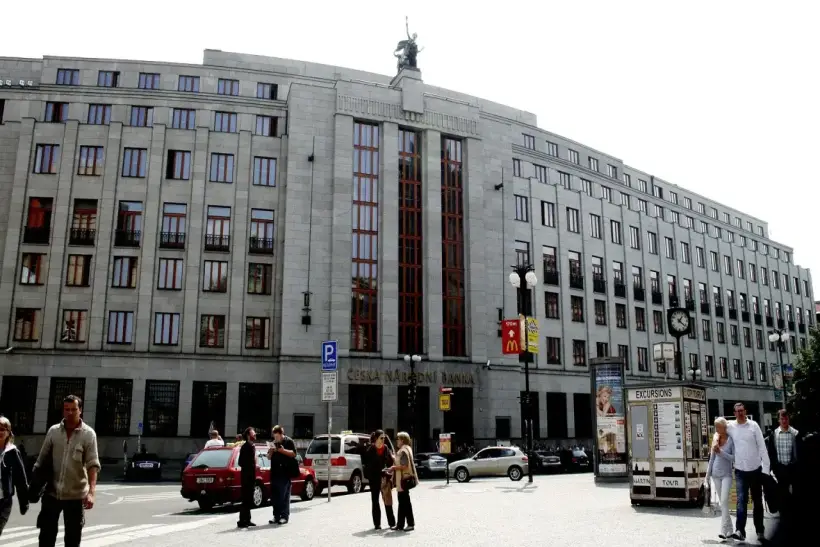
The Czech National Bank may move from a long pause to an interest-rate increase for the first time in several years. Governor Aleš Michl said the case for a June move has strengthened, even though headline inflation has slowed. For Prague, this is not only a price-stability issue, but also a test of central-bank independence amid government pressure, wage growth, expensive housing and new energy risks.
The Czech central bank talks about a hike again
Czech monetary policy is entering a new phase. After a period of high inflation, then stabilization and a long pause, the Czech National Bank is again discussing not a rate cut, but a rate increase. For markets, this is an important shift: not long ago, investors and politicians expected borrowing costs to gradually fall; now the focus is on the risk of renewed tightening.
Czech National Bank Governor Aleš Michl told Bloomberg that the arguments for raising interest rates at the June meeting have strengthened. He said such a move is now a real possibility. The central bank must decide not whether tight policy is needed at all, but how tight it should be.
The CNB’s key rate has been held at 3.5% for more than a year. That is already restrictive policy: money remains expensive, credit is not being artificially stimulated and the central bank is trying to lock in inflation’s return to target. But Michl is signaling that the current level may not be enough if underlying price pressure persists.
Inflation has slowed, but the problem has not disappeared
At first glance, the case for a hike appears limited. Annual inflation in the Czech Republic slowed to 2.1% in May, almost matching the central bank’s 2% target. For households, this looks like a victory after the period when inflation approached 20%.
But for a central bank, headline inflation is not the only measure. Core inflation, which better captures domestic demand pressures and excludes some volatile components, remains elevated at about 2.9%. That is what worries policymakers. If services, housing and wages continue to rise faster than target, the overall index may accelerate again after a temporary decline in some goods prices.
Michl has stressed that the Czech National Bank still needs to fight core inflation. That means the regulator is looking not at one favorable monthly print, but at the durability of price dynamics. If inflation falls only because of a temporary drop in food or energy prices, that does not guarantee long-term stability.
Wages have become the main domestic risk
One of the key factors is wage growth. In the first quarter of 2026, annual wage dynamics accelerated markedly. For workers, this is positive: real incomes are recovering after the inflation shock. For the central bank, it is a risk because rapid wage growth can become embedded in service prices.
If companies pay more, they often pass part of the cost on to customers. In manufacturing, this is harder because of international competition. In services, it is easier, especially if demand is resilient and the labor market remains tight. That is why wages, combined with service prices, make inflation stickier.
The Czech economy also faces a skills mismatch in the labor market. Workers are available, but not always with the skills companies need. This supports wage pressure in some sectors even when overall economic growth is moderate.
Housing and services keep pressure alive
The second area of risk is housing. High rates have already made mortgages expensive, but the housing market remains sensitive: rents, construction costs, property maintenance and utilities continue to affect household budgets.
For the Czech National Bank, housing is not only a social problem, but also an inflation component. If housing-related costs and services rise, they keep overall prices above target even when goods prices decline.
Services more broadly have become one of the main sources of post-inflation persistence. After the energy shock and the cost-of-living surge, service companies continue to reset prices, while consumers do not always cut demand sharply. This creates a situation in which inflation no longer looks like a crisis, but remains too high for comfortable rate cuts.
The oil shock changes the calculation
The external risk comes from the Middle East and oil prices. Conflict in the region has raised concerns about energy, transport, costs and inflation expectations. For the Czech Republic, as an open industrial economy, this is especially important: the country depends on external markets, energy imports and European supply chains.
The Czech National Bank says it will not automatically react to the first-round effect of higher energy prices. If oil rises, it can temporarily raise fuel and transport prices. But the central bank is more concerned about second-round effects: when expensive energy starts lifting prices in other sectors, influencing wage demands and changing business expectations.
That is where the argument for a preventive hike emerges. The central bank may decide that it is better to make policy slightly more restrictive now than to fight reaccelerating inflation later.
The koruna gets support from expectations
Hawkish signals from the Czech National Bank are already influencing the market. When investors begin to expect higher rates, the national currency usually receives support: higher yields make assets in that currency more attractive.
For the Czech Republic, a strong or stable koruna is an additional anti-inflationary factor. It lowers the cost of imports and partly softens external price shocks. If the koruna weakens amid global uncertainty, imported inflation could intensify.
The CNB’s spring forecast assumes that the koruna will remain broadly stable at around 24.3–24.4 per euro. But currency stability depends on confidence in the central bank’s policy. If markets believe the CNB is ready to defend its inflation target, the koruna has a better chance of remaining firm.
Markets are already pricing in tightening
After the central bank’s hawkish comments, markets began to price in a higher probability of rate increases. This is visible in short-term interest-rate expectations and investor behavior ahead of the meeting.
The Czech National Bank’s own spring forecast already indicated that a rise in short-term market interest rates in the second quarter of 2026 was consistent with the outlook. That is important: the current discussion of a hike does not fully contradict the central bank’s internal model.
The same forecast, however, also expected rates to decline again in 2027. A possible June hike therefore does not necessarily mean the start of a long tightening cycle. It could be a calibration — a targeted adjustment to an already restrictive policy setting.
The political conflict becomes open
A possible rate increase puts the Czech National Bank on a collision course with the government. Prime Minister Andrej Babiš has called for lower rates, arguing that current levels obstruct lending and make mortgages expensive.
This is a classic conflict between government and central bank. Politicians tend to focus on growth, credit, construction and voter frustration over expensive mortgages. Central banks focus on inflation, expectations and the long-term stability of money.
Michl responded firmly: the bank’s decisions will not be influenced by political statements. For investors, that is as important as the rate itself. Central-bank independence is one of the key assets of a monetary system. If markets conclude that the regulator is yielding to political pressure, confidence in the inflation target falls.
Expensive mortgages pressure households
The 3.5% rate is already affecting the mortgage market. For families, it means higher monthly payments, more cautious banks and lower housing affordability. A rate increase, even by 25 basis points, could intensify this pressure.
A basis point is one hundredth of a percentage point. A 25-basis-point increase means, for example, a rise from 3.5% to 3.75%. For financial markets, this is a standard step. For households with mortgages, it can be meaningful, especially when rates on existing loans are refixed.
The Czech National Bank understands this risk. But for the central bank, mortgages are not the only criterion. If policy is loosened too soon, or kept insufficiently restrictive for the sake of cheap credit, inflation could become more persistent — hurting the same households through food, services, rents and energy prices.
Business is caught between credit and inflation
For companies, a possible rate increase is also mixed. On the one hand, expensive money limits investment, working capital and expansion. This is especially sensitive for small businesses, construction, developers and companies with high debt loads.
On the other hand, high and unpredictable inflation is also damaging for business. It complicates pricing, contracts, wage negotiations and investment planning. For exporters, a stable currency and predictable prices may matter more than slightly cheaper credit.
The business community is therefore not unified. Some companies want lower rates. Others prefer tight monetary policy if it preserves koruna stability and reduces inflation risks.
The Czech Republic moves near Europe, but not behind it
The European Central Bank has also moved toward higher rates because of renewed inflation pressure. But Michl emphasizes that the Czech National Bank’s decision will not be an automatic reaction to the ECB. Prague will decide based on its own assessment of risks.
This matters because the Czech Republic is not in the euro area and retains its own monetary policy. It has an independent currency, an independent interest rate and the ability to respond to local conditions. If Czech inflation behaves differently from euro-area inflation, its policy rate can also follow a different path.
At the same time, Prague cannot ignore the ECB entirely. The euro area is the country’s main trading partner, source of demand, price impulses and financial conditions. If Europe tightens policy, it affects the koruna, exports, investment and expectations.
The June meeting will test credibility
The June meeting of the Czech National Bank will test not only the rate, but also communication. If policymakers raise the rate, they will need to explain why this is necessary when inflation is around 2.1%. If they leave rates unchanged, they will need to convince markets that they are still ready to act if the data deteriorate.
The most likely choice will depend on how the board weighs two risks. The first is premature tightening, which could hurt the economy, mortgages and investment. The second is insufficient reaction to core inflation, wages and the energy shock.
ING sees an unchanged rate as its base case, but acknowledges that a hike cannot be ruled out. That reflects the uncertainty: macro data are not alarming enough to make a hike inevitable, but central-bank signals have become hawkish enough for markets to take the risk seriously.
A hike may be a one-off adjustment
If the Czech National Bank does raise rates, it may not mark the start of a long series. Michl has described a possible move as a calibration of the degree of restrictiveness. In other words, the central bank could take one step, then pause and assess the effect.
This approach would preserve the anti-inflationary reputation without pushing the economy into excessive tightening. For markets, it would signal that the central bank is ready to act, but does not intend to raise rates mechanically at every meeting.
A “one hike and pause” scenario is especially plausible if the oil shock proves temporary and core inflation begins to ease. If wages, services and housing continue to accelerate, the regulator will have to talk about a longer period of tight policy.
The key risk is inflation expectations
Central banks fear not only current inflation, but expectations. If businesses and households start believing that prices will rise faster, they change behavior. Workers demand higher wages, companies raise prices in advance, tenants and landlords renegotiate contracts, and banks build risk into rates.
That is how a temporary shock can become persistent inflation. Central banks therefore sometimes act before the problem is fully visible in the data. This is unpleasant for politicians and borrowers, but it is part of inflation targeting.
The Czech Republic has already lived through a severe inflation episode. For Michl and his team, the main risk is repeating the mistake of premature easing. They want to show that the return of inflation to target will not automatically be treated as a reason to support credit growth.
The Czech economy is resilient, but not overheating
The Czech National Bank’s spring forecast sees GDP growth of 2.5% in 2026 and 2.7% in 2027. That is a moderate recovery, not overheating. The economy is growing, but not fast enough to make a rate increase obvious.
That is why the decision is difficult. If inflation were high, the choice would be easier. If the economy were falling sharply, a hike would be unlikely. Current data are mixed: inflation is close to target, but underlying risks remain; growth is present, but external demand may weaken; the labor market supports wages, but industry is sensitive to Europe.
For investors, this means communication will matter heavily. The rate itself is important, but the explanation of what the central bank sees as the main risk over the next few quarters matters even more.
Prague chooses between growth and reputation
Czech monetary policy now faces a classic dilemma. The government wants cheaper credit and support for the economy. The central bank wants to protect trust in the inflation target. Both arguments have an economic basis, but they operate on different time horizons.
Politicians usually think about the coming quarters, investment, mortgages and voter sentiment. The central bank is responsible for the next several years. Its task is not only to bring inflation down once, but to make it predictable.
If the CNB raises rates, it will signal that reputation matters more than short-term comfort. If it leaves rates unchanged but maintains a hawkish tone, it will be trying to buy time without losing credibility. In either case, the era of expecting quick Czech monetary easing is probably over.
As reported by International Investment experts, the Czech story matters beyond Prague. It shows how central banks in Central Europe are entering a new phase after defeating high inflation: the risk is no longer a shock surge in prices, but their re-anchoring through wages, services, housing and energy. A Czech rate hike, if it happens, would not be panic, but a warning to the market: inflation’s return to 2% does not automatically create a right to cheap money.
FAQ: Czech National Bank interest rates
Why might the Czech National Bank raise rates?
The central bank is concerned about persistent core inflation, wage growth, service and housing prices, and potential second-round effects from higher energy prices linked to Middle East tensions.
What is the current Czech key rate?
The Czech National Bank’s key rate has been held at 3.5% for more than a year. That is considered a restrictive monetary-policy level.
Why might rates rise if inflation is close to 2%?
Headline inflation slowed to 2.1%, but core inflation remains higher at about 2.9%. The central bank is focused on persistent domestic pressures, not only one month’s headline index.
What does a 25-basis-point hike mean?
Twenty-five basis points equal 0.25 percentage points. If a 3.5% rate is raised by that amount, it becomes 3.75%.
How would a rate hike affect mortgages?
Mortgages could become more expensive or remain expensive for longer. This would hurt housing affordability, but the central bank sees persistent inflation as an even greater risk for households.
Is a Czech rate hike already decided?
No. The governor has said a June hike is a real possibility, but the final decision depends on the full Bank Board’s assessment. Some analysts still expect rates to remain unchanged with hawkish guidance.