













Rotterdam Bans Night-Time Presence in Part of De Esch
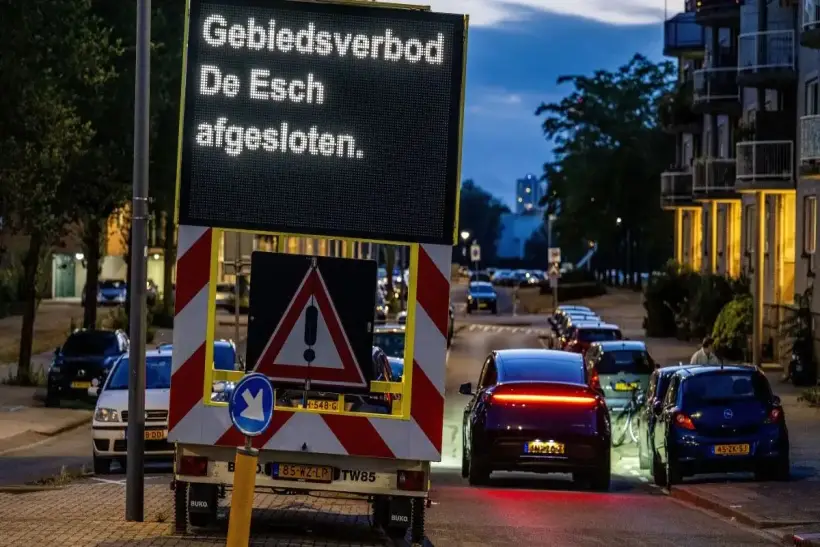
Rotterdam has introduced a temporary night-time presence ban in a designated part of De Esch. Between 11 p.m. and 5 a.m., the public area is open to residents, their guests, workers, customers of local venues and other exempt groups, while people outside those categories may be reported for breaching the municipal order.
The night-time order expires on October 23
The restriction took effect on July 23, 2026, and is scheduled to expire on October 23. It does not cover the whole of Rotterdam or the entire De Esch neighbourhood. The legal order applies to public space within the red boundaries shown on its attached map, including roads and road sections situated along the boundary.
The measure operates daily from 11 p.m. to 5 a.m. It is not a citywide curfew. Residents remain free to use the area, businesses may continue operating and legitimate visitors are covered by exemptions.
Mayor Carola Schouten adopted the measure under Article 2:47a of Rotterdam’s General Municipal By-law, a local legal instrument governing public order, safety and the use of urban space.
The formal decision published in Rotterdam’s Municipal Gazette was adopted on July 16 and published on July 17. It cites years of persistent nuisance and the failure of less restrictive measures to produce a lasting improvement.
The order defines specific exemptions
The ban does not apply to residents of homes inside the designated zone. Their visitors are also exempt, as are people working in the area and those attending restaurants, other hospitality businesses, event venues or sports facilities.
Police officers, municipal supervisors, emergency services and people carrying out necessary work may enter and remain in the area. Article 2:47a also allows the mayor to grant an individual exemption.
The legal text does not contain an unrestricted exemption for any “good reason.” A person must fall within a defined category or hold an individual waiver. News reports using the phrase “without a good reason” simplify the actual structure of the order.
The City of Rotterdam says police may ask people to explain why they are in the zone. The order does not create a pass or advance-registration system and does not expressly require visitors to carry a booking confirmation, invitation or employer’s letter.
Transit through the area is not a formal exemption
Passing through De Esch, returning from work and walking a dog are not separately listed as exemptions in the formal decision. Police have nevertheless said they do not intend to remove ordinary commuters or people walking their dogs.
That statement describes the anticipated enforcement approach but does not alter the legal wording. It would therefore be inaccurate to say that all transit through the zone is automatically permitted.
Visitors should check the mapped boundaries and be prepared to explain their destination and purpose. The order regulates presence in the designated public area, not only entry by car.
Street racing and night-time noise prompted the ban
The city identifies the quay and parking areas at Rhijnspoorkade and Plantagedreef, together with the Kralinger Esch car park, as persistent gathering points. The locations attracted mainly young adults assembling near parked cars and in surrounding public space.
Reported nuisance included vehicle horns, amplified music, excessive exhaust noise, repeated driving circuits and street racing. The official explanation also refers to shouting, large gatherings, litter and the use of nitrous oxide, commonly known as laughing gas.
Authorities say the number of outside visitors increased partly because gathering locations were shared through social media. The area developed from a relatively limited meeting place for vehicles into a recurring destination for large night-time groups.
During an earlier enforcement period, officers turned away between 350 and 400 vehicles and issued at least 85 tickets for speeding, excessively tinted windows, loud exhaust systems, missing seat belts and other traffic offences, according to the Dutch National Police.
The police statement’s estimate of how many people were inside the vehicles is arithmetically inconsistent with its own stated average number of occupants. That estimate should not be used as reliable statistical evidence.
Cameras and barriers failed to end the nuisance
Before introducing the ban, Rotterdam changed the road layout and installed planters, speed humps and other obstacles intended to prevent racing. Cameras, reflective bollards, information boards and access barriers were also deployed.
Plantagelaan was temporarily closed with gates on weekend nights. A permanent barrier was later installed at Rhijnspoorkade. The city also used high-frequency acoustic devices designed to be more audible to younger people.
Police increased visible and covert patrols, conducted vehicle inspections and turned away visitors. Enforcement remained difficult because officers generally had to witness the underlying noise or dangerous behaviour. The nuisance often stopped when a patrol car arrived.
The new measure makes unauthorised presence enforceable in its own right. Officers do not need to prove that every person found in the area personally participated in racing or generated noise.
More than 20 breaches were recorded on the first night
Police recorded more than 20 breaches during the night of July 23–24. It is more precise to describe these as reported violations rather than final fines because the Public Prosecution Service must assess the files and determine the appropriate disposal.
NOS reported noticeably quieter streets during the first night. Residents interviewed by the broadcaster described an absence of the usual shouting, vehicle horns and discarded rubbish. Those early observations do not establish whether the effect will last throughout the three-month period.
A breach is a punishable violation of municipal rules. It does not by itself mean that the person has been accused of street racing, drug dealing, violence or another separate serious offence.
The consolidated Rotterdam General Municipal By-law includes Article 2:47a among provisions carrying a statutory maximum of a second-category fine or detention for up to three months. These are legal ceilings, not the standard penalty for a first breach. Prosecutors or a court determine the actual sanction.
Legal scrutiny centres on proportionality
Michel Vols, professor of public-order law at the University of Groningen, described the measure as highly unusual in the Netherlands. Dutch area exclusions are more commonly imposed on identified individuals following disruptive conduct rather than on everyone outside several defined categories.
The central legal issue is proportionality because the order may affect people who have not personally caused any nuisance. Rotterdam argues that less restrictive tools were exhausted and that the exemptions preserve access for residents, workers, visitors and customers.
The original DutchNews report cited Vols’s view that the measure was unprecedented, but no court has yet ruled that the order is unlawful or disproportionate.
Interested parties may file an objection with the mayor within six weeks. After submitting an objection, they may ask the administrative division of the Rotterdam District Court for interim relief, including temporary suspension. A court fee applies.
The present decision expires on October 23. The municipal rules permit renewals, but each additional period may last no longer than three months and requires a further decision.
As International Investment experts report, a sustained reduction in night-time nuisance could support the residential appeal of De Esch, but several quiet nights do not prove a durable improvement. A credible assessment will require comparable data on complaints, offences, local business footfall, enforcement costs, displacement into neighbouring areas and legal challenges. Broad enforcement without transparent criteria could create legal uncertainty, meaning investors should not treat the initial result as evidence of a long-term increase in the area’s attractiveness.
FAQ: De Esch Night-Time Ban
Is the whole De Esch neighbourhood closed at night?
No. The order applies only to public space inside the boundaries marked on the official map. It does not cover all of De Esch or the wider city.
When does the restriction apply?
It operates daily from 11 p.m. to 5 a.m. The current order runs from July 23 to October 23, 2026.
Can guests visit residents at night?
Yes. Visitors of residents are expressly exempt. Police may ask them to explain the purpose of their presence.
Can people visit restaurants and events?
Yes. Customers of hospitality businesses and visitors to event venues and sports facilities are exempt.
Is transit through the zone automatically permitted?
No separate blanket exemption exists for transit. Police have indicated that ordinary commuting and dog walking are not the intended targets, but enforcement depends on the circumstances.
Has a fixed fine been announced?
No. Police record the violation, while prosecutors or a court determine the actual penalty. No single confirmed amount has been published for the first cases.
Can the order be challenged?
Interested parties may file an objection within the applicable six-week period and subsequently ask the Rotterdam District Court for interim relief.