







 Covivio Hotels Revenue Grows 4.7% as European Markets Split
 Lithuanian Apartment Prices Accelerate Across Major Cities
 Georgia's Tourism Revenue Hits Record High
 Norway's Sovereign Fund Commits €1.5bn to European Warehouses
 Market Rout of October 2026: Can Branded Hotels Protect Capital?
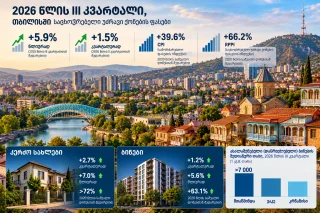 Residential Property Prices in Tbilisi Rise by 5.9% Year-on-Year
French Inflation Accelerates to 3.4%
French inflation accelerated sharply in September 2026. The Harmonised Index of Consumer Prices, used to compare inflation across the European Union, rose 3.4% year on year from 2.6% in August. France's domestic Consumer Price Index increased 3.0%, up from 2.4% a month earlier. Energy remained the main driver, while price growth also strengthened across services and food.
French inflation exceeds expectations
September's inflation increase was stronger than markets had expected. France's domestic Consumer Price Index rose 3.0% year on year, compared with forecasts of around 2.8%. The EU-harmonised measure climbed to 3.4%, its highest level in more than two years. Bloomberg identified surging oil and natural-gas costs as the main force behind the acceleration.
The difference between the two measures is methodological. France's domestic CPI is designed around national household expenditure, while the Harmonised Index of Consumer Prices follows common EU rules for cross-country comparisons. One important distinction concerns healthcare costs: the harmonised measure uses prices net of social-security reimbursements, while the domestic index is based on gross prices.
Final September inflation figures are due on October 15.
Energy prices rise more than 20%
Energy was the main source of the September increase. Prices rose 21.2% year on year, accelerating from 16.7% in August, with petroleum products and natural gas among the key drivers. Services inflation increased to 2.2% from 1.9%, while food inflation rose to 1.5% from 1.1%. Fresh-food prices jumped 9.9%, while manufactured-goods prices remained 0.3% below their level a year earlier.
The picture was already changing rapidly in August. Domestic inflation then stood at 2.4%, while energy prices were 16.7% higher than a year earlier. Energy increased 3.4% in a single month, including a 5.6% rise in petroleum-product prices. France's national statistics institute identified energy as the main reason for the acceleration in headline inflation.
The impact extends beyond household utility bills. Fuel, gas and electricity feed into the costs of transport, manufacturing, retail, hospitality and building operations. The longer energy prices remain elevated, the greater the risk that businesses pass those costs on to other goods and services.
Services and food inflation also strengthen
September's figures show that price pressure is no longer confined to energy. Services inflation rose to 2.2%, while food inflation reached 1.5%. Fresh-food prices were almost 10% higher than a year earlier.
Manufactured goods remained the only major category with declining prices, falling 0.3% year on year after a 0.4% decline in August. Tobacco prices increased 3.3%.
Services are particularly important when assessing the persistence of inflation. Oil and gas prices can move rapidly in either direction, while services are more closely linked to domestic costs such as wages, rents, utilities and business expenses.
A sustained increase in services inflation would therefore represent a more persistent source of price pressure than a temporary jump in fuel prices.
Prices decline from August
The sharp increase in annual inflation came even as consumer prices fell from the previous month. The domestic CPI declined 0.3% after rising 0.7% in August, while the harmonised measure fell 0.4%.
The main explanation was seasonal. Transport and accommodation prices typically decline after the end of the summer tourism period, partly offsetting another increase in energy costs.
The monthly and annual figures therefore measure different developments. The monthly rate compares September with August 2026, while annual inflation compares prices with September 2025, when energy was considerably cheaper.
The next few releases will be important in determining whether September's increase remains largely an energy effect or becomes more persistent. Stabilising oil and gas prices could reduce headline inflation relatively quickly, while broader pass-through into services and food would take longer to unwind.
Inflation has accelerated since early summer
September extended a trend that began during the summer. Domestic inflation increased from 1.8% in June to 2.1% in July, 2.4% in August and 3.0% in September.
The harmonised rate stood at 2.0% in June and 2.4% in July before accelerating further in August and September. The change is particularly striking compared with 2025, when France spent part of the year among the euro-area economies with the weakest inflation.
The wider currency union is also experiencing stronger price growth. Eurostat's final August figures put euro-area inflation at 3.2%, up from 2.9% in July and 2.0% a year earlier. Energy prices increased 14.3%, while services rose 3.0%. Services contributed 1.43 percentage points to headline inflation and energy another 1.29 points.
The September euro-area estimate will indicate how closely France's latest increase reflects the trend across other major economies in the currency bloc.
Banque de France expects inflation to ease
Banque de France expects harmonised inflation to average 2.3% in 2026, compared with 0.9% in 2025. It projects a decline to 1.9% in 2027 and 1.6% in 2028. The central bank identifies energy, including oil, gas and unusually high refining margins, as the main source of current price pressure. Inflation excluding energy and food is projected at 1.6% this year before rising to 2.3% in 2027 as earlier energy increases feed through into other prices.
This pass-through is one of the main risks to the outlook. Persistently expensive energy raises the cost of transport, manufacturing, storage, heating and other business operations, some of which can eventually be transferred to consumers.
Weather conditions are adding pressure to parts of the food sector. French statisticians estimate that the 2026 summer heatwaves could reduce annual economic growth by around 0.1 percentage point, mainly through lower agricultural output, while putting upward pressure on some vegetable prices.
ECB has already raised interest rates
The French inflation increase follows another tightening of euro-area monetary policy. The European Central Bank raised all three key interest rates by 25 basis points on September 10. From September 16, the deposit facility rate stands at 2.50%, the main refinancing rate at 2.65% and the marginal lending rate at 2.90%.
The ECB expects headline euro-area inflation to average 3.0% in 2026, 2.5% in 2027 and 2.1% in 2028. It continues to target 2% inflation over the medium term and says future rate decisions will remain data-dependent rather than following a predetermined path.
French inflation alone will not determine ECB policy, which is set for the euro area as a whole. France is nevertheless the currency union's second-largest economy, making such a sharp acceleration an important part of the wider inflation outlook.
French economic growth remains weak
The rise in prices comes against a subdued economic backdrop. French gross domestic product was unchanged quarter on quarter in the second quarter of 2026 after contracting 0.2% in the first three months of the year. Unemployment stood at 8.3% in the second quarter, household confidence was at 86 in September and the overall business-climate indicator was 96.
The central bank expects the French economy to grow by only 0.4% in 2026, followed by 0.9% in 2027 and 1.2% in 2028. Private investment is expected to remain constrained by tighter financing conditions and uncertainty surrounding fiscal policy.
France is therefore entering the final months of the year with weak economic momentum and stronger inflation. For households, this creates renewed pressure on purchasing power. For businesses, costs are rising while borrowing remains expensive.
Expensive financing weighs on property
For real estate, one of the most important effects of higher inflation is the cost of borrowing. The longer price growth remains above the ECB's 2% target, the greater the risk that financing costs stay elevated.
For homebuyers, this means more expensive mortgages and reduced borrowing capacity. Developers face high construction and refinancing costs. In commercial property, rising bond yields can push investors to demand higher returns from real-estate assets.
Energy adds another source of pressure through building operating costs. Older and less energy-efficient properties are particularly exposed because rising heating and electricity costs widen the expense gap between modern buildings and ageing stock.
As International Investment experts note, the September figures do not yet indicate broad overheating in the French economy: energy remains the main source of the acceleration and consumer prices actually declined from August. The greater risk is that higher oil and gas costs continue spreading into services and food. If that process becomes entrenched, borrowing costs could stay elevated for longer, limiting the recovery in real-estate transactions and keeping pressure on property valuations and investment returns.
FAQ
What was France's inflation rate in September 2026?
France's domestic Consumer Price Index increased 3.0% year on year, while the EU-harmonised measure reached 3.4%. The figures are preliminary.
Why did French inflation accelerate?
Energy was the main driver, with prices rising 21.2% from a year earlier. Services and food inflation also increased.
How much did food prices rise?
Overall food inflation reached 1.5%, while fresh-food prices increased 9.9% year on year.
Why did monthly prices fall while annual inflation increased?
Transport and accommodation prices declined after the summer tourism season. Annual inflation still increased because September 2026 was compared with September 2025, when energy prices were substantially lower.
What is the difference between the 3.0% and 3.4% rates?
The 3.0% figure is France's domestic CPI. The 3.4% figure is the Harmonised Index of Consumer Prices calculated under common EU methodology.
How does inflation affect French real estate?
Persistent inflation can keep borrowing costs elevated, increasing mortgage, development and refinancing expenses while pushing investors to demand higher property yields.
When will the final figures be published?
Final French inflation data for September 2026 are scheduled for October 15.