







 Alta Banka Collapse in Serbia: What Happens to Russian Depositors' Money
 Covivio Hotels Revenue Grows 4.7% as European Markets Split
 Lithuanian Apartment Prices Accelerate Across Major Cities
 Georgia's Tourism Revenue Hits Record High
 Norway's Sovereign Fund Commits €1.5bn to European Warehouses
 Market Rout of October 2026: Can Branded Hotels Protect Capital?
Georgia’s GDP in 2026: Growth Forecast Raised to 6.8%
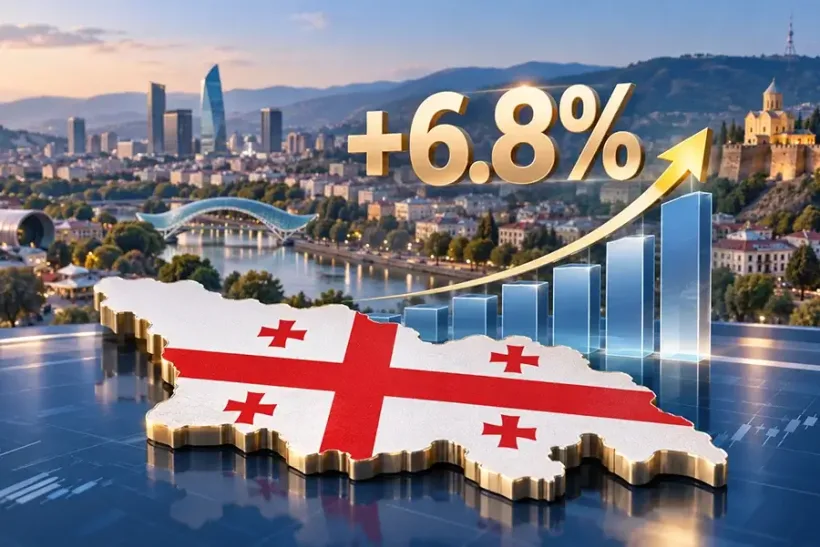
The Georgian government has raised its GDP growth forecast for 2026 to 6.8%. International financial institutions also expect the country’s economy to expand at a strong pace. The World Bank has issued the most optimistic projection, raising its previous estimate by two percentage points to 7%.
Georgia’s Economy in 2026
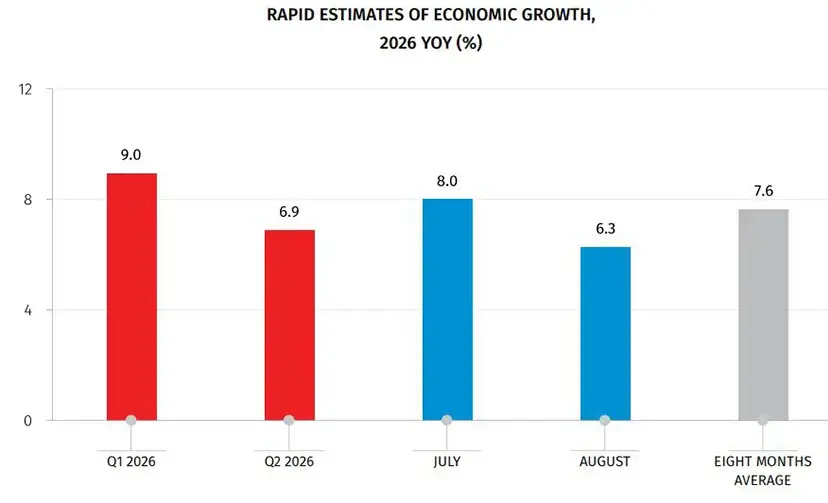
Georgia’s economy grew by 7.6% in January–August 2026 compared with the same period in 2025. Real GDP increased by 9% in the first quarter and 6.9% in the second. Growth reached 8% in July before slowing to 6.3% in August, according to the National Statistics Office of Georgia (Geostat).
The main contributors to growth in August were manufacturing, information and communication technologies, financial and insurance activities, trade, transportation, warehousing, and real estate activities. Construction, however, recorded a decline in activity.
Georgia’s foreign trade turnover reached $17.93 billion in the first eight months of the year (+8.4%). Merchandise exports rose to $5.42 billion (+22.1%), while imports increased to $12.5 billion (+3.4%). Consumer prices in August were 5.6% higher than a year earlier and rose by 0.4% compared with July. Industrial producer prices increased by 5.8% annually and 0.9% monthly.
Turnover among VAT-paying enterprises reached ₾16.86 billion in August (+12.1%). A total of 6,261 new businesses were registered (+35.1%). For comparison, VAT-paying enterprises recorded turnover growth of 5.9% in January, 13.4% in March, and 14% in June.
Georgia’s Economic Forecasts for 2026–2027
Strong economic performance has enabled the government to raise its GDP growth forecast for Georgia to 6.8% for 2026. First Deputy Finance Minister Giorgi Kakauridze considers this estimate realistic and believes the actual year-end result could be even higher. The government will use the 6.8% projection when preparing next year’s state budget, according to Georgia’s First Channel.
For 2027, the Ministry of Finance expects Georgia’s real GDP to grow by 5%. Nominal economic output is projected to increase by 8.9% and exceed ₾126 billion. Inflation is expected to reach 3% by the end of the year, while the budget deficit is projected at 2.5% of GDP and public debt at 31.6%.
Consolidated budget revenues are planned at ₾37.53 billion, with expenditures reaching ₾37.56 billion. Compared with the expected results for 2026, revenues will increase by ₾1.53 billion and spending by ₾1.93 billion. Tax revenues are projected at ₾29.52 billion.
Shota Berekashvili, Chairman of the Georgian Parliament’s Economic Policy Committee, noted that spending on healthcare and social programs will increase by ₾830 million in 2027. Of this amount, ₾555 million will be allocated to higher pension payments.
International GDP Growth Forecasts for Georgia
In October, the World Bank raised its GDP growth forecast for Georgia from 5% to 7% for 2026. The institution expects the economy to expand by 5.5% in 2027 and 5% in 2028. Georgia is among the countries with the highest projected growth rates in the Europe and Central Asia region. By comparison, Armenia’s GDP is expected to grow by 6.3% in 2026, Kazakhstan’s by 4.6%, and Türkiye’s by 2.8%. Regional growth overall is projected at 2.2%, down from 2.6% in 2025. Analysts identify high energy prices, weaker demand from trading partners, and global economic uncertainty as the main constraints.
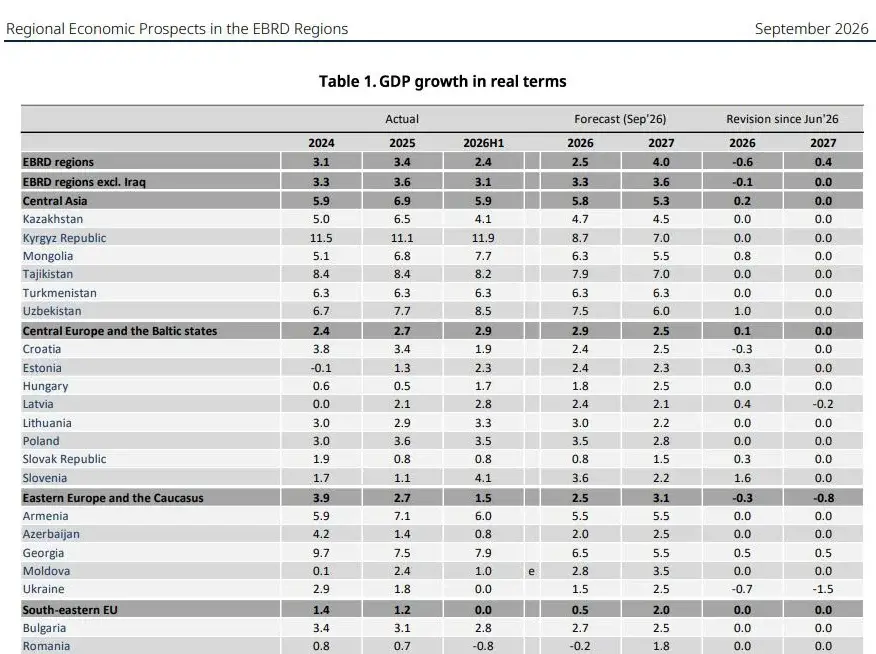
In September, the European Bank for Reconstruction and Development (EBRD) revised its economic growth forecast for Georgia from 6% to 6.5% for 2026 and from 5% to 5.5% for 2027. Analysts highlight resilient domestic demand, supported by rising wages and lending, as well as the expansion of the services sector. Tourism remains an important part of the economy: in 2025, revenues from international visitors were equivalent to 12.3% of the country’s GDP. The EBRD also identifies major projects in real estate, transport infrastructure, and renewable energy as promising areas for further development.
In June, the International Monetary Fund (IMF) raised its growth forecast for Georgia from 5.3% to 6.5% for 2026. The organization expects the economy to expand by 5.7% in 2027 and 5% in 2028. The IMF highlights the development of information technology, transportation, and education services, alongside resilient domestic demand.
What Georgia’s GDP Growth Means for Investors
International Investment analysts note that Georgia’s GDP growth has repeatedly exceeded the initial forecasts of international financial institutions in recent years. The country’s economy has expanded faster than expected by experts at banks and investment funds, which traditionally adopt cautious projections. Given this trend, the slowdown anticipated for 2027 may be less pronounced than current estimates suggest.
Strong business activity and the Georgian market’s resilience to external challenges create favorable conditions for long-term projects. Positive economic trends strengthen investor confidence, encourage business expansion, and support further inflows of foreign capital.
The tourism industry offers particularly attractive opportunities, especially in hospitality and resort real estate. Growing interest from international operators in Georgia is encouraging the development of modern hotels, branded residences, and mixed-use complexes. Such properties appeal to foreign buyers seeking potentially higher returns through professional management.