







 China Nears a Decision on Fresh Stimulus
 Fines for Illegal Rentals in Spain Reach €800,000
 Australia’s Spring Auctions Rise but Remain Well Below 2025
 Number of Foreigners Holding Turkish Residence Permits Exceeds 1.27 Million
 Demand from Russian Tourists for Holidays in Georgia Rises by 20–25%
 Montenegro Property Buying Costs in 2026
Italy Rations Jet Fuel at Some Airports
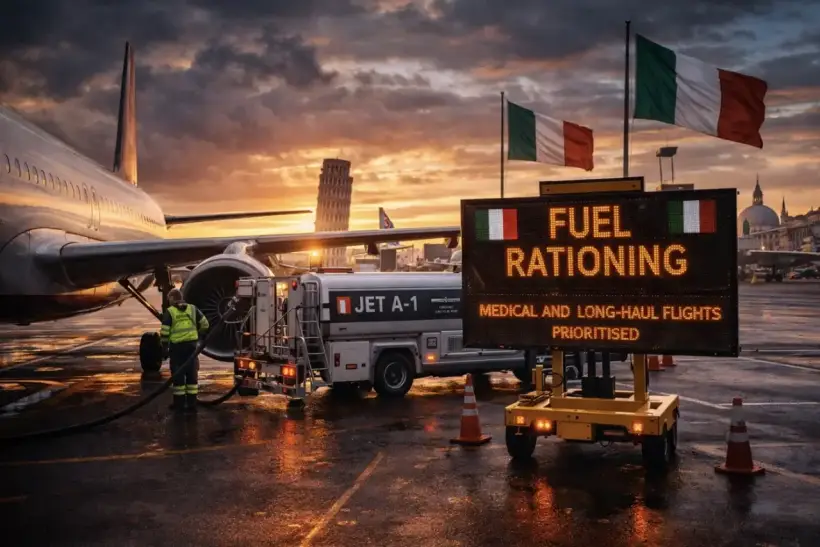
Italy is imposing temporary jet fuel limits at several airports
Italy has begun imposing temporary limits on aircraft refuelling at several airports after localized disruptions in jet fuel supply. According to the Wall Street Journal and Bloomberg-linked reporting, the restrictions affected at least Bologna, Treviso and Venice, while Milan Linate was also discussed as a possible risk point. The temporary regime was expected to last through Thursday, with priority given to medical flights and flights longer than three hours.
The move is one of the clearest signs yet that the Middle East energy crisis is starting to move from a price problem into a physical aviation logistics issue in Europe. As recently as March 31, Bloomberg reported that Europe still had enough jet fuel to avoid outright shortages in April, but warned that the market could tighten far more seriously in May as stocks are drawn down and imports slow.
Which Italian airports are under pressure
The limits do not appear to reflect a nationwide shutdown, but rather pressure at specific airports where supply chains proved more exposed. The Wall Street Journal pointed to Bologna, Treviso and Venice, and said Milan Linate could also face constraints. That suggests Italy is dealing with localized fuel logistics stress rather than a general aviation-fuel collapse across the country.
Italian aviation authorities have tried to prevent the impression of a systemic national shortage. According to the Journal, ENAC President Pierluigi Di Palma said there are no general jet fuel issues in Italy. SAVE, which manages Venice and Treviso among other airports, also said the issue concerns one supplier only and that alternative suppliers remain available.
The trigger is larger than Italy and tied to Hormuz disruption
The Italian restrictions have emerged against a broader reshaping of Europe’s jet fuel market after Middle East supply disruptions. The Wall Street Journal linked the localized limits to reduced supply from a BP subsidiary, but the wider backdrop is the disruption of flows through the Strait of Hormuz. Bloomberg and IATA have both highlighted that Europe remains vulnerable because a significant share of jet fuel depends on imported logistics rather than only domestic refining.
Bloomberg reported in early March that jet fuel prices were surging worldwide amid the Iran war, with European prices reaching their highest level since 2022. In a later piece, the agency said Europe could still avoid outright shortages in April, but that May looked more dangerous if disrupted flows continued. Italy therefore appears less as an isolated exception than as one of the first European markets where the broader risk is already becoming operational.
Why Europe is structurally exposed to jet fuel stress
Europe’s jet fuel market has become more fragile in recent years because it relies more heavily on imports while losing part of its own refining base. IATA says Europe’s supply resilience has weakened as imported fuel increasingly compensates for regional shortfalls. That leaves the continent more exposed to external shipping shocks and disruptions in third-country supply routes.
The current problem is therefore not just price. Airlines have already been warning that the main danger is not only more expensive fuel, but the possibility that fuel may be unavailable at specific airports or in specific countries. The Guardian, citing Ryanair chief Michael O’Leary, reported that jet fuel in Europe had already more than doubled from a year earlier and that summer schedules could come under pressure if the conflict drags on.
Italy’s measures show the market shifting from price shock to prioritisation
The form of the restrictions matters. Giving priority to medical flights and long-haul services means airport operators and suppliers have already moved into an internal allocation mode for a scarce resource. That is typical of the early phase of a supply crisis, when authorities and infrastructure operators try not to halt the market entirely, but to protect the most critical traffic first.
There is still no evidence of a nationwide wave of flight cancellations across Italy caused specifically by fuel shortages. But the need to ration jet fuel at individual airports shows that the supply chain is already operating under stress. For aviation, that matters because even localized constraints at a few airports can quickly affect schedules, aircraft rotations and airline operating decisions.
What this means for airlines and passengers in Europe
For airlines, the situation creates two overlapping risks. The first is continued jet fuel inflation, which is already weighing on margins and cost volatility. The second is the possibility of localized supply disruptions at specific bases, where the issue becomes availability rather than price. Bloomberg has already reported that European carriers are only partially hedged against the current fuel surge, leaving profitability and the summer schedule vulnerable if the crisis lasts.
For passengers, this does not yet mean a Europe-wide aviation breakdown. It does, however, increase the likelihood of localized delays, altered fuelling strategies, rerouted operations and eventually more expensive tickets if the market reaches May without restored supply flows. That is the logic that links Bloomberg’s late-March assessment of “enough for April” with the early-April restrictions now visible at Italian airports.
As International Investment experts report, Italy’s jet fuel limits matter not only as a local story for a handful of airports. They are one of the first concrete European signs that the Middle East energy crisis is moving from a pricing phase into an operational phase. If disrupted imports persist, Europe’s aviation market may soon face not just expensive fuel, but harder allocation choices across airports, airlines and flight categories.
FAQ
Which Italian airports were affected by the jet fuel limits?
Reporting on April 5 pointed to Bologna, Treviso and Venice, with Milan Linate also mentioned as a possible risk location.
Which flights are being prioritised?
Medical flights and flights longer than three hours were given priority access to available fuel.
Is Italy facing a nationwide jet fuel shortage?
ENAC President Pierluigi Di Palma said there is no general fuel problem across Italy, and authorities described the issue as localized and tied to one supplier.
Why is Europe vulnerable to jet fuel shortages?
Because its supply resilience has weakened as import dependence has increased and parts of the refining base have been lost, leaving it more exposed to external shocks.
When could the broader European risk worsen?
Bloomberg reported that April may still be manageable, but the tighter effects are more likely to become visible in May if supply disruptions continue.