







 Vietnam Mortgage Surge Pushes Homes Out of Reach
 Lithuanian Apartment Prices Accelerate Across Major Cities
 London Flats Lose Value Ahead of Leasehold Reform
 Construction of the Batumi–Sarpi Highway Begins in Georgia
 Baltic Property Investment Accelerates in 2026
 Hong Kong and Singapore Renew Their Expat Rivalry

ETIAS.com
Germany does not have a dedicated digital nomad visa. However, foreigners working remotely can obtain a residence permit on several other grounds. Depending on their employment status, permits are available for freelancers, entrepreneurs, and some employees of foreign companies, according to ETIAS.com.
German Residence Permits for Remote Workers
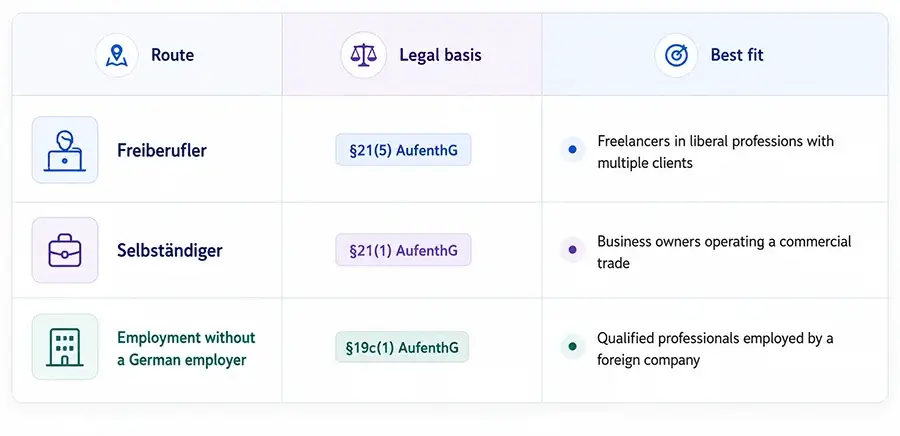
The type of residence permit depends on the nature of employment. Germany provides separate routes for liberal professionals, entrepreneurs, and some employees of foreign companies. The chosen category determines the document requirements, application procedure, and tax obligations.
Residence permit for liberal professions (Freiberufler) is provided under Section 21(5) of the Residence Act. It is suitable for journalists, translators, designers, architects, engineers, IT consultants, doctors, lawyers, and creative professionals. Immigration authorities generally expect applicants to work with several clients. Ongoing cooperation with only one client may raise concerns about bogus self-employment. The permit is initially issued for up to three years, although some authorities may grant it for a shorter period. Actual income and business performance are taken into account upon renewal.
Residence permit for self-employment (Selbständiger) is provided under Section 21(1). It is intended for owners of commercial businesses, such as agencies, online stores, retail shops, and restaurants. Authorities assess financing, the business plan, the project’s prospects, its economic value, and its impact on the local market. Chambers of commerce may also be involved in the assessment in some cases. Entrepreneurs may also be subject to trade tax, while many liberal professionals are exempt. The final tax classification is determined by the tax office (Finanzamt).
Residence permit for employees of foreign companies may in some cases be issued under Section 19c(1). It is intended for qualified professionals who live in Germany but remain employed by a foreign company. How this provision is applied varies between immigration offices, particularly where the work has no connection to the German labor market.
EU Blue Card is available to qualified professionals hired by an employer in Germany, provided they meet the established requirements.
Opportunity Card (Chancenkarte) allows qualified foreigners to come to Germany to look for work.
General Requirements for German Residence Permit Applicants
To obtain one of the relevant residence permits, applicants must prove that they can support themselves through their own work without relying on state assistance. They must also have health insurance valid in Germany and compliant with local requirements. Travel insurance and some short-term expat policies may not be accepted.
Professional qualification requirements depend on the field of activity. Designers, writers, and creative professionals may prove their experience through portfolios and client history, while engineers and IT specialists may need degrees or professional certificates. Regulated professions, including medicine, law, dentistry, pharmacy, architecture, and psychotherapy, require prior recognition of foreign qualifications. This is a separate procedure and may take several months.
Applicants aged 45 and over may also be required to prove adequate retirement provision. Pension savings, property, investments, and other assets may be accepted as evidence.
German language skills are generally not mandatory for obtaining a residence permit. However, some immigration offices conduct appointments only in German, so applicants may need an interpreter or German-speaking companion. Language becomes more important later: B1 German is required for permanent residence under the general procedure.
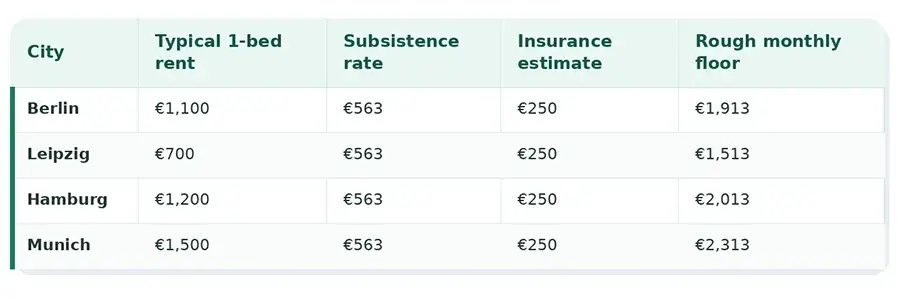
Nationality primarily affects the application procedure. Citizens of the United States, the United Kingdom, Canada, Australia, New Zealand, Japan, South Korea, and Israel can enter Germany without a national visa and apply for a residence permit after arrival. Special conditions apply to citizens of Brazil, El Salvador, Honduras, and certain other countries. Most other non-EU nationals must first obtain a national visa from a German consulate.
An applicant’s immigration history is also taken into account. Previous Schengen overstays, visa refusals, or entry bans may affect the decision, so such circumstances should be disclosed and, where necessary, explained.
How Much Freelancers Need to Earn in Germany
There is no fixed minimum income requirement for a residence permit for a liberal profession (Freiberufler). Applicants must demonstrate that their earnings are sufficient to cover housing, health insurance, and other expenses without state assistance.
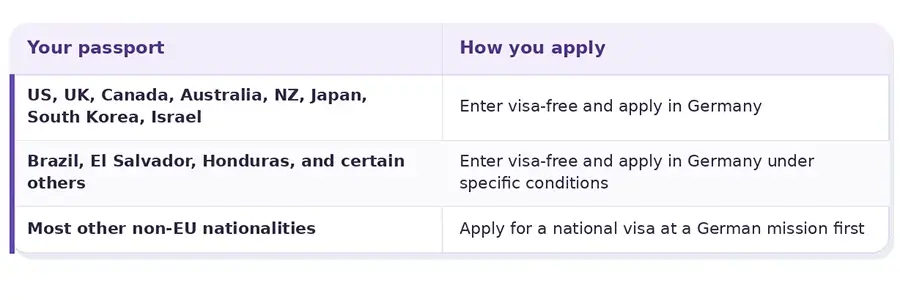
In Berlin, the basic subsistence benchmark is around €563 per month. Rent and insurance costs are added to this amount. For example, with monthly rent of €900 and health insurance costing €250, an applicant would need around €1,700 in net monthly income. There is no single official threshold, however, as each applicant’s financial position is assessed individually.
Applicants commonly demonstrate monthly income of between €1,000 and €2,500, depending on the city and their expenses. Taking into account rent for a one-bedroom apartment, insurance, and basic living costs, the approximate required amount is around €1,913 in Berlin, €1,513 in Leipzig, €2,013 in Hamburg, and €2,313 in Munich.
Financial stability can be demonstrated through bank statements covering the previous three to six months, contracts, and client agreements. If there is no stable income history, one option may be a blocked account (Sperrkonto) funded with €12,000–14,000 for one year. The money is then released in monthly installments. In some cases, a formal financial guarantee from a person living in Germany may also be accepted.
Applicants over 45 must additionally prove adequate retirement provision. Pension savings, real estate, investments, and other assets may be used as evidence.
Documents for Liberal Professional Activity
To obtain Freiberufler status, applicants need a passport valid for at least 12 months, two biometric photographs, and a completed application form. They also need health insurance valid in Germany, a CV, degrees, certificates, or a portfolio demonstrating professional experience.
Those applying from within Germany will need local registration (Anmeldung), as well as a rental agreement or confirmation from the property owner. Financial stability is demonstrated through bank statements covering the previous three to six months.
The application package also includes documents relating to future activity:
- business plan;
- income and expense forecast;
- capital requirement plan;
- letters from prospective clients.
Documents issued outside Germany may require certified German translations. The publication estimates the cost at around €40–80 per page.
Business Plan and Proof of Clients
The business plan should explain what the applicant intends to do, who will pay for the services, and how sustainable the income is expected to be over the next two to three years. It usually includes an income and expense forecast (Ertragsvorschau) and a capital requirement plan (Kapitalbedarfsplan).
The calculations should include expected client revenue, professional expenses, housing costs, health insurance, and estimated taxes. All figures should be consistent with the rest of the application. For example, if projected income is €3,200 per month but bank statements show receipts of around €1,900, the applicant will need to explain the difference.
Letters of intent (Absichtserklärung) from clients provide additional evidence of future work. They are generally not binding contracts but demonstrate the client’s intention to cooperate after the residence permit is issued. In Berlin, applicants are usually expected to provide at least two such letters.
The document should specify the nature of the work, expected duration or volume of cooperation, approximate remuneration, and the client’s signature and contact details. For a Freiberufler residence permit, clients may also be based outside Germany.
How to Apply for a German Residence Permit
The application procedure depends on the applicant’s nationality. Foreigners eligible for visa-free entry can complete the process after arriving in Germany. Most other nationals must first apply for a national category D visa through a German consulate.
When applying from inside Germany, applicants first need to secure accommodation and obtain confirmation from the landlord, then register their place of residence (Anmeldung). A tax identification number is issued after registration, usually within two to three weeks. The applicant then applies to the local immigration office (Ausländerbehörde), submits the documents, and pays the fee.
Applicants are advised to book an appointment as early as possible, as waiting times vary significantly by city and may extend for several months. If an application is submitted before the end of the permitted stay, a temporary certificate of legal residence (Fiktionsbescheinigung) may be issued, allowing the applicant to remain in Germany until a decision is made.
In Berlin, a significant share of applications for a residence permit for liberal professional activity are submitted through the immigration authority’s online portal, where documents are uploaded digitally.
Those who need a visa before traveling must complete the VIDEX application form, book an appointment at a German consulate, and submit the required documents. Processing may take several months because applications can be forwarded to the immigration office in the German city where the applicant plans to live.
Once the national visa has been issued, the applicant can enter Germany and begin the permitted activity, then obtain a residence permit through the local Ausländerbehörde. Some citizens of visa-exempt countries also choose to apply through a consulate in advance to obtain greater certainty before relocating.
Costs and Processing Times
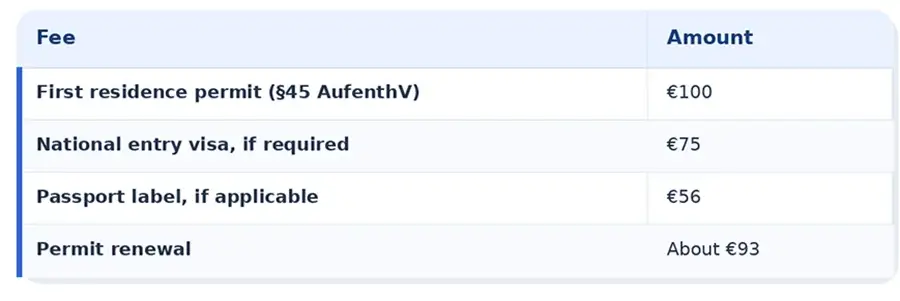
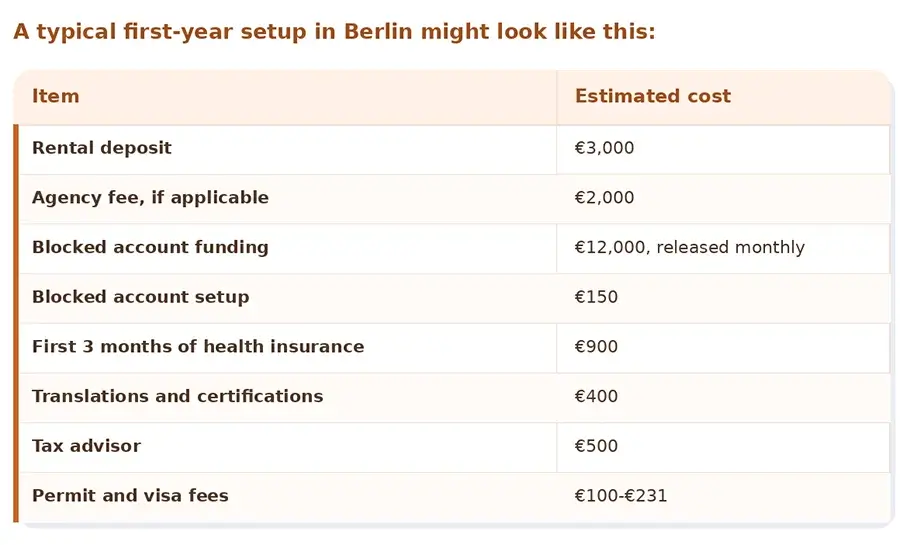
The fee for an initial residence permit is around €100. If a national category D visa is required before entry, an additional €75 is charged. Renewal costs approximately €93.
The main expenses are related not to government fees but to relocation and document preparation. Certified translations may cost €40–80 per page, opening a blocked account (Sperrkonto) around €150, and the services of a tax adviser several hundred euros. Housing is another major expense: landlords may require a deposit of up to three months’ rent excluding utilities.
Health insurance also requires a separate budget. Private coverage for a healthy person aged around 30–39 may cost approximately €250–450 per month. Public insurance for self-employed people may be more expensive in some cases.
For the first year, the publication recommends budgeting around €12,000–16,000. Part of this amount, however, may be held in a blocked account and gradually used for living expenses.
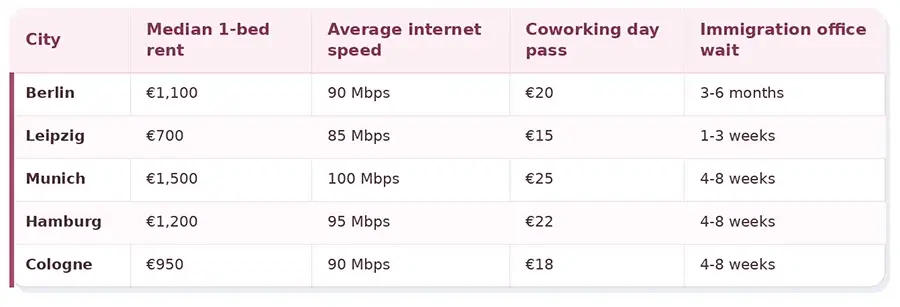
Processing times vary significantly by city. In Berlin, the wait for an appointment may take three to six months, followed by another six to ten weeks for processing. In Munich, Hamburg, and Frankfurt, both stages generally take around four to eight weeks. Leipzig is considerably faster, with around one to three weeks for an appointment and roughly the same period for processing.
Applications submitted through a consulate are generally processed within six to twelve weeks after submission, excluding the wait for an appointment. The procedure may take longer if authorities request additional information or refer the application to another agency.
After approval, the electronic residence permit card usually takes another four to six weeks to produce and must be collected in person.
Taxes and Registration in Germany
Moving to Germany may create an obligation to declare income, including earnings from foreign clients. Tax residency usually arises after 183 days of presence in the country during a calendar year, but it may begin earlier if Germany becomes the person’s permanent place of residence.
After registration, applicants must complete the tax registration questionnaire (Fragebogen zur steuerlichen Erfassung) through the electronic portal ELSTER. The tax office (Finanzamt) then issues a tax number. This usually takes two to six weeks.
Freelancers are subject to progressive income tax. The rate can reach 42%, and 45% for very high incomes. A solidarity surcharge may also apply in some cases. Members of certain officially recognized religious communities may additionally pay church tax of around 8–9% of their income tax liability.
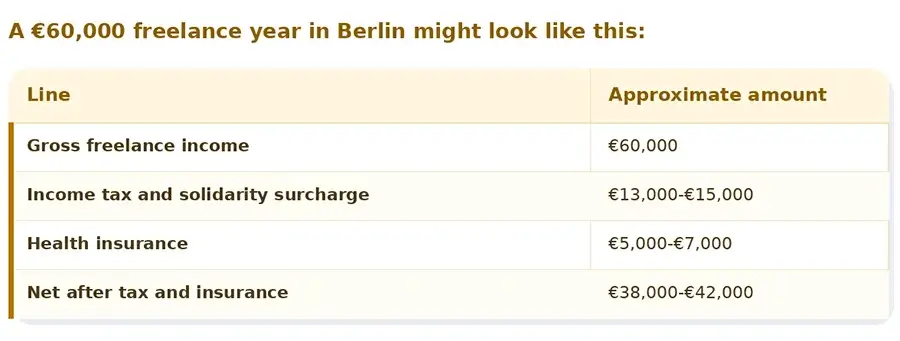
With annual income of €60,000, income tax and the solidarity surcharge may amount to approximately €13,000–15,000, while health insurance may cost another €5,000–7,000. This leaves an estimated €38,000–42,000 after these payments.
Liberal professionals holding a Freiberufler residence permit are generally exempt from trade tax (Gewerbesteuer). Business owners classified as Selbständiger may be required to pay it, with rates depending on the municipality.
Germany’s standard VAT rate is 19%. Reverse charge may apply when services are provided to companies in other EU countries, while services supplied to many clients outside the European Union are invoiced without German VAT. The small business regime (Kleinunternehmer) allows eligible businesses not to charge VAT to clients.
Health insurance remains mandatory throughout the entire period of residence. Freelancers may use private insurance or, where eligible, voluntary public health insurance. Public insurance contributions are primarily based on income, while private premiums depend on age, health status, and the level of coverage.
Where It Is Easier to Obtain a German Residence Permit
The choice of city affects not only living costs but also the speed of document processing. Applications are handled by the immigration office (Ausländerbehörde) responsible for the applicant’s registered address, so waiting times can vary considerably.
Berlin remains Germany’s largest hub for freelancers and remote professionals due to its international environment and large pool of potential clients. However, rents are relatively high, and waiting for an immigration appointment may take three to six months. The average rent for a one-bedroom apartment is estimated at around €1,100 per month.
Leipzig is considerably cheaper: a similar apartment costs around €700, while the wait for an appointment may be only one to three weeks. The city also attracts creative professionals and freelancers who find Berlin increasingly expensive.
In Munich, a one-bedroom apartment costs around €1,500 per month. At the same time, the city offers more opportunities in technology, engineering, and consulting. In Hamburg, comparable housing costs around €1,200, and the local market is particularly attractive to professionals in media, advertising, and publishing.
Cologne is a more affordable alternative, with rents of around €950 per month and a strong media sector. It also offers convenient access to clients in nearby Düsseldorf.
Moving to another city after obtaining a residence permit is possible. The holder must register the new address (Anmeldung) and notify the relevant immigration authority.
Renewing a German Residence Permit
When considering a renewal, authorities assess how actual results compare with the forecasts submitted with the original application. Particular attention is paid to actual income, the sustainability of professional activity, and the applicant’s ability to support themselves without state assistance.
Applicants will need a tax assessment notice (Steuerbescheid), recent bank statements, current client contracts, invoices for completed work, and proof of health insurance. If income is lower than initially projected, this does not automatically result in refusal, but the applicant will need to explain the decline and provide a realistic financial plan for the next period.
Applications should be submitted two to three months before the permit expires. Timely filing generally allows the applicant to maintain legal status while the renewal is being processed.
Permanent Residence and German Citizenship
The timeline for obtaining permanent residence (Niederlassungserlaubnis) depends on the category of the original permit. Holders of a residence permit for self-employment (Selbständiger) may qualify for permanent status after only three years if the business is successful and provides sufficient income for the applicant and their family.
For holders of a residence permit for liberal professional activity (Freiberufler), the general five-year period applies. Applicants generally need to demonstrate stable income, adequate housing, retirement provision, and B1-level German. Under the general procedure, pension contributions are also taken into account, usually requiring 60 months of qualifying contributions.
Freelancers with private health insurance should plan for retirement provision in advance. Evidence may include voluntary contributions to the German Pension Insurance system (Deutsche Rentenversicherung) or suitable private pension arrangements.
German citizenship can generally be obtained after five years of lawful residence. The accelerated three-year naturalization route for exceptional integration achievements was abolished in October 2025. Separate rules remain for spouses and registered partners of German citizens, who may in some cases apply after three years.
Naturalization generally requires B1-level German, passing the citizenship test, financial self-sufficiency, and no serious criminal convictions. Germany allows dual citizenship.
Residence permit holders may also bring family members to Germany. A spouse who joins through family reunification generally has the right to take up employment or self-employment. Dependents, however, increase the income, health insurance, and housing requirements.
Why a German Residence Permit May Be Refused
One of the most common problems is choosing the wrong permit category. If an applicant applies as Freiberufler but the tax office (Finanzamt) classifies the activity as commercial, this can create a discrepancy between immigration and tax status. Applicants are therefore advised to determine the correct professional classification before filing.
Applications may also be refused because of insufficient or unstable income. Financial projections should be supported by bank statements, contracts, and other documents, and applicants are advised to show a financial buffer above their minimum expenses.
Another risk is a business plan that is too vague or internally inconsistent. It should identify clients, expected income, and expenses, while the figures should match bank statements and letters of intent.
Letters of intent (Absichtserklärung) may also cause problems. They should specify the type of work, expected volume of cooperation, approximate remuneration, as well as the client’s contact details and signature. Generic, identical letters without specific information are less convincing.
Health insurance is another key issue. Travel or short-term insurance may not meet residence permit requirements, so applicants should obtain confirmation from the insurer in advance that the coverage is suitable for long-term residence in Germany.
Timing also matters. Applying after the permitted period of stay has expired may complicate the procedure. If a residence permit is refused, the decision should be reviewed carefully: in some cases it may be easier to correct the deficiencies and submit a new application, while disputed legal issues may require advice from an immigration lawyer. Appeal deadlines may be short.
Conclusion
Analysts at International Investment note that Germany does not offer a dedicated digital nomad visa, so the appropriate status depends on the nature of employment. Freiberufler remains the main option for independent professionals, Selbständiger for business owners, while employment by a foreign company requires a separate assessment.
Germany retains one of the fastest routes to citizenship in Europe: applicants may qualify for a passport after five years of lawful residence. Portugal, which previously had the same five-year period, increased it to ten years for most foreigners in 2026.
The migration policy of Friedrich Merz’s government is developing in two directions. The authorities are tightening controls on irregular migration and revising approaches to asylum and naturalization, while at the same time seeking to attract more qualified workers.
Labor shortages across many sectors will continue to push Germany to recruit professionals from abroad. For foreigners in high-demand occupations, this may lead to simpler and faster procedures for relocation and employment.