







 Covivio Hotels Revenue Grows 4.7% as European Markets Split
 Lithuanian Apartment Prices Accelerate Across Major Cities
 Georgia's Tourism Revenue Hits Record High
 Norway's Sovereign Fund Commits €1.5bn to European Warehouses
 Market Rout of October 2026: Can Branded Hotels Protect Capital?
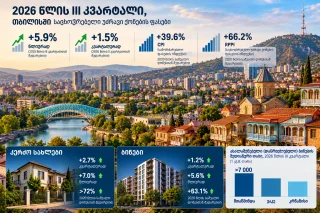 Residential Property Prices in Tbilisi Rise by 5.9% Year-on-Year
Montenegro Tourism Grows Nearly 8%

Montenegro recorded 1,617,563 tourist arrivals in the first seven months of 2026, an increase of 7.78% from a year earlier. Overnight stays rose 7.98% to 8,855,238. July was particularly strong, with 623,104 arrivals and 3,717,441 overnight stays, up 11.26% and 10.13% respectively from July 2025. Montenegro's Ministry of Tourism published the figures based on data from statistical agency MONSTAT.
July Accelerates Montenegro's Tourism Growth
Between January and July, Montenegro registered about 1.62 million tourist arrivals and almost 8.86 million overnight stays. Vijesti highlighted that cumulative growth in both indicators had approached 8% by the end of July.
July alone generated about 38.5% of all arrivals and 42% of overnight stays recorded during the first seven months. Average length of stay was approximately 5.5 nights per registered arrival between January and July and close to six nights in July.
Foreign tourism expanded particularly quickly. International visitors generated 600,852 arrivals in July, 11.94% more than a year earlier, and 3,613,647 overnight stays, an increase of 10.59%. Foreigners therefore accounted for approximately 96.4% of July arrivals and 97.2% of overnight stays.
July Lifted a More Moderate First-Half Result
Growth accelerated during the peak summer season. Montenegro recorded 994,459 tourist arrivals and more than 5.1 million overnight stays during the first six months of 2026. At that stage, arrivals were up 5.7% year on year and overnight stays 6.5%. After July was included, cumulative growth increased to 7.78% and 7.98%, respectively.
July alone added more than 623,000 arrivals and about 3.72 million overnight stays to the first-half figures.
The shift illustrates the extreme seasonality of Montenegro's tourism economy. A single peak month can materially change year-to-date performance, while autumn and winter carry much less weight in the annual total.
Private Accommodation Accounts for Much of the Market
The Ministry's overall figures are substantially higher than MONSTAT's separate monthly data for collective accommodation.
Hotels, holiday facilities, boarding houses, motels, tourist resorts, hostels and similar establishments recorded 244,754 arrivals and 1,081,249 overnight stays in July 2026.
The difference is explained by Montenegro's large individual-accommodation market. Total tourism statistics also cover officially registered privately rented apartments, rooms and houses.
The scale of that sector is clear from the 2025 figures. Individual accommodation generated 1,223,796 arrivals and 10,179,395 overnight stays. Foreign tourists accounted for 99.6% of overnight stays in the segment, while seaside resorts captured 94.8%.
National tourism growth therefore does not translate directly into equivalent growth for hotels. A significant proportion of demand is absorbed by private accommodation.
Montenegro Remains Highly Dependent on Foreign Visitors
Montenegro recorded 2,728,564 tourist arrivals and 15,367,166 overnight stays in 2025. Foreign visitors generated 95.8% of all overnight stays, leaving domestic tourists with a share of only 4.2%.
Serbia was the largest source market, accounting for 23.4% of foreign overnight stays. Russia generated 16.4%, Bosnia and Herzegovina 8.1%, Germany 4.6%, Türkiye and Ukraine 4.3% each and the United Kingdom 4.1%.
By the end of July 2026, Montenegro had already recorded around 59% of last year's arrivals and 58% of its overnight stays. That ratio cannot simply be extrapolated through December because of the country's pronounced seasonal pattern.
More Than 90% of Nights Are Spent on the Coast
Montenegro's tourism industry remains heavily concentrated geographically. Seaside resorts generated 92.6% of all overnight stays in 2025. Mountain resorts accounted for 2.8%, Podgorica for 2.7% and other destinations for around 2%.
The concentration was even stronger in 2024, when coastal destinations accounted for 93.8% of overnight stays. Montenegro registered 2,606,854 arrivals and 15,594,299 overnight stays that year.
Comparing 2024 with 2025 provides an important qualification to the headline arrival numbers. Tourist arrivals increased by roughly 4.7%, while overnight stays fell by about 1.5%. Average stays consequently became shorter.
Higher visitor numbers therefore do not automatically translate into proportionately higher tourism revenue. Length of stay, visitor spending, occupancy and accommodation prices matter alongside the arrival count.
Airport Capacity Is Becoming a Constraint
Tourism growth has coincided with an expansion in air connectivity. Wizz Air announced a Podgorica base from March 2026 together with 14 new routes. Montenegro's Tourism Ministry said the expansion was expected to increase international arrivals and help extend the tourism season.
Transport infrastructure is now becoming a constraint of its own. In early September, the government announced an accelerated programme to expand Podgorica and Tivat airports and said the existing infrastructure had long since reached its capacity limits. A long-term master plan and measures to increase capacity ahead of the next summer season are being prepared.
The issue is particularly acute because traffic is concentrated in July and August. Airports, roads and utilities must absorb demand during a short period that is far more intense than the rest of the year.
Visa Rules Change From November 1
Montenegro's source-market mix faces another change after the summer season. In July, the government amended its visa regime as part of alignment with European Union policy.
Nationals of Russia, Belarus, China, Saudi Arabia and Türkiye will require visas to enter Montenegro from November 1, 2026. The government adopted the relevant decree on July 23.
For Russian citizens, the current visa-free arrangement remains valid through October 31, 2026, allowing stays of up to 30 days with a valid travel document.
The change is material for the tourism industry. Russia accounted for 16.4% of foreign overnight stays in Montenegro in 2025 and 22.1% within individual accommodation. Türkiye generated 4.3% and 4.9%, respectively.
The impact will only become measurable after the new regime takes effect. Much will depend on visa-processing capacity, air connections and Montenegro's ability to attract additional demand from other markets.
Higher Arrivals Do Not Yet Settle the Record Debate
The Tourism Ministry described the latest data as evidence of a record season, citing the strong July and year-to-date figures. Tourism-industry representatives have been more cautious. Vijesti reported after the official figures were released that industry participants did not regard the number of arrivals alone as sufficient to declare a record season.
The 2025 figures support that caution. Arrivals increased compared with 2024, while overnight stays declined. A stronger assessment of the season therefore requires data on length of stay, occupancy, prices, visitor expenditure and tourism revenue.
There is also a statistical distinction worth retaining. Tourist arrivals measure registrations at accommodation establishments and are more accurately described as arrivals than as a count of unique individuals entering the country.
As International Investment experts report, growth of almost 8% points to a strong summer season but leaves Montenegro's underlying vulnerabilities largely unchanged. The country remains highly dependent on foreign visitors, the Adriatic coast, private accommodation and a short summer peak. Airport infrastructure is already under pressure, while visa rules affecting several important source markets change in November. By year-end, overnight stays, average trip length, tourism revenue and the ability to attract visitors outside July and August will provide a clearer measure of the industry's performance than arrival numbers alone.
FAQ: Montenegro Tourism in 2026
How many tourist arrivals has Montenegro recorded in 2026?
Montenegro registered 1,617,563 tourist arrivals between January and July, 7.78% more than in the same period of 2025.
How many overnight stays were recorded?
Visitors generated 8,855,238 overnight stays during the first seven months, an increase of 7.98% year on year.
How strong was July?
Montenegro recorded 623,104 arrivals and 3,717,441 overnight stays in July. Arrivals increased 11.26% and overnight stays 10.13%.
What share of Montenegro's tourists are foreign?
Foreign visitors accounted for about 96.4% of July arrivals and 97.2% of overnight stays. In 2025, international visitors generated 95.8% of all overnight stays.
Why are hotel figures lower than total tourism numbers?
Collective-accommodation statistics cover hotels and similar establishments. Total tourism data also include officially registered private apartments, houses and rooms, which account for a large part of Montenegro's accommodation market.
Where do most tourists stay?
The Adriatic coast dominates tourism. Seaside resorts accounted for 92.6% of all overnight stays in 2025.
What are Montenegro's largest foreign tourism markets?
In 2025, the largest shares of foreign overnight stays came from Serbia, Russia, Bosnia and Herzegovina, Germany, Türkiye, Ukraine and the United Kingdom.
Will Russians need a visa for Montenegro?
Russian citizens can enter Montenegro without a visa for stays of up to 30 days through October 31, 2026. A visa requirement is due to take effect on November 1, 2026.