







read also
 China Nears a Decision on Fresh Stimulus
 Fines for Illegal Rentals in Spain Reach €800,000
 Australia’s Spring Auctions Rise but Remain Well Below 2025
 Number of Foreigners Holding Turkish Residence Permits Exceeds 1.27 Million
 Demand from Russian Tourists for Holidays in Georgia Rises by 20–25%
 Montenegro Property Buying Costs in 2026
News / Analytics / Reviews / Ukraine / Germany / Poland / Czech Republic / France / Estonia / Ireland / Denmark / Bulgaria / Austria / Migration 12.12.2025
EU Temporary Protection for Ukrainians in 2025: Statistics, Geography and New Conditions
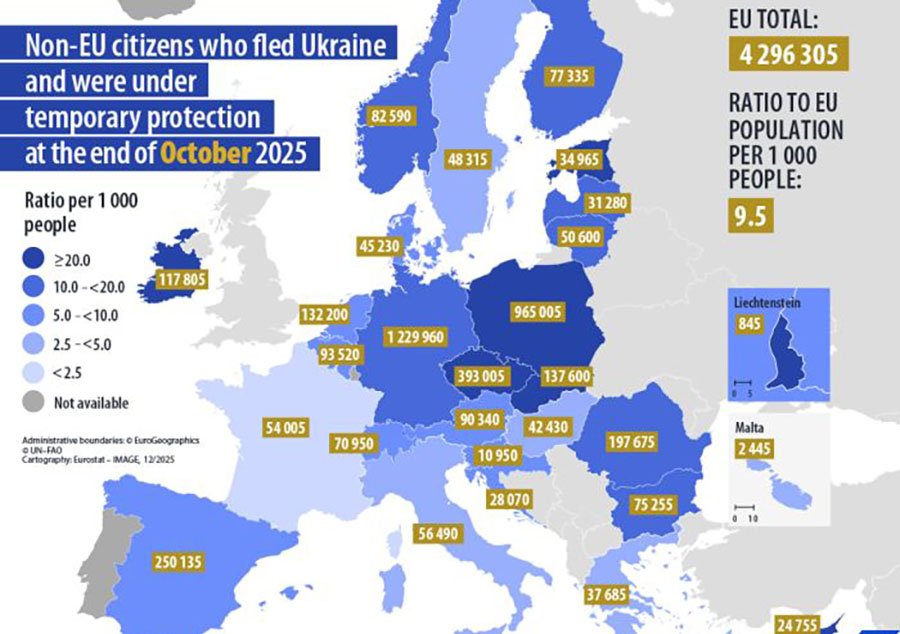
At the end of October 2025, 4.3 million foreigners who had left Ukraine due to hostilities and obtained temporary protection status were residing in the countries of the European Union, reports Eurostat. The total number decreased by 0.1% compared with September, however the inflow of new applicants remains among the highest in recent months.
The largest number of Ukrainian refugees is registered in Germany — 1,229,960, accounting for 28.6% of the EU total. Poland hosts 965,005 (22.5%), while Czechia accounts for 393,005 (9.1%). The EU average stands at 9.5 per thousand inhabitants. By this indicator, Czechia (36), Poland (26.4) and Estonia (25.5) lead.
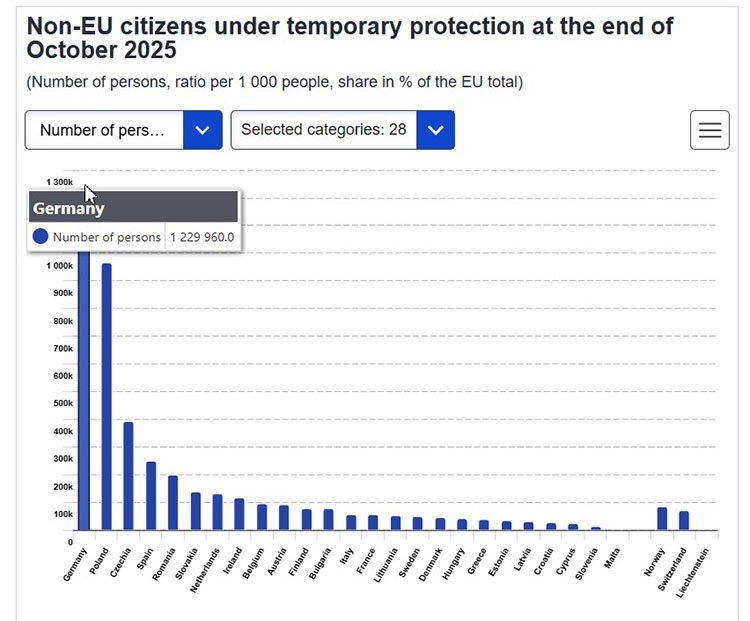
Compared with September, the number of people granted temporary protection increased in 22 EU countries. The largest absolute increase was recorded in Germany — up by 11,860 people, or 1%. Czechia saw an increase of 3,695 (+0.9%), Spain of 3,140 (+1.3%). Poland recorded a decrease of 43,880 (-4.3%), France of 485 (-0.9%), and Estonia of 10.
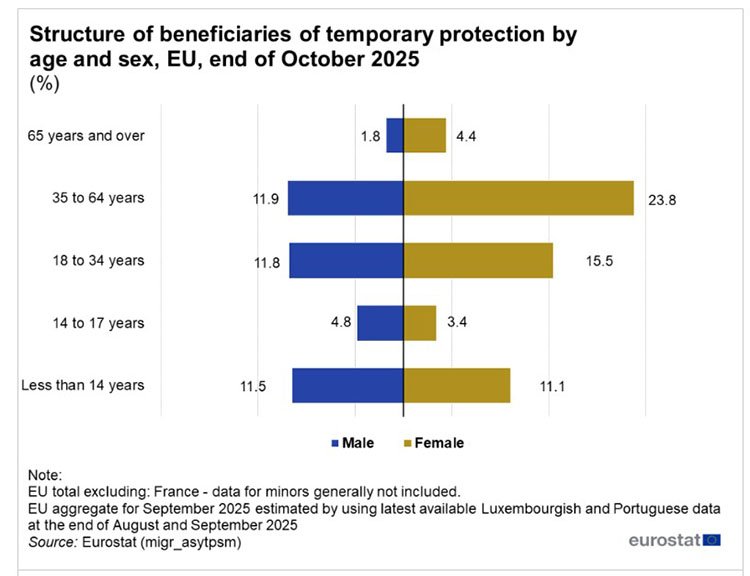
Among all status holders, 98.4% are Ukrainian citizens. Other groups include Russians — 12,133 (0.3%), Nigerian citizens — 4,812 (0.1%) and Azerbaijani citizens — 4,279 (0.1%). Women predominated, accounting for 43.8%, with more than half aged between 35 and 64. Men accounted for 25.5%, while minors represented 30.8%. In July–September 2025, the share of approvals granted to women declined to 36.6% (-7.4 pp), marking the lowest quarterly level since 2022. At the same time, the share of decisions granted to men increased by 5.1 pp, reaching a record high of 35.4%. In October, the figure rose to 50%, which is apparently linked to a decision by the Ukrainian authorities. At the end of August, they allowed men aged 18 to 22 to leave the country without restrictions.
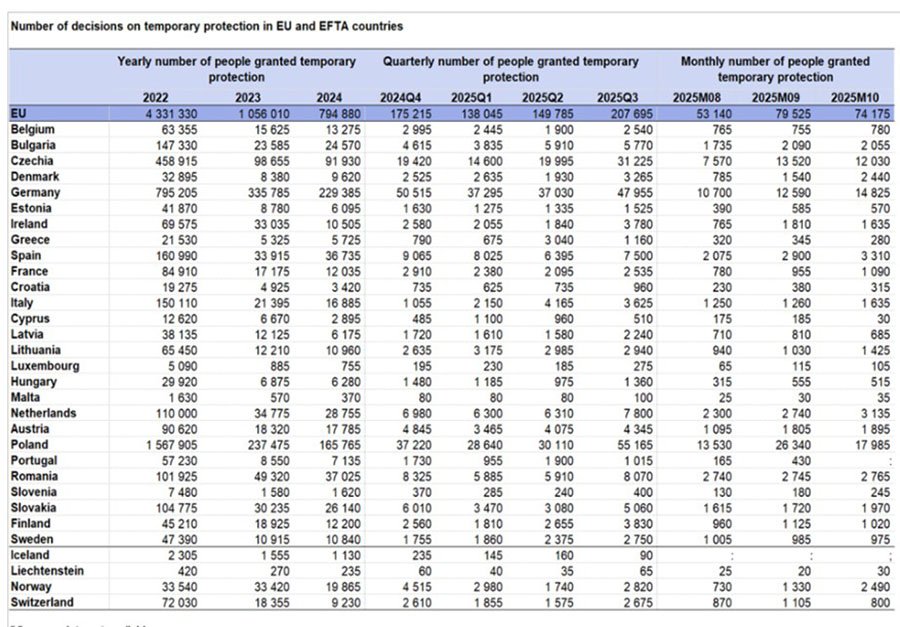
In October, 74,175 new refugees appeared in EU countries — the second-highest monthly figure in 2025 after the September peak of 79,525. In the third quarter of 2025, the European Union issued 207,695 new decisions granting temporary protection. This was 38.7%, or 57,910, more than in April–June. The largest absolute increase was recorded in Poland (+25,055), Czechia (+11,230) and Germany (+10,925). Declines were recorded in Greece (-1,880), Portugal (-885) and Italy (-540).
Since the start of hostilities in February 2022, 6.75 million people who left Ukraine have received temporary protection status. In 2023, more than one million new decisions were registered. In 2024, the number fell to 794,880 (-24.7%). The decline was observed in most countries: in Germany by 31.7% (-106,400), in Poland by 30.2% (-71,710), and in Ireland by 68.2% (-22,530). Only five states issued more new temporary protection decisions in 2024 than in 2023. The most notable growth was recorded in Spain — up 8.3% (+2,820), Denmark — up 14.2% (+1,240), and Bulgaria (+985; +4.2%).
In June 2025, the Council of the European Union unanimously supported extending the temporary protection mechanism for people who left Ukraine for an additional year — until 4 March 2027. This decision preserves the right to residence, access to the labour market, housing, healthcare, social support and education for millions of displaced persons, allowing them to remain in the EU without having to apply individually for asylum. A possible strategy for transitioning to other forms of legal status or preparing for return is also being discussed, should the situation in Ukraine allow.
At the same time, some countries are tightening residence rules. In Poland, free state-provided housing is now provided only to vulnerable categories — elderly people, persons with disabilities and large families. Eligibility for child benefits under the Rodzina 800+ programme has been directly linked to compulsory attendance at Polish schools, becoming a condition for maintaining support for such families.
In Austria, from 1 November 2025, payments are maintained only if there is official employment. In Ireland, from 10 November, the period of free state accommodation for new arrivals from Ukraine has been reduced to 30 days.
Overall, Eurostat data show that the EU temporary protection regime remains resilient and large-scale despite the first signs of a decline in the total number of beneficiaries. The flow of new applicants remains high, while the structure of migration is changing. At the same time, a clear trend is emerging toward revising national support measures: countries are gradually reducing the scope of social assistance and tightening accommodation conditions, shifting the focus from emergency support to integration and independent living for refugees.