







 Vietnam Mortgage Surge Pushes Homes Out of Reach
 Lithuanian Apartment Prices Accelerate Across Major Cities
 London Flats Lose Value Ahead of Leasehold Reform
 Construction of the Batumi–Sarpi Highway Begins in Georgia
 Baltic Property Investment Accelerates in 2026
 Hong Kong and Singapore Renew Their Expat Rivalry
Eurozone Growth Slower Than First Reported
Eurozone GDP revised lower for late 2025
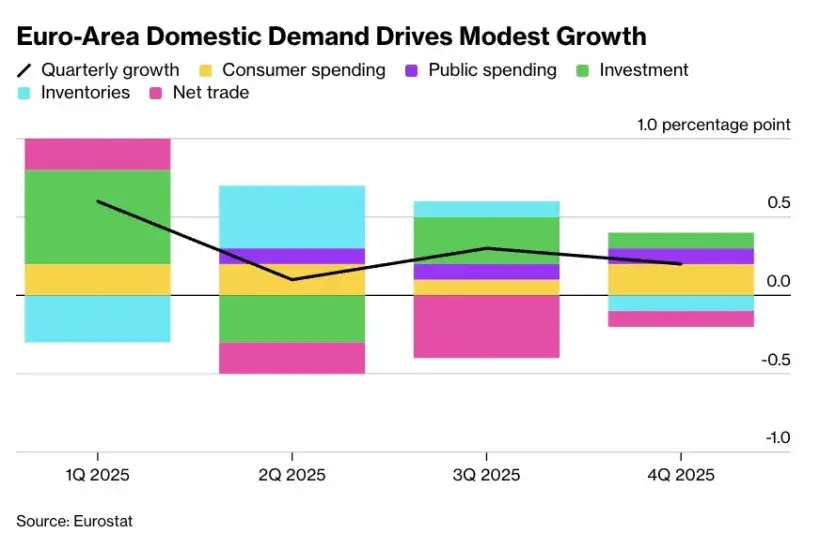
The euro-area economy grew more slowly than initially estimated at the end of 2025. According to revised figures released by Eurostat, gross domestic product across the 21 countries sharing the euro increased by 0.2% in the fourth quarter compared with the previous three months.
This was lower than the preliminary estimate of 0.3%, confirming that the region’s economic recovery remains modest and vulnerable to external pressures. While the economy continues to expand, the pace of growth remains relatively weak amid global economic uncertainty.
Domestic demand supported economic activity
Household consumption was the largest contributor to growth in the final quarter of the year. Strong consumer spending helped sustain economic activity despite weaker external trade performance.
Government expenditure and investment also made positive contributions to GDP, partially offsetting the drag from trade. Slower export performance weighed on overall growth during the period.
Economists note that the reliance on domestic demand highlights structural challenges within the European economy, particularly as global trade conditions remain uncertain.
Middle East conflict adds economic uncertainty
The outlook for the euro-area economy is increasingly tied to geopolitical developments in the Middle East. Military operations by the United States and Israel against Iran have already pushed energy prices higher, raising concerns about inflation in Europe.
If the conflict continues, higher energy costs could curb economic activity and increase pressure on both households and businesses through rising transportation and production costs.
The situation adds another layer of uncertainty to Europe’s economic outlook at a time when global trade tensions are already affecting growth prospects.
European Central Bank assessing economic impact
European Central Bank policymakers have said it is still too early to assess the full economic consequences of the conflict. Officials are monitoring the situation closely ahead of the next policy meeting scheduled in two weeks.
Bundesbank President Joachim Nagel has suggested that the inflationary effects of rising energy prices could become a bigger concern than the impact on economic growth.
The ECB is expected to evaluate the situation carefully before deciding whether any policy response is required.
Inflation and growth forecasts remain moderate
In its December projections, the European Central Bank expected inflation in the euro area to remain slightly below 2% in both 2026 and 2027 before reaching the target in 2028.
Economic growth was forecast to accelerate modestly to around 1.4% in 2027, up from 1.2% in 2026. However, current geopolitical risks could alter those projections.
Wage growth remains resilient
Despite modest economic growth, the euro-area labor market remains relatively strong. Separate Eurostat data showed compensation per employee increased by 3.7% year-on-year between October and December.
Although this marked a slowdown from the 4% increase recorded in the previous quarter, wage growth continues to support household spending and domestic demand across the region.
As International Investment experts report, the downward revision of euro-area GDP highlights the fragile nature of the region’s economic recovery. Future performance will depend heavily on energy prices, geopolitical developments in the Middle East and the European Central Bank’s policy decisions.