







 Vietnam Mortgage Surge Pushes Homes Out of Reach
 Lithuanian Apartment Prices Accelerate Across Major Cities
 London Flats Lose Value Ahead of Leasehold Reform
 Construction of the Batumi–Sarpi Highway Begins in Georgia
 Baltic Property Investment Accelerates in 2026
 Hong Kong and Singapore Renew Their Expat Rivalry
EU Launches Repatriation Flights for Stranded Travelers
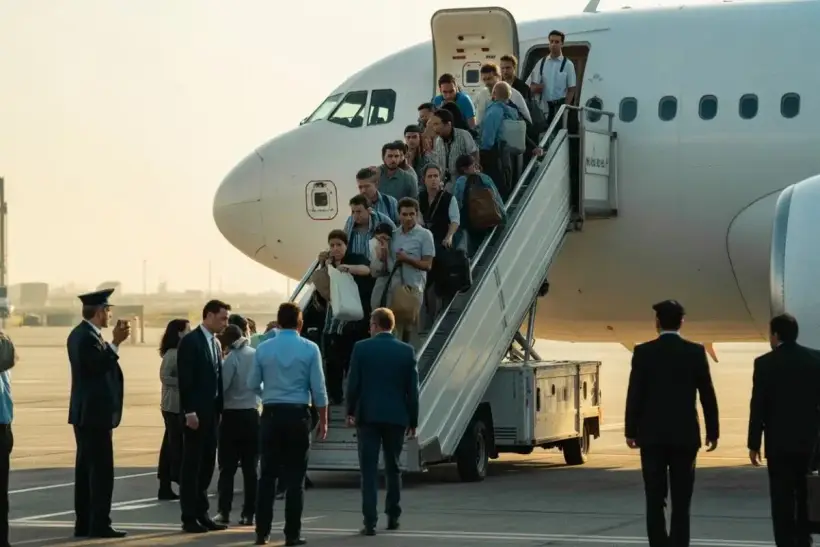
European citizens evacuated from Middle East conflict zone
The European Union has launched coordinated evacuation operations to bring its citizens home from the Middle East as the regional conflict escalates. Under the coordination of the European Commission’s Emergency Response Coordination Centre (ERCC), six repatriation flights have already transported stranded European travelers back to Europe.
The evacuation operations have been supported by several countries in the region including the United Arab Emirates, Saudi Arabia, Qatar, Jordan and Oman, which have served as key transit hubs for Europeans unable to leave the region after flight cancellations and airspace closures.
EU Civil Protection Mechanism activated
The evacuation effort is being coordinated through the EU Civil Protection Mechanism (EUCPM), one of the European Union’s main crisis response tools used during major emergencies ranging from natural disasters to geopolitical conflicts.
Through the ERCC, EU member states receive logistical, operational and financial support to organize emergency evacuations of citizens stranded abroad.
The European Commission activated the mechanism after the Middle East conflict began disrupting international aviation routes and leaving travelers stranded across the region.
Special flights return hundreds of Europeans
As of March 2026, six repatriation flights have departed from the Middle East and landed in Bulgaria, Italy, Austria and Slovakia, bringing hundreds of EU citizens back home.
Bulgaria has been among the most active countries organizing evacuation flights. Three aircraft departed from Dubai, Abu Dhabi and Muscat carrying more than 500 European citizens using both government aircraft and commercial airlines including GullivAir and Bulgaria Air.
Italy has also played a key role by organizing two flights from Muscat, Doha and Riyadh. More than 300 passengers, including tourists and business travelers, were transported to Rome and Milan.
Austria and Slovakia assist evacuation efforts
Austria organized a charter flight from Muscat carrying around 170 passengers, including vulnerable citizens and travelers stranded in the region.
Slovakia also participated by receiving one of the first repatriation flights from Amman, Jordan. The aircraft landed in Bratislava carrying Slovak nationals and other EU citizens affected by the aviation disruptions.
Although smaller in scale, Slovakia’s involvement included consular support and coordination with other EU member states to ensure safe travel arrangements.
European Commission provides financial support
A key component of the Civil Protection Mechanism is financial assistance for evacuation operations. The European Commission can reimburse up to 75% of repatriation flight costs, provided that at least 30% of available seats are offered to citizens from other EU countries.
If no member state can organize evacuation flights, the rescEU mechanism allows the Commission to cover 100% of the costs.
This system enables rapid mobilization of emergency transportation while ensuring that citizens from multiple EU countries can access available flights.
Conflict disrupts tourism and global aviation
The evacuation operations highlight the growing impact of the Middle East conflict on international travel and tourism.
The region has long served as a crucial aviation hub linking Europe, Asia and Africa. With airspace restrictions and flight cancellations spreading across the region, both tourism and business travel have been heavily affected.
Many European governments are now advising citizens to avoid non-essential travel to the region until the security situation stabilizes.
As International Investment experts report, the EU’s coordinated evacuation effort illustrates the importance of collective crisis management in protecting citizens abroad. The activation of civil protection mechanisms allows European institutions to respond quickly to geopolitical emergencies and reduce risks for travelers stranded outside Europe.