













Bitcoin Searches for Support After Worst Quarter
Bitcoin posted its weakest first quarter since 2018
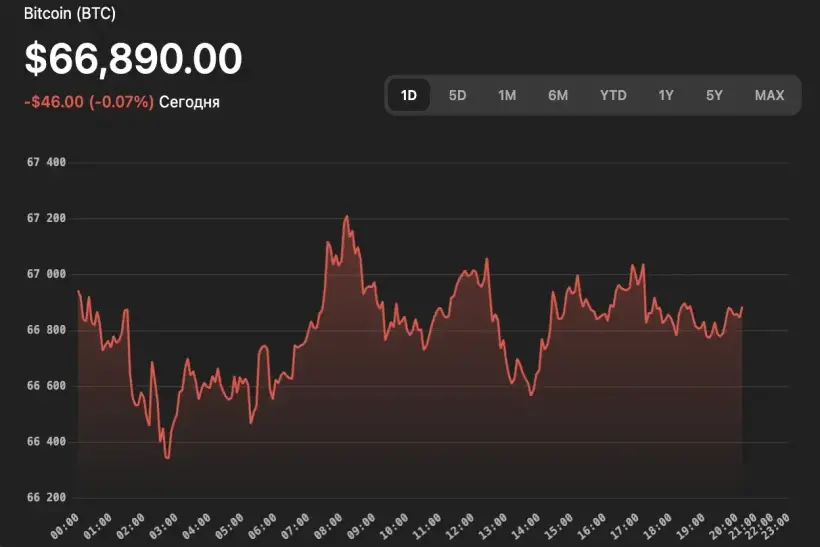
Bitcoin entered the second quarter of 2026 after its weakest start to a year in eight years. CoinDesk reported that BTC fell about 22% in the first quarter of 2026 after dropping another 25% in the final quarter of 2025, turning the current stretch into one of the longest periods of relative weakness for the largest cryptocurrency. Current market data show bitcoin trading near $66,871, well below the levels seen at the start of the year.
That is the backdrop for Yahoo Finance’s question about where bitcoin goes next after its worst quarter. The claim itself is supported by other market coverage. Cointelegraph, citing CoinGlass data, also said bitcoin was down about 22.3% in the first quarter, calling it the worst Q1 performance since 2018.
Macro conditions stopped working in crypto’s favor
The defining feature of early 2026 has been bitcoin’s failure to behave like a safe-haven asset. In a separate Yahoo Finance article, the outlet said that with multiple wars under way and inflation concerns rising, investors were not buying more bitcoin but were instead moving away from risk assets. That marks an important shift for a market that had hoped digital assets could benefit from geopolitical deterioration.
Higher energy costs and a broader rise in uncertainty also weighed on prices. Tom’s Hardware reported that after the escalation around Iran and the jump in oil above $100 a barrel, mining economics deteriorated sharply while bitcoin’s market price stayed near $66,700. For the market, that created a double headwind: the growth narrative weakened and the production economics of the network worsened at the same time.
Mining sent a new warning signal to the market
One of the clearest structural signals of the quarter came from the network itself. CoinDesk and Tom’s Hardware reported that bitcoin’s hashrate fell by about 4% in the first quarter of 2026, marking the first quarterly decline since 2020 after several years of sustained growth. That matters not only as a technical indicator but also as a signal about sector economics: some operators have been increasingly shifting infrastructure and facilities away from mining and toward AI-related hosting.
That shift changes how the mining sector is interpreted. In earlier cycles, rising computational power was often read as a sign of confidence in bitcoin’s future. The current drop instead points to harder capital-allocation choices in a period of high energy costs and compressed margins. Tom’s Hardware said the estimated cost of producing one BTC for some operators had approached $88,000, well above the current market price.
The market is debating a new cycle or a deeper correction
Two broad narratives are competing in the market. One says bitcoin is going through an extended correction within a broader bullish cycle. The other says the old post-halving recovery logic is breaking down under a harsher macro backdrop. Yahoo Finance has also published the opposing case: Grayscale argues bitcoin could still reach fresh record highs in 2026 and that the traditional four-year cycle may prove less rigid than in the past.
For now, however, the factual picture remains more cautious. CoinDesk described March 2026 as part of a historically weak period of relative performance rather than a convincing recovery. That means the market has not yet received a clear signal that the selloff is over.
ETFs remain an important support point for bitcoin
Despite the weak quarter, institutional infrastructure around bitcoin has not disappeared. The official iShares Bitcoin Trust ETF page confirms that the fund continues to hold a substantial amount of BTC and remains one of the key institutional channels for exposure to the asset. That matters because the next upward impulse will likely require not just a better macro backdrop, but also renewed and durable demand through major ETF vehicles.
That is why bitcoin’s next path will depend on more than one variable. It will hinge on whether global risk sentiment stabilizes, whether pressure on miners eases, whether ETF flows improve and whether price can hold below the $70,000 area without a new wave of capitulation. The current level near $66,871 shows the market is still in a zone where any new macro shock can quickly intensify downside pressure.
As International Investment experts report, bitcoin finished the first quarter of 2026 in a vulnerable position, with weak returns colliding with a harsher macro backdrop, higher energy costs and the first hashrate decline in years. That does not prove a long-term bear market has begun, but it does show that the old assumption of an automatic post-halving surge can no longer be treated as a base case. For investors, that means the decisive factors in the second quarter will include not only technical price levels, but also the durability of institutional demand, ETF behavior and whether the market is willing to treat bitcoin as a growth asset again rather than as an additional source of risk.
FAQ
How much did bitcoin fall in the first quarter of 2026?
CoinDesk said bitcoin fell about 22% in the first quarter of 2026, its worst first quarter since 2018.
What is bitcoin’s current price?
At the time of the market check, BTC was trading near $66,871.
Why was the quarter so weak for bitcoin?
The market was pressured by geopolitical risks, inflation concerns, weak risk appetite and higher energy costs that worsened mining economics.
What happened to bitcoin’s hashrate in 2026?
Hashrate fell by about 4% in the first quarter, marking the first quarterly decline since 2020.
Why are miners being linked to AI infrastructure?
Because some mining operators are increasingly viewing AI hosting as a more profitable use of power and data-center infrastructure while mining margins are under pressure.
Can bitcoin still reach a new high in 2026?
That view is still present. Yahoo Finance, citing Grayscale, reported that the firm believes bitcoin could still make fresh highs in 2026, but current market data do not yet show a durable reversal.