







 Egypt Prepares New Law for Property Developers
 Young Japanese Buyers Turn to 50-Year Mortgages
 Argentina Narrows Tourism Gap as Arrivals Rise
 Seattle Luxury Housing Loses Its Former Momentum
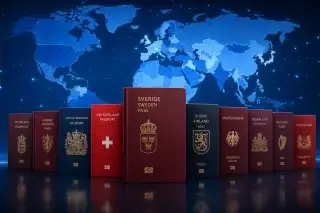 The World’s Strongest Passports for Travel, Living and Investment
 Russian Developers’ Debt Nearly Doubled in a Year

The Central Bank of Paraguay kept its key interest rate at 5.5% for the third consecutive time in May, considering the current monetary policy stance to be neutral. The regulator expects inflation to return to its target level in the second half of the year, while continuing to take external risks into account, including geopolitical uncertainty and changes in US interest rates, Bloomberg reports.
Paraguay GDP and inflation
In its post-meeting statement, the regulator noted that the current interest rate level is consistent with a neutral monetary policy stance. Annual inflation in Paraguay accelerated to 2.3% in April from 1.9% in March — the lowest level in five and a half years. The central bank expects the figure to approach the 3.5% target in the second half of 2026.
Paraguay’s GDP grew by 5.3% in 2025, while growth is expected to slow to 4.2% in 2026, according to the Ministry of Economy and Finance. The fiscal deficit is estimated at 0.8% of GDP, with continued gradual fiscal consolidation and control of public spending.
It is expected that the services sector will grow by 4.5–4.6%, industry by 4.0–4.1%, and agriculture in the range of 2.4–3.1%. The services sector will remain the main contributor to overall growth. Domestic demand will remain the key driver of the economy. Private consumption is expected to grow by about 4% supported by employment and income growth. Investment will remain on a positive trajectory.
Latin American economies
The International Monetary Fund notes a slowdown in the global economy due to the conflict in the Middle East and rising uncertainty. Energy-importing countries such as Central America and the Caribbean may face slower growth if the conflict persists. At the same time, energy exporters such as Brazil and Venezuela could benefit from higher energy prices, although this effect may be partially offset by rising costs of other goods, including fertilizers.
The World Bank highlights that the region’s largest economies — Brazil and Mexico — remain under pressure from high interest rates, weak investment demand, and trade policy uncertainty, which is weighing on economic activity. At the same time, Argentina has seen improved financial conditions due to fiscal stabilization and reforms. Paraguay continues to expand agricultural exports, and its macroeconomic situation remains stable, making it one of the fastest-growing economies in the region.
Conclusion
Analysts at International Investment note that the impact of rising fuel prices in Paraguay was partially offset by lower prices for other goods. This is particularly important as the country fully imports fuel and refined petroleum products, making its economy sensitive to external price shocks.
At the same time, uncertainty remains over a possible end to the conflict in the Middle East, as well as the future path of US interest rates. These external factors may affect inflation dynamics and the overall economic situation through changes in import costs and global financing conditions.
The expected slowdown in GDP growth is seen as a transition to a more sustainable growth path and does not indicate a deterioration in overall macroeconomic performance.