







 Asunción Property Market Accelerates as Construction Booms
 Egypt Expands Aviation for Tourism Growth
 Latvia’s Residence Permits for Real Estate to Be Abolished from September 15
 Egypt Prepares New Law for Property Developers
 Young Japanese Buyers Turn to 50-Year Mortgages
 Argentina Narrows Tourism Gap as Arrivals Rise
New mass migrant crossing attempt into Ceuta: nearly 300 detained
El País
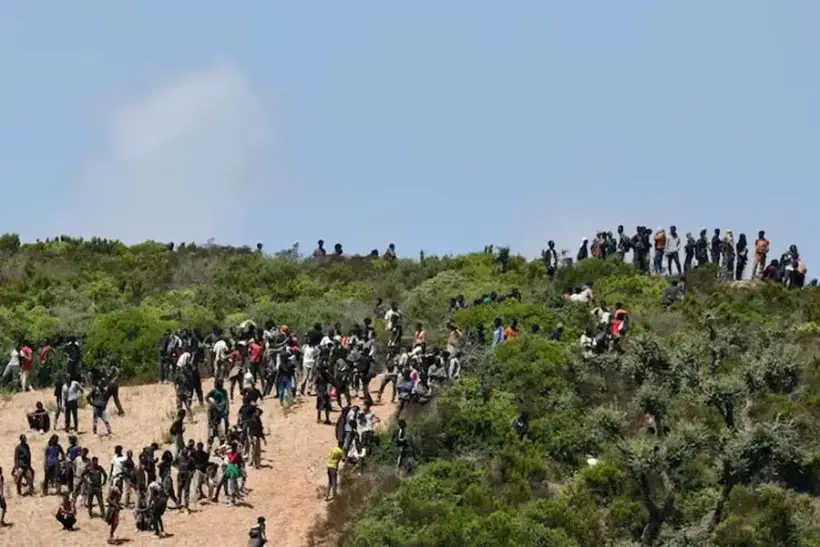
A new mass attempt by migrants to enter Ceuta has taken place. Moroccan security forces detained 294 people near the city of Fnideq on 15 August. None of the migrants reached Spanish territory, El País reported.
Preparations for the Ceuta crossing attempt
Several days before 15 August, Spain and Morocco reinforced security along the borders of Ceuta and Melilla following calls for mass crossings circulated on social media and messaging platforms. Some posts claimed that the border crossing between Fnideq and Ceuta would be open.
Spanish Defence Minister Margarita Robles said another attempt at unauthorised mass entry had to be stopped. The European Commission stepped up cooperation with Meta, TikTok and fact-checking organisations. Commission spokesperson Arianna Podesta said action was being taken against content linked to human trafficking and violence.
Preparations by irregular migrants caused particular concern after 30–31 July, when more than 70,000 people crossed into Ceuta within 24 hours. Many subsequently returned to Morocco or were removed by police.
Migrant crossing attempt on 15 August
On the morning of 15 August, hundreds of migrants gathered near Fnideq and tried to approach the Ceuta border. Morocco deployed thousands of security personnel along the routes leading to the Spanish enclave.
Clashes continued from dawn until early afternoon. Riot-control units used tear gas and pushed the migrants back towards the forests near Belyunes. A helicopter and drones monitored their movements, while police dogs were also deployed. Some participants tried to set fire to vegetation to cover their retreat, but they were stopped about three kilometres from the border fence.
The Tétouan prefecture reported the detention of 294 people. They included 248 migrants from sub-Saharan Africa and 46 citizens of Morocco, Algeria and Mauritania. Most were forcibly transported by bus to cities in southern Morocco, including Ouarzazate, more than 800 kilometres from Ceuta. The authorities provided no information about possible casualties. No one reached Spanish territory.
Migrants plan further attempts
After the clashes with police, some participants said they would try to cross the border again. Among them was Ali Quné, a 28-year-old bricklayer from northern Chad. After seeing footage of the July crossing, he left his wife and two young children, travelled through Libya and Algeria, and reached Morocco. According to Quné, around 400 migrants are sheltering in forest camps near Ceuta. “Our only hope is to reach Europe. Let us enter Ceuta,” he said.
Journalists also saw two young migrants from sub-Saharan Africa heading towards the border with hooks for scaling the barriers. Another participant, 24-year-old Moroccan Abdullah al-Beij from Beni Mellal, said he planned to try to enter Melilla. “I have no future here. I have nothing to lose,” he explained.
Morocco’s role in border security
On the Spanish side, 880 police officers, 714 Civil Guard personnel and 2,000 troops were stationed in Ceuta on 15 August — around 3,600 security personnel in total. Only a small part of this force was deployed directly at the border. The migrants reached neither the El Tarajal crossing nor the land barriers or the 500-metre floating barrier.
Before the events of 30 July, the perimeter was permanently guarded by 60 officers from the ARS reserve unit and six Civil Guard patrol boats. These forces proved insufficient during the mass crossing. In the latest operation, the main action unfolded on Moroccan territory, leaving little need for Spanish units to intervene.
Spanish police believe the events of 15 August confirmed Morocco’s key role in preventing mass crossings. An unnamed senior officer noted that Moroccan security forces had not stopped tens of thousands of migrants from advancing towards Ceuta in late July, but this time mobilised their full capacity and completely blocked the route.
Ceuta’s migration crisis continues
Tensions remain high in Ceuta. Between 5,000 and 9,000 migrants with irregular status are still in the enclave following the mass crossing on 30–31 July. Temporary camps remain in place, while more than 80 bodies are being held in the morgue. Moroccan non-governmental organisations recorded another 64 deaths on their side of the border.
Spanish Interior Minister Fernando Grande-Marlaska said foreigners with no legal right to remain would be removed as soon as possible. The process will take time because the immediate-return procedure can only be applied directly after a person crosses the border.
The National Police have begun reviewing each case individually. Officers must establish the identities of migrants, many of whom arrived without passports, and prepare removal proceedings in accordance with all legal requirements. A further 26 specialists have been sent to Ceuta to speed up the process.
Returning 1,898 registered unaccompanied minors presents particular difficulties. Morocco must provide information about their family circumstances, while an opinion from the Spanish public prosecutor’s office will also be required.
Migrant legalisation deepens divisions in the EU
The Ceuta crisis has intensified debate over Spain’s migration policy, which includes a large-scale legalisation programme. Around 500,000 foreigners living in the country without legal status may apply for residence permits. Leaders of 22 EU states argue that the measure sends a dangerous signal by suggesting that those who arrive irregularly may later be legalised. According to Politico, the number of participants could reach 1.2 million.
International Investment analysts believe Spain’s migration policy will remain a source of dispute within the EU. The Ceuta crisis has already led to the reinstatement of border controls within the Schengen area. Italy introduced checks on arrivals from Spain, and Madrid responded with similar measures.
European countries are also facing labour shortages and recruiting workers from abroad. Spain has adopted one of the EU’s most lenient approaches to legalising foreigners already living in the country. Over time, Madrid may have to seek a compromise between the economy’s demand for workers and the tighter migration controls sought by its European partners.