







 Vietnam Mortgage Surge Pushes Homes Out of Reach
 Lithuanian Apartment Prices Accelerate Across Major Cities
 London Flats Lose Value Ahead of Leasehold Reform
 Construction of the Batumi–Sarpi Highway Begins in Georgia
 Baltic Property Investment Accelerates in 2026
 Hong Kong and Singapore Renew Their Expat Rivalry
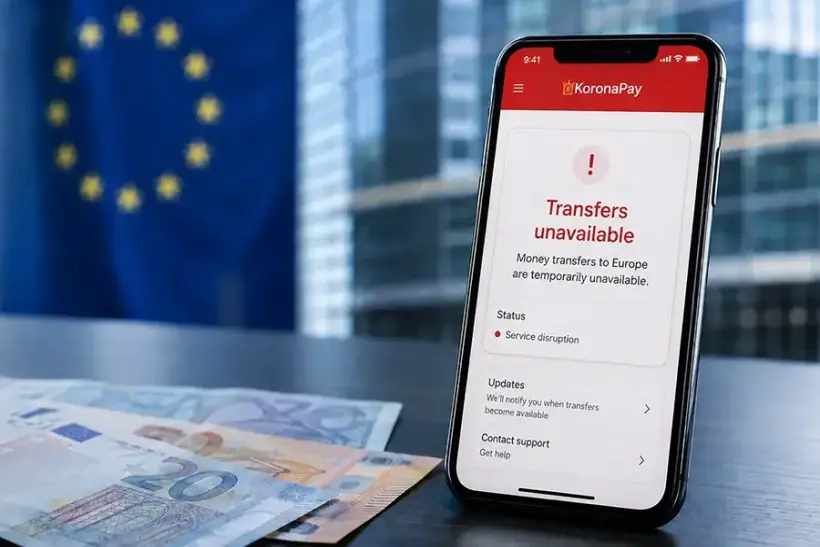
European company Koronapay Europe Limited is discontinuing money transfer services and has begun the process of voluntarily surrendering its licence. New transactions are no longer available, while funds from previously sent transfers can be refunded through the service’s app.
Koronapay Europe gives up its licence
Koronapay Europe Limited has informed customers that it is in the process of voluntarily withdrawing its authorisation. As a result, the company will no longer offer or provide regulated financial services, and new transfers have already been suspended. Funds from previously initiated transactions can be refunded through the Korona mobile app.
The European company is registered in Cyprus and still lists itself on its website as an Electronic Money Institution (EMI). Licence No. 115.1.3.30 was issued by the Central Bank of Cyprus. Koronapay Europe Limited was the entity through which the system provided regulated services to customers in the European market.
The statement does not specify the reasons for the voluntary surrender of the licence or the timeline for completing the process. However, the announcement comes after a sharp reduction in the system’s international operations amid EU sanctions.
EU sanctions target the operator of “Golden Crown”
On July 23, 2026, the Council of the European Union approved the 21st package of sanctions against Russia. It included 218 new listings — 48 individuals and 170 entities. In the financial sector, the EU imposed asset freezes and a ban on making funds available to 94 banks and major financial institutions.
The sanctions list included the Russian non-bank credit organisation Payment Center, based in Novosibirsk. In the official EU document, the organisation is described as a major non-bank credit institution holding a specialised licence from the Bank of Russia. It is also identified as part of the Center of Financial Technologies group and as an operator and settlement centre for several payment systems.
Payment Center acts as the operator and settlement centre of the “Golden Crown” payment system. The EU cited the company’s activities in the banking sector, which, according to Brussels, generates substantial revenues for the Russian state, as the basis for the sanctions. The restrictions provide for the freezing of the organisation’s assets in the EU and prohibit European citizens and companies from making funds or economic resources available to it. Koronapay Europe Limited itself does not appear in the published sanctions listing.
International transfer routes began shutting down
Problems with international transfers emerged as early as July 24, one day after the adoption of the EU’s 21st sanctions package. Transfers from Russia to Georgia and Kazakhstan through “Golden Crown” became unavailable, according to TASS. Transactions to Armenia were also reported to have been suspended. Azerbaijan later disappeared from the list of destinations, leaving only Kyrgyzstan, Türkiye and Uzbekistan available for online transfers from Russia.
The restrictions also affected transfers in the opposite direction. Azerbaijan’s Unibank and Yelo reported that sending money to Russia through “Golden Crown” had temporarily become impossible because of problems with the service. In Belarus, however, the system continued to operate: BSB Bank and Technobank reported no difficulties with such transactions.
Sanctions risks also began affecting the system’s partners. In Uzbekistan, local banks started discussing a switch to a different technical operator for “Golden Crown” in late July. A representative of the country’s Central Bank said the move was intended to avoid exposure to European restrictions.
Before the new measures were introduced, “Golden Crown” remained one of the most widely used ways to send money from Russia abroad, particularly after Russian-issued Visa and Mastercard cards stopped functioning within the international payment infrastructure.
How to transfer money from Russia abroad
Following the reduction in “Golden Crown” services, there is effectively no single universal alternative: available options depend on the destination country, the banks involved and current restrictions. Direct bank transfers, specialised payment services and SWIFT transfers through banks that retain access to the international system are still used for Georgia, Kazakhstan and Uzbekistan, according to Sravni.
Transfers to Georgia can, in particular, be made to accounts at Bank of Georgia, TBC Bank and Credo Bank, although availability depends on the Russian sending bank. Multitransfer, Unired and Avosend are also used. For Kazakhstan, transfers from T-Bank to Kaspi remain one of the popular options, while KwikPay and Unired are also available. In Uzbekistan, Unired, KwikPay and Unistream continue to operate.
The stability of these channels, however, is not guaranteed. Conditions can change rapidly, while additional fees and losses from currency conversion may apply. Sravni expert Liana Kadyrova notes that, based on user experience, transfers tend to be more reliable when they are made through Russian banks that are not under sanctions.
Conclusion
These are not the first sanctions to affect the infrastructure of “Golden Crown”. In August 2024, the United States imposed restrictions on the Center of Financial Technologies group, which develops software for the system. Payment Center itself was not directly added to the US sanctions list at the time. Nevertheless, some banks outside Russia temporarily suspended cooperation with “Golden Crown” while assessing potential risks.
Analysts at International Investment note that the latest EU restrictions have proved more significant because they directly target the Russian operator and settlement centre of the system. The subsequent reduction in international transfer destinations, followed by Koronapay Europe Limited’s decision to surrender its European licence, points to a further contraction of “Golden Crown’s” infrastructure outside Russia.
If the geopolitical situation does not change, sanctions pressure on Russia’s financial sector is likely to intensify. This could lead to a further reduction in available transfer destinations and prompt more foreign banks and payment companies to stop cooperating with Russian operators.