







 Covivio Hotels Revenue Grows 4.7% as European Markets Split
 Lithuanian Apartment Prices Accelerate Across Major Cities
 Georgia's Tourism Revenue Hits Record High
 Norway's Sovereign Fund Commits €1.5bn to European Warehouses
 Market Rout of October 2026: Can Branded Hotels Protect Capital?
 Residential Property Prices in Tbilisi Rise by 5.9% Year-on-Year
Cairo Airport Replaces Paper Visas with QR Codes
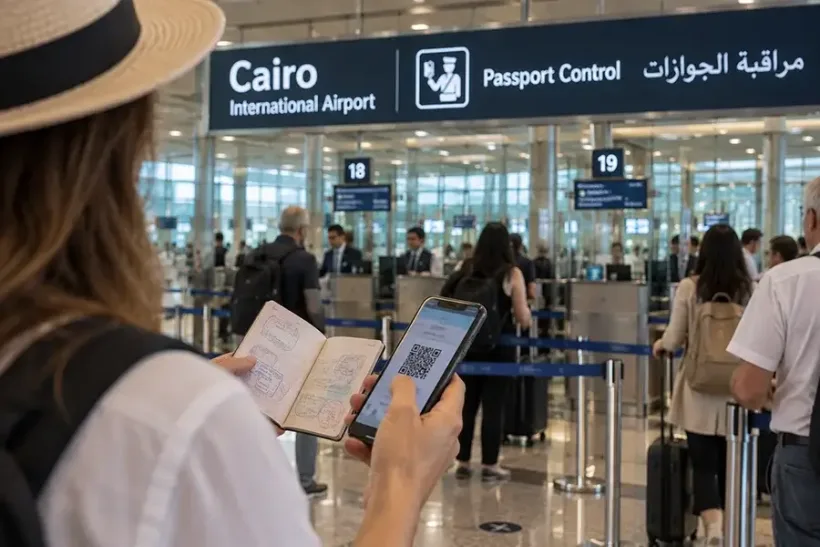
Since September 15, 2026, visas on arrival at Cairo Airport have been issued as electronic QR codes, Ahram Business reports. The new procedure was introduced after several weeks of testing. It is expected to reduce the time tourists spend completing arrival formalities.
Visa Reform in Egypt
Transition to a Digital System
Egypt’s Ministry of Tourism and Antiquities, together with other government agencies, is moving the issuance of tourist visas on arrival to a digital system. The new technology includes QR codes, electronic payments, and information exchange between airport services. The authorities expect the changes to reduce waiting times and speed up arrival procedures.
Testing began at Cairo Airport on August 1, 2026, covering Terminals 1, 2 and 3, as well as the seasonal terminal. During the transition period, the new technology was used alongside paper visa stickers, allowing the system to be tested under real-world conditions. The trial period ended on September 15, when the new procedure became operational in all arrival halls at Cairo Airport. The system is expected to be introduced at other Egyptian airports at a later stage, although no timetable for the rollout has been announced.
Who Can Obtain a Digital Visa in Cairo
The new procedure applies to foreign nationals eligible for a Visa on Arrival. Egypt’s Minister of Tourism and Antiquities, Sherif Fathy, said the scheme covers citizens of 118 countries. These include Russia, Georgia, Ukraine, the United States, Canada, the United Kingdom, Australia, New Zealand, Japan, South Korea, Serbia, Norway, and EU member states. The list is determined by an interagency working group that takes into account security requirements, the interests of the tourism industry, and the principle of reciprocity.
Egypt is also expanding other simplified entry programs, with various visa facilitation measures available to citizens of 180 countries in total. Separate rules apply to trips to the South Sinai resorts. Citizens of many countries can stay visa-free for up to 15 days in Sharm El-Sheikh, Dahab, Nuweiba and Taba.
How to Obtain a QR Code for an Egyptian Visa
The QR code can be obtained either in advance or after arrival at Cairo Airport. Travelers can use the official Visa on Arrival portal, the Visa On Arrival Egypt mobile app, or self-service kiosks in the arrival halls. The code can be saved on a phone or printed and then presented together with a passport. It remains valid for seven days from the date of issue, so travelers are advised not to obtain it too far in advance. If the code is not used within that period, a new one must be issued.
The service is not free. An Egyptian visa on arrival costs $30, with an additional $6 charged for the QR code and banking services, bringing the total to $36. If the code expires, the payment is non-refundable. Travelers must complete the procedure again and pay the applicable fee for a new code.
Tour operators can also obtain QR codes for organized groups. They can purchase multiple codes at once and monitor their use. This allows documents to be prepared before a group arrives and reduces the time required to complete airport formalities.
Tourist Arrivals in Egypt Continue to Rise
In 2024, Egypt welcomed around 15.7 million international tourists, rising to 19 million in 2025. The positive trend has continued: around 12.8 million foreign visitors arrived between January and September 2026. Tourism and Antiquities Minister Sherif Fathy expects the total to reach 20 million by the end of the year. By 2030, the authorities aim to increase international arrivals to 30 million. Egypt is expanding its hotel infrastructure and air connectivity while simplifying entry procedures to support this goal.
Analysts at International Investment note that tourism plays a significant role in Egypt’s economy, generating foreign currency inflows, employment, and revenue for businesses connected to the industry. Maintaining positive momentum therefore has implications well beyond the tourism sector. Rising visitor numbers support the hotel industry, aviation, retail, and services.
Instability in the Middle East remains one of the main risks. Egypt’s tourism market has continued to grow so far, but a further escalation of regional conflicts could disrupt air travel, increase travel costs, and prompt some travelers to choose alternative destinations. Under an unfavorable scenario, the current pace of growth could slow, potentially forcing the authorities to revise their targets.