







 Egypt Prepares New Law for Property Developers
 Young Japanese Buyers Turn to 50-Year Mortgages
 Argentina Narrows Tourism Gap as Arrivals Rise
 Seattle Luxury Housing Loses Its Former Momentum
 The World’s Strongest Passports for Travel, Living and Investment
 Russian Developers’ Debt Nearly Doubled in a Year
Paraguay Emerges as Property Hub
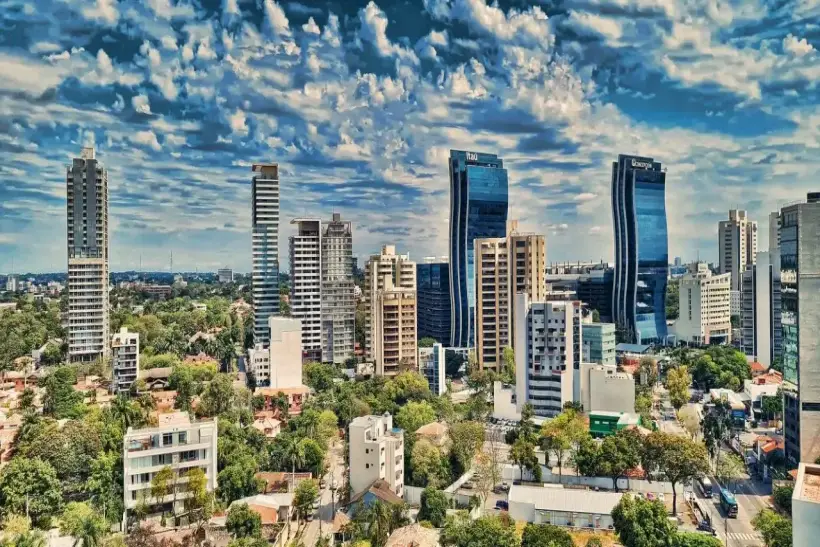
Paraguay is becoming increasingly visible on the regional real estate investment map. Against a backdrop of economic stability, low inflation, tax incentives and competitive prices, the country is starting to compete not only with neighboring South American markets, but also with more mature destinations for Latin American capital. Asunción, Ciudad del Este and Encarnación offer three distinct investment profiles, while residential rental yields remain higher than in many traditional regional markets.
Paraguay strengthens its property position
Paraguay was long viewed as a niche market for local capital, agribusiness and border trade. In 2025–2026, that picture is changing. Investors increasingly see the country as a calmer, more predictable and more affordable alternative to larger South American markets.
La Nación reports that Paraguay is consolidating its position as a real estate investment destination thanks to orderly economic growth, an expanding middle class and a strategic location in the heart of South America. For foreign capital, stability, clear rules, competitive prices and yields above those of some more mature markets are especially important.
This does not mean Paraguay has already become a fully mature property market. Rather, it is in a transition phase: demand is becoming more international, developers are launching more projects and investors are beginning to compare Asunción not only with domestic cities, but also with Montevideo, Punta del Este, Miami and São Paulo.
Asunción becomes the main demand center
The main magnet for capital is Asunción. The capital concentrates corporate demand, administrative functions, commerce, services, international schools, healthcare and the most active construction pipeline. It is also where the premium segment is forming, attracting both local buyers and foreigners.
According to La Nación, prices in premium districts of Asunción stand at about $1,800–2,500 per square meter. In emerging areas, prices are lower, at around $900–1,400 per square meter. This gap allows for different investment strategies: buying in an established area for liquidity or entering an emerging district for potential appreciation.
For foreign investors, this is an important difference from more expensive markets. In Uruguay, for example, premium locations can exceed $4,000 per square meter, while average yields are lower. In the United States, the entry ticket in major cities and popular states for Latin American capital is often still higher. Against that background, Asunción looks like a market with a lower entry point.
Three cities, three investment models
Paraguay’s market cannot be reduced to the capital alone. La Nación identifies three key profiles: Asunción, Ciudad del Este and Encarnación. Each city offers a different property economy.
Asunción is a market for residential and corporate projects, supported by offices, services, banks, government institutions, middle- and high-income families and foreigners relocating to the country. Location, security, building management, parking, access to schools and shopping centers are key.
Ciudad del Este is driven by border trade with Brazil and Argentina. Its market is more commercial and volatile, but can offer opportunities in retail, warehouse and service real estate. Investors there are buying not just square meters, but access to customer flows, logistics and cross-border business.
Encarnación is developing on the back of the agro-industrial region, tourism and its location on the Argentine border. It is a quieter market, where demand depends on domestic tourism, seasonality, infrastructure and the quality of the urban environment. Its potential is tied less to rapid speculative growth and more to the gradual expansion of the consumer base.
Yield remains the main argument
One of Paraguay’s strongest attractions is rental yield. According to La Nación, traditional and short-term residential rentals can generate annual returns of 3-4%. For the region, this is a competitive figure.
Rental yield is the ratio of annual rental income to the value of the property. If an apartment costs $100,000 and generates $8,000 a year before expenses and taxes, the gross yield is 8%. Investors must distinguish gross yield from net yield: vacancy, repairs, management, taxes, utilities, commissions and currency costs must be deducted.
In the commercial and corporate segment, La Nación notes the advantage of lower tenant turnover. This is important for investors seeking predictable cash flow. An office, retail unit or service property may be less liquid than an apartment, but with a strong tenant it can deliver more stable income.
Macroeconomics supports investment demand
Paraguay’s economic backdrop remains a strong part of the investment story. The World Bank expects the country’s economy to grow by an average of about 4.3% in 2026–2028 and notes that Paraguay has not experienced significant macroeconomic imbalances for two decades thanks to prudent management.
Paraguay’s Ministry of Economy and Finance expects gross domestic product to grow by 4.2% in 2026. Gross domestic product is the value of all goods and services produced in a country in a year. The forecast specifically points to contributions from construction, energy and water production.
The International Monetary Fund also highlights Paraguay’s favorable medium-term prospects, controlled inflation, prudent public debt and adequate international reserves. For real estate, this reduces part of the country risk: buyers are not looking at an economy with runaway inflation, overheated debt or a chronic currency crisis.
Tax environment strengthens foreign interest
For foreign capital, Paraguay is attractive not only because of prices. The tax and regulatory environment also matters. Paraguay is known for its territorial tax principle: in general terms, the country taxes income generated from local sources, while foreign income may fall outside local taxation if the rules are met.
For entrepreneurs, rentiers, investors and families considering relocation, this model can be an important factor. It does not eliminate tax obligations in the country of origin and requires professional advice, but it makes Paraguay stand out compared with jurisdictions with higher tax burdens.
The U.S. State Department’s investment overview notes that Paraguay’s government encourages private foreign investment, while the law provides tax breaks, allows full repatriation of capital and profits and guarantees national treatment for foreign investors. For property buyers, this strengthens the sense that the market is open.
Buying procedures remain relatively simple
La Nación cites market participants as saying that the investment process in Paraguay is perceived as simple: an identity document or passport and proof of source of funds are enough to begin. For foreign buyers, this lowers the administrative barrier.
But ease of entry should not be confused with absence of risk. Real estate requires legal due diligence: title, land history, encumbrances, construction permits, compliance with planning rules, developer quality and real maintenance costs.
For buyers from other countries, it is especially important to work with an independent lawyer, not only with the seller or broker. In emerging markets, the main risk is often hidden not in the price, but in documents, delivery timing, property management and future liquidity.
Paraguay competes with Uruguay and the U.S.
The comparison with Uruguay and the United States explains why Paraguay has become more visible. Uruguay remains a more mature, institutional and expensive market. Montevideo, Punta del Este and Colonia attract capital through stability, legal culture and tax incentives, but yields are usually lower and entry prices higher.
The United States remains the largest and most liquid destination for Latin American capital, especially Florida. But high entry costs, taxes, insurance, rising operating expenses and competition in popular states are pushing some investors to look for alternatives.
In this logic, Paraguay occupies the niche of a growth market. It does not offer the institutional depth of the U.S. or the maturity of Uruguay, but it combines lower prices, higher yields, a stable macro backdrop and an opportunity for early entry into a developing investment cycle.
The market is growing but uneven
Paraguay’s main risk is unevenness. Good projects in strong districts of Asunción can find buyers and tenants quickly. But weak locations, poorly designed buildings and assets without clear demand will depend on general market optimism.
Segmentation is especially important for investors. A premium apartment in Asunción, an office unit in a business district, retail property in Ciudad del Este and a tourism asset in Encarnación are different products with different risks. They cannot be judged by one average yield.
Construction growth may also eventually create an oversupply of similar apartments. If developers begin repeating the same format without regard to real demand, part of the market will face pressure on rents and sales timelines. Project quality, management and micro-location therefore become decisive.
Infrastructure will test the market
The long-term potential of real estate depends on infrastructure. Asunción needs roads, transport, water supply, sewage systems, safety, public spaces and more orderly urban planning. Without this, price growth may run ahead of the quality of the urban environment.
For Ciudad del Este, logistics, customs infrastructure, trade flows and the stability of border business are critical. For Encarnación, the key factors are tourism, the waterfront, services, links with the agro-industrial hinterland and a steady flow of domestic and foreign visitors.
If public and private investment supports infrastructure, the market can move from a phase of rapid growth to more sustainable maturity. If not, part of the investment story will remain driven by expectations rather than real urban economics.
Paraguay is no longer a hidden niche
Paraguay no longer looks like a completely hidden market. Investors from neighboring countries, entrepreneurs, developers and family capital increasingly consider it part of a regional portfolio. Interest in Asunción is especially visible because it combines growth, affordability and demand for modern urban real estate.
But growing attention requires caution. The more fashionable the market becomes, the higher the risk of inflated expectations. Investors should not rely only on the general story that “Paraguay is growing.” They need to assess the specific asset: who the tenant is, what the real yield is, how much maintenance costs, whether competing projects exist, how liquid the location is and whether an exit is possible without a large discount.
Paraguayan real estate may become one of the region’s interesting opportunities, but its strength does not lie in universal growth across all assets. Its strength lies in the combination of a stable economy, competitive prices, tax appeal and correctly chosen locations.
As reported by International Investment experts, Paraguay is entering a phase in which real estate is moving from a local story to part of regional capital allocation. The main opportunity is early entry into a market with high yields and rising international visibility. The main risk is buying into optimism without checking documents, tenants, infrastructure and real liquidity. In Paraguay, investors now need to choose not the country in general, but a specific city, district and product.
FAQ: real estate investment in Paraguay
Why is Paraguay becoming attractive for real estate investors?
Paraguay attracts investors through economic stability, low inflation, competitive prices, a favorable tax environment, a growing middle class and residential rental yields that can reach 7–9% annually.
Which Paraguayan cities are most interesting for investment?
Asunción, Ciudad del Este and Encarnación are the most visible. Asunción is suited to residential and corporate projects, Ciudad del Este is linked to border trade and Encarnación to tourism and the agro-industrial region.
How much does property cost in Asunción?
In premium districts of Asunción, prices are around $1,800–2,500 per square meter. In emerging areas, prices are about $900–1,400 per square meter.
Can foreigners buy property in Paraguay?
Foreign investors can buy property, but they must prove the source of funds and conduct legal due diligence. Independent legal advice is essential before purchase.
What are the risks of real estate investment in Paraguay?
The main risks are legal title, construction quality, location liquidity, possible oversupply of similar apartments, infrastructure limits and inflated yield expectations.