











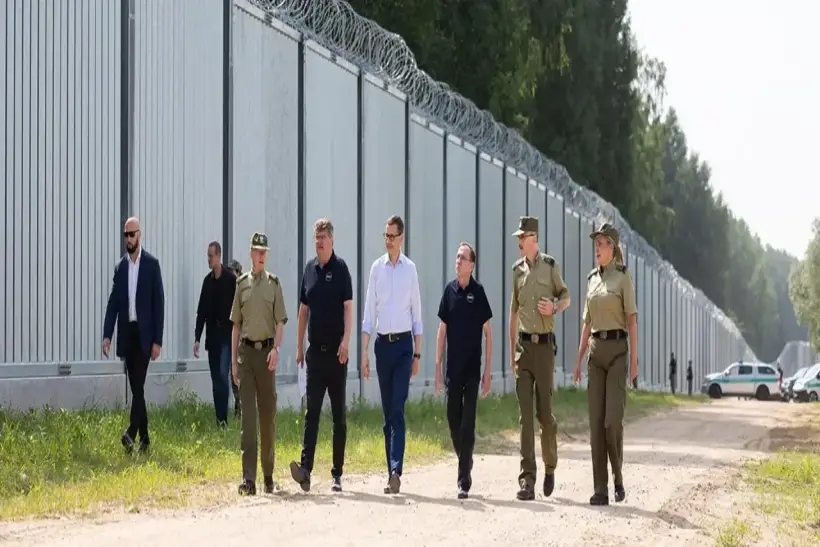
The European Union’s new migration and asylum rules became applicable on 12 June 2026, but Poland has said it will enforce only the provisions it considers useful for border security, data exchange and returns. Warsaw has rejected relocated asylum applicants and opposes parts of the border procedure at its frontiers with Belarus and Russia. Poland’s relief applies to the 2026 solidarity mechanism, however, and does not amount to a blanket exemption from the pact.
EU Migration Pact Enters Its Operational Phase
The Pact on Migration and Asylum was adopted in May 2024 and became applicable across the European Union after a two-year preparation period. It is a package of interlinked legal acts covering screening, biometric registration, reception, asylum decisions, responsibility for applications, border procedures and returns.
The framework requires people arriving irregularly to undergo identity, security, preliminary health and vulnerability checks. Defined groups of applicants can be placed in an accelerated procedure at the external border without being legally authorised to enter EU territory while their cases are examined.
The package contains directly applicable regulations as well as measures requiring national legislative and administrative changes. A government’s declaration that it will enforce selected provisions is therefore distinct from a formal exemption created under EU law.
Warsaw Backs Returns and Expanded Data Checks
Poland plans to apply provisions that strengthen access to migration data, improve identification, accelerate returns and create special procedures during a sudden influx or the instrumentalisation of migration by another state.
The Interior Ministry has said it supports the new return system, tighter rules against irregular migration and expanded use of the Eurodac biometric database. Eurodac is intended to record asylum applicants, identify applications lodged in several countries and help determine which member state is responsible for each case.
The crisis provisions are particularly important for Warsaw because they allow temporary procedural adjustments when a national asylum system faces disproportionate pressure or when another country directs people towards an EU border for political or security purposes.
Poland Rejects Some Eastern-Border Procedures
The disputed part of the pact concerns mandatory border processing for certain asylum applicants. The common system requires states to provide facilities where people can be registered, receive preliminary medical checks and have their claims examined without being formally admitted to EU territory.
Polish authorities argue that permanent processing infrastructure near Belarus could encourage further organised attempts to cross the border. The government describes the pressure at its eastern frontier as a security operation organised by Belarus and supported by Russia rather than a conventional migration route.
Polskie Radio reported that Poland does not intend to implement all requirements relating to additional processing and medical facilities at its borders with Belarus and Russia. Warsaw nevertheless plans to apply the pact’s return, security and crisis-management provisions.
Poland Avoids Relocation Under the 2026 Pool
The pact establishes an annual solidarity mechanism to support Cyprus, Greece, Italy, Spain and other countries that process a disproportionate share of arrivals.
Member states can contribute by relocating asylum applicants, making financial payments, providing personnel or equipment, or combining several forms of assistance. The financial equivalent is calculated at €20,000 for each relocation not undertaken.
The permanent framework has an annual reference minimum of 30,000 relocations or €600 million. Since the first cycle runs only from 12 June to the end of 2026, the inaugural pool was reduced to 21,000 relocations or €420 million.
Austria, Bulgaria, Croatia, Czechia, Estonia and Poland were classified as facing a significant migratory situation after cumulative pressure in previous years. Their solidarity pledges could consequently be reduced in full or in part.
Poland’s Interior Ministry says the country will neither accept relocated applicants nor bear the corresponding financial cost under the first pool. The relief is linked to the 2026 annual cycle and is not a permanent opt-out.
Ukrainian Temporary Protection Shaped the Decision
Poland had demanded that the EU recognise the cost of hosting people displaced from Ukraine. Most are covered by the Temporary Protection Directive rather than the ordinary asylum system, meaning they are not automatically included in the pact’s relocation mechanism.
At the end of April 2026, Poland hosted 971,255 people under temporary protection, representing 22.2% of the EU total. Only Germany hosted a larger number.
Warsaw also cited the continuing pressure on the Belarus border, the cost of reinforcing the EU’s eastern frontier and the resources committed by the Border Guard. These factors formed the basis for treating Poland as a country facing a significant cumulative migration burden.
Selective Enforcement Is Not a Full Legal Opt-Out
Poland’s political position does not give it an unrestricted right to disregard any provision it opposes. The European Commission has stated that the pact’s legislation applies throughout the EU from 12 June and that national procedures will remain subject to implementation monitoring.
The solidarity mechanism and the broader asylum framework are legally separate. The Council can reduce Poland’s annual contribution because of exceptional pressure. That decision does not automatically remove obligations relating to registration, procedural guarantees, responsibility for applications and independent monitoring of fundamental rights.
A dispute may therefore emerge over border procedures rather than relocation. Poland has obtained formal relief from the first solidarity pool, while its refusal to establish or use certain procedures could be examined separately under EU compliance rules.
Poland Has Already Tightened Its National Policy
The partial application of the pact forms part of a wider tightening of Polish migration controls.
The Interior Ministry reported that the number of work visas issued during the first quarter of 2026 fell to 16,000 from 123,000 in the corresponding period of 2022. Work permits dropped from 122,000 to 38,000, while enforced removal decisions increased from about 900 to 2,700. These are ministry figures and describe administrative actions rather than the full scale of migration into Poland.
The EU framework therefore does not reverse Poland’s domestic course. Warsaw views stronger databases, faster returns and action against repeated applications as compatible with its policy while rejecting measures that may require additional groups to remain near the eastern border.
The Dispute Shifts From Quotas to Implementation
The pact is frequently characterised as a mandatory quota system, but relocation is only one of several possible solidarity contributions. Countries experiencing verified pressure can obtain reductions.
For Poland, the central question is now whether it will operate the common registration and asylum system at its own border, rather than whether it will receive applicants transferred from southern Europe.
The reform begins at a time of lower irregular arrivals. The European Commission reported that detected illegal border crossings had declined by 55% over two years. This may ease the initial rollout but does not resolve the tension between uniform EU rules and Poland’s security model for the Belarus frontier.
As International Investment experts report, Poland has secured a substantial but limited concession. Exemption from relocation and the related payment under the first solidarity pool does not amount to withdrawal from the migration pact. Warsaw’s strongest argument is the exceptional nature of the Belarus border and its large Ukrainian population. Its legal vulnerability lies in treating mandatory border rules as optional. The outcome will depend on whether Poland and EU institutions can develop a special operational model for the eastern frontier without undermining common registration, asylum and fundamental-rights safeguards.
FAQ
Is Poland implementing the EU Migration Pact?
Yes, but selectively. Poland supports the provisions on data exchange, returns, crisis procedures and action against the instrumentalisation of migration while rejecting certain border-processing requirements.
Is Poland exempt from the entire pact?
No. Its current relief concerns contributions to the 2026 solidarity pool. The broader EU asylum and migration rules continue to apply.
Will Poland accept relocated asylum seekers?
The Polish government says it will not accept applicants relocated from other EU member states under the first solidarity pool.
Must Poland pay instead of accepting relocations?
Warsaw says its 2026 contribution has been reduced so that it will not be required to relocate applicants or make the corresponding financial payment.
Is the exemption permanent?
No. The solidarity pool and national contributions are reviewed annually according to migration pressures across the EU.
Why was Poland granted relief?
The assessment reflected the large number of people from Ukraine under temporary protection, continuing pressure at the Belarus border and Poland’s accumulated migration-management burden.
What does the €20,000 figure mean?
It is the financial equivalent used when a member state chooses a monetary contribution instead of one relocation. It is a solidarity contribution rather than a penalty.
Are Ukrainians in Poland included in relocation quotas?
Most are covered by temporary protection and are not automatically redistributed under the asylum relocation mechanism. Their presence was nevertheless considered when the EU assessed Poland’s overall burden.