







 Covivio Hotels Revenue Grows 4.7% as European Markets Split
 Lithuanian Apartment Prices Accelerate Across Major Cities
 Georgia's Tourism Revenue Hits Record High
 Norway's Sovereign Fund Commits €1.5bn to European Warehouses
 Market Rout of October 2026: Can Branded Hotels Protect Capital?
 Residential Property Prices in Tbilisi Rise by 5.9% Year-on-Year

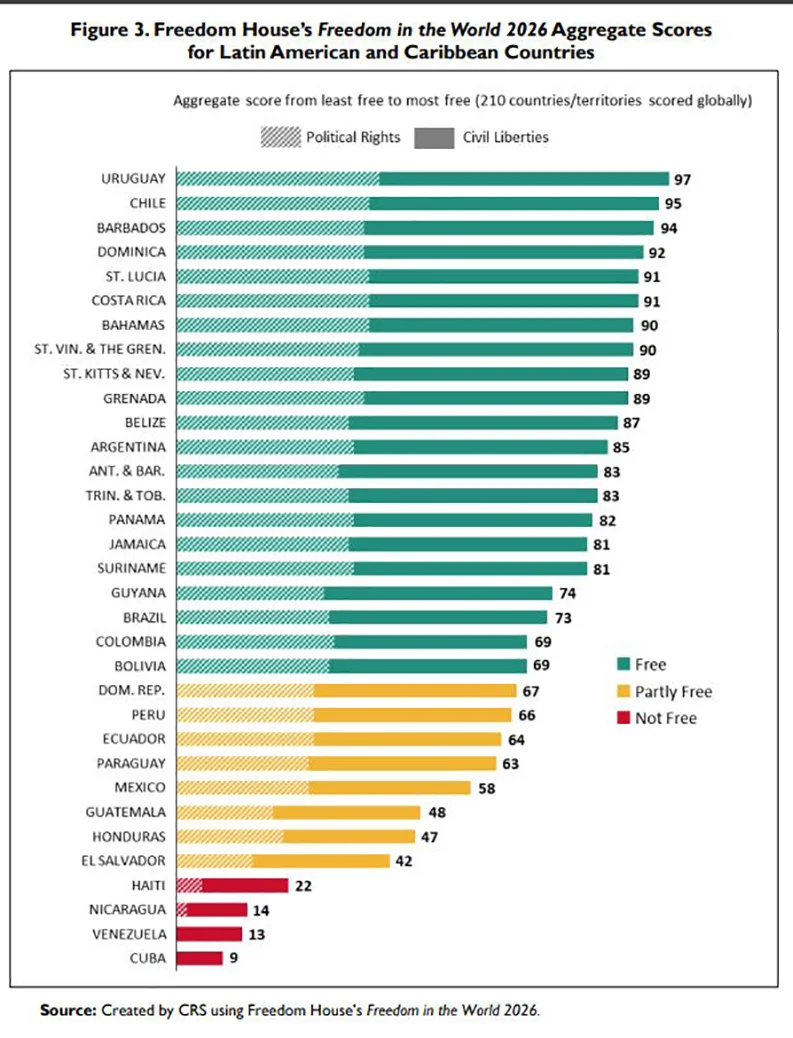
The average democracy index in Latin America and the Caribbean has risen for the first time in nine years. Improvements were recorded in 13 of the 24 countries, but conditions across the region differ sharply in terms of political rights, security and the functioning of the courts, according to the U.S. Congressional Research Service.
The report draws on data from four international studies of democracy and presents Freedom House scores ranging from 0 to 100 for political rights and civil liberties.
South America
Uruguay — 97 points. The Economist Intelligence Unit (EIU) classifies the country as a full democracy. It holds competitive elections and maintains independent media and broad civil rights. Experts point to slow court proceedings and prison conditions among its problems. In 2025, the homicide rate fell to 10.3 per 100,000 residents, although it remained above the level recorded before crime surged in 2018.
Chile — 95 points. Political institutions remain stable, although corruption and land disputes involving the Mapuche people persist. The EIU classifies Chile as a flawed democracy. The country has a relatively favorable homicide rate: 5.4 cases per 100,000 residents were recorded in 2025, compared with 6.1 a year earlier. Authorities continue to combat the influence of international criminal groups.
Argentina — 85 points. The country has free media and competitive elections. The EIU recorded an improvement in its scores for 2025, while V-Dem, which uses a different methodology, identified signs of weakening in some democratic institutions. Economic instability and corruption remain serious problems. The homicide rate stands at 3.7 per 100,000 residents. Currency and tax risks are also significant for investors.
Brazil — 73 points, up one point from the previous year. Political competition continues, but independent journalists face threats, and corruption remains a serious problem. V-Dem identifies signs of recovery in democratic institutions. In 2025, the homicide rate fell from 21 to 19.2 per 100,000 residents. Conditions are more difficult in northern states and Rio de Janeiro because of conflicts between criminal groups. National statistics therefore say little about safety at a particular address.
Bolivia — 69 points. Based on the results for 2025, the EIU placed the country among the five countries worldwide showing the greatest improvement in its democracy index. However, Bolivia is still classified as a hybrid regime. The extent of the changes remains to be assessed: InSight Crime could not obtain comparable nationwide homicide statistics for 2025.
Central America and the Caribbean
Costa Rica — 91 points. Its status as a full democracy coexists with a drug-trafficking problem. Elections are held regularly, civil liberties are well protected, and the legal system is relatively stable. In recent years, however, the country has become a major transit hub for cocaine. In 2025, the homicide rate reached 16.8 per 100,000 residents. Risks in areas linked to drug trafficking may be much higher than the national average.
Jamaica — 81 points. Elections are competitive, and transfers of power take place peacefully. Yet corruption and longstanding ties between politicians and criminal groups remain serious problems. In 2025, the number of homicides fell by almost 41%, to 23.7 per 100,000 residents. This is a notable improvement, but illegal firearms trafficking and gang activity continue to affect security.
Trinidad and Tobago — 83 points for political rights and civil liberties. The country has a parliamentary democracy and independent media, but crime remains high. In 2025, the homicide rate fell from 45.7 to 27 per 100,000 residents. The reduction has been linked to emergency measures introduced by the authorities, although it is unclear whether the results will last. The World Justice Project also reported a 1.2% improvement in its rule-of-law index.
Political Restrictions and Crises
Cuba — 9 points. There is no free competition between political parties for power, while independent media and civil society organizations operate under severe restrictions. The EIU classifies the political system as authoritarian. For foreign businesses, a major concern is the dependence of economic activity on government decisions and existing legal restrictions.
Nicaragua — 14 points. The opposition and independent organizations face pressure, and public oversight is limited. In the 2026 Rule of Law Index, the country ranks 139th out of 143. Reliable, comparable homicide data for 2025 are unavailable, making it difficult to assess actual safety conditions.
Venezuela — 13 points. The country ranks last, 143rd, in the World Justice Project's rule-of-law index. Political freedoms are restricted, and the independence of state institutions raises serious concerns. For investors, this increases risks when signing contracts, protecting property and resolving disputes with government authorities.
Haiti — 22 points for political rights and civil liberties. The country ranks 141st out of 143 for the rule of law. Armed groups control parts of its territory, and government institutions and courts operate under significant constraints. Around 8,100 homicides, or 68 per 100,000 residents, were recorded between January and November 2025. The UN estimates that some victims may have gone uncounted because access to dangerous areas is restricted.
Outlook for Investors
Analysts at International Investment note that the recovery in democratic indicators across Latin America has not been matched by comparable improvements in conditions for living and doing business. The regional index has risen because of changes in only some countries. Even well-developed political institutions do not eliminate organized crime, while a decline in homicides does not necessarily indicate a stronger justice system. For investors, this means that countries with similar political-freedom scores may differ considerably in their risk profiles.
The consequences are particularly visible in real estate. High crime rates increase the cost of securing properties and may weaken rental demand. Poor judicial protection makes it harder to enforce contracts, resolve disputes with developers and protect ownership rights. Markets where reductions in violence are supported by transparent rules and an independent judiciary will gain a long-term advantage. Together, these conditions can make investments more resilient, rather than a country's improved position in any single ranking.