










Montenegro Property Enters New Cycle
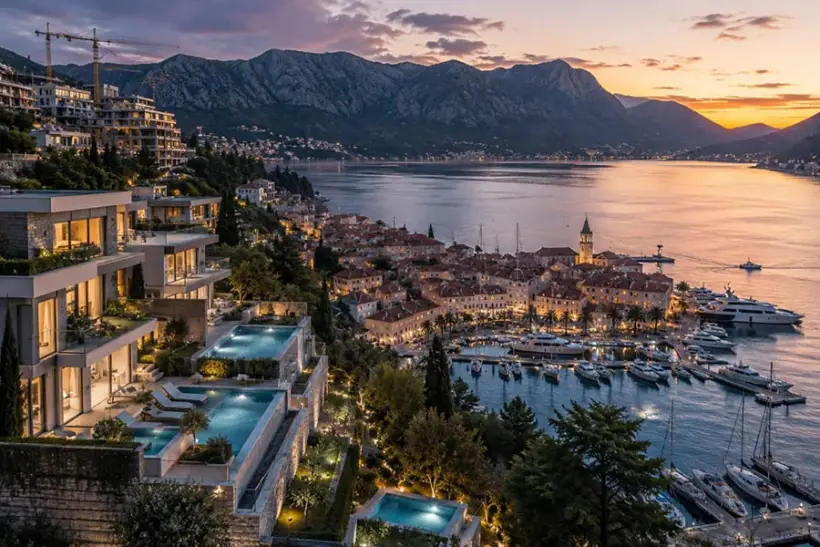
Montenegro’s real estate market is entering 2026 after a sharp price run-up and sustained foreign-capital inflows, with new residential buildings averaging €2,228 per square meter in the third quarter of 2025, coastal locations commanding a premium and tourism plus EU-accession talks continuing to support investor demand despite overheating and affordability risks.
The market is splitting between the coast and inland cities
Montenegro has become one of the most closely watched small real estate markets on the Adriatic not because of its size, but because of concentrated demand. A limited coastline, euro use and heavy reliance on tourism have attracted buyers looking for seaside property, rental income and exposure to a possible European Union convergence story.
Cyril Jarnias’ 2026 market analysis describes Montenegro as a market of micro-locations, where the coast, Tivat, the Bay of Kotor, Budva, Lustica and selected inland cities follow different trajectories. The report says that after strong growth since 2020, the market no longer moves uniformly: the most liquid assets are concentrated in tourism and infrastructure zones, while yields increasingly depend on seasonality, management quality and legal clarity.
For investors, this means that “buying Montenegro real estate” is no longer a precise strategy. An apartment in Budva, a managed unit near a Tivat marina, a stone house in the Bay of Kotor and a flat in Podgorica are different markets with different liquidity, tenant bases and overpayment risks.
New-build prices remain elevated
Official data confirm that prices have already moved significantly higher. According to MONSTAT, the average price per square meter in new residential buildings reached €2,228 nationwide in the third quarter of 2025, €2,153 in Podgorica, €2,458 in the coastal region and €1,578 in the northern region. No new residential-building sales were recorded in the central region during the reporting period.
The figures matter for two reasons. First, the coast already trades at a visible premium to most inland areas. Second, the data refer specifically to new residential buildings, not the entire property market. Existing homes, land, commercial property, villas and premium resort apartments may follow different price dynamics.
High new-build prices are raising the bar for buyers. Montenegro once competed mainly on affordability against neighboring markets. It now increasingly competes on a mix of sea access, location scarcity, tax environment, tourism rentals and expectations of EU accession.
Tourism remains the key rental driver
The holiday-home market is directly linked to tourism flows. In 2025, Montenegro recorded 2,728,564 tourist arrivals and 15,367,166 overnight stays, with foreign tourists accounting for 95.8% of all nights.
For property owners, this is a strong but not risk-free signal. The high share of foreign visitors supports short-term rentals in Budva, Kotor, Tivat, Herceg Novi and Lustica. But dependence on external demand makes yields sensitive to flights, regional security, visa rules, tourist incomes and competition among units.
The main constraint is seasonality. Summer rates can be high, but annual returns depend on occupancy outside July and August. Gross yield, meaning income before expenses, should not be confused with net yield after taxes, repairs, management fees, utilities, vacancies and marketing costs.
Foreign capital is supporting prices
Foreign buyers remain one of the market’s main drivers. SeeNews, citing the Central Bank of Montenegro, reported that total foreign direct investment inflows reached €212 million in January–March 2025, while real estate investment rose 21% year on year to €114 million. Investment into companies and banks fell 40% to €22 million.
That capital structure shows how important real estate has become to Montenegro’s investment image. Money is flowing into assets that investors can understand, see and rent out. For a small economy, that supports construction, employment, banking services and tax revenues, but it also increases dependence on foreign buyers.
If foreign demand weakens because of geopolitics, banking compliance, sanctions risks or a shift in investment preferences, expensive and less liquid assets could face longer resale periods. Purchases based on quick resale expectations, rather than income calculations, are especially exposed.
Construction does not automatically solve scarcity
New projects can increase supply, but they do not necessarily solve the shortage of affordable housing. In the fourth quarter of 2025, Montenegro issued 277 building permits and construction-work notifications; those permits provided for 1,474 dwellings with a total floor area of 108,529 square meters.
For the market, the signal is mixed. Construction activity creates future housing stock. But a large share of new development is aimed at coastal buyers, investment apartments or higher-end segments rather than local households with average incomes.
That is why construction growth can coexist with price growth. If new units are sold mainly to foreign buyers or investors, they expand the market without necessarily easing pressure on renters and first-time buyers in Podgorica, Budva or Tivat.
The EU path is now part of pricing
Montenegro’s path toward the European Union has become one of the main arguments for property buyers. The Council of the EU said the country had opened all 33 negotiating chapters, and after another provisional chapter closure in January 2026, 13 chapters had been provisionally closed in total.
For real estate, this means some investors are buying not only square meters, but also the expectation of future institutional convergence. Convergence means alignment of rules, standards and economic conditions with more developed EU markets. Buyers assume that accession could improve legal predictability, liquidity, infrastructure quality and country risk perception.
But that expectation is already partly priced in. If negotiations take longer than expected, reforms slow or investors overestimate the speed of EU alignment, the “future Europe” premium can become a source of disappointment. EU accession supports the long-term story, but it does not replace asset-level due diligence.
Macroeconomics supports demand but adds constraints
The International Monetary Fund projected Montenegro’s real gross domestic product growth at 3.2% in 2025 and similar rates over the forecast horizon. It also pointed to inflation of around 4% and a current-account deficit expected to widen to about 18% of GDP. A current-account deficit means a country spends more abroad on current transactions than it receives from exports of goods, services and income.
For real estate, the macro picture is mixed. Economic growth, tourism, wages and foreign investment support demand. But external imbalances and inflation make the market sensitive to capital inflows, import costs, energy prices and tourism earnings.
The World Bank separately noted that Montenegro’s growth slowed to 2.7% in 2025, the fiscal deficit widened to 4.3% of GDP and public debt stood at about 64% of GDP amid sizeable upcoming repayments.
For investors, this does not imply an immediate property shock, but it shows the limits of public support. If the market overheats, the government will need to balance fiscal discipline with infrastructure investment, social needs and preparations for EU membership.
Premium locations benefit from scarcity
The strongest assets remain those that are hard to reproduce: sea-view apartments, houses in the Bay of Kotor, units near marinas, high-quality managed complexes, plots with clear planning status and property close to airports and tourism infrastructure.
Tivat commands a premium for marina infrastructure, an international buyer base and higher service levels. The Bay of Kotor benefits from heritage, scenery and limited supply. Budva remains a liquid mass rental market, but competition among units is higher. Podgorica is driven more by local demand, employment, administrative functions and long-term rentals.
This market requires a micro approach. A national average price does little to value a specific asset if that asset’s price depends on views, distance to the sea, road access, parking, construction status, property management and the legality of short-term rentals.
Legal due diligence is becoming the main filter
In a fast-growing market, legal due diligence is not a formality. Buyers need to verify ownership title, cadastral records, building permits, encumbrances, the match between actual and registered floor area, utility access and the ability to rent the asset legally.
Extra care is needed when buying land, old houses, renovation assets and off-plan units. Restrictions may relate to land designation, planning conditions, road access, prior-owner debts or discrepancies between the built property and permits.
This is where market price and investment value can diverge. An expensive property with clean documentation and a clear rental model may be less risky than a cheaper asset with uncertain status, ownership conflicts or hidden costs that surface after completion.
As International Investment experts report, Montenegro’s 2026 property market can no longer be treated as a simple “cheap Adriatic” story. It is a post-surge market where the main opportunity has shifted from broad country re-rating to selective asset choice. The most resilient properties are rare, well-documented, rentable beyond peak season and transparent on ownership costs. The riskiest purchases are those based only on EU-accession expectations, advertised gross yields or hopes of a quick resale to the next foreign buyer.
FAQ
Why is Montenegro real estate attracting investors in 2026?
Montenegro combines an Adriatic coastline, euro use, tourism demand, foreign buyers and EU-accession negotiations. These factors support demand in Tivat, Budva, the Bay of Kotor, Lustica, Herceg Novi and Podgorica.
How much does property cost in Montenegro?
Official data show that in the third quarter of 2025, the average price in new residential buildings was €2,228 per square meter nationwide, €2,153 in Podgorica and €2,458 on the coast. Premium seaside properties can differ significantly from national averages.
Which areas of Montenegro are most attractive for buyers?
For holiday rentals, investors usually look at Budva, Tivat, the Bay of Kotor, Lustica and Herceg Novi. Podgorica is more closely linked to domestic demand, employment, administration and long-term rentals.
What are the main risks of buying property in Montenegro?
The main risks are legal title, overpaying in popular coastal locations, rental seasonality, dependence on foreign buyers, ownership costs and possible delays in EU integration.
Can investors earn rental income in Montenegro?
Yes, but returns depend on location, seasonality, property quality, management, taxes and vacancy. Gross yield before expenses does not show the investor’s actual net result.