












Dubai Villa Prices Rise by 18%
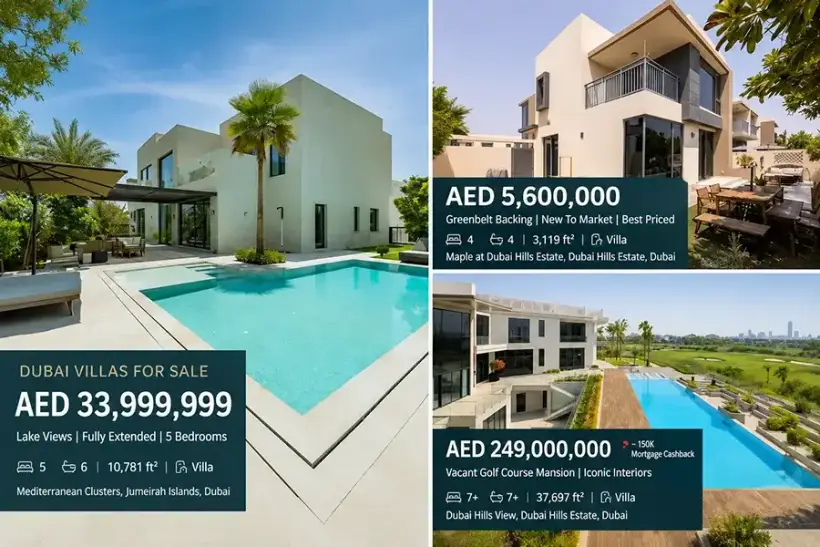
The market for villas in Dubai continues to rise, with the strongest momentum seen in larger properties. Buyers are increasingly considering homes with four bedrooms or more, while price differences between districts can reach several times over, according to Property Finder data.
Dubai House Price Trends
As of September 1, 2026, Property Finder listed around 13,900 homes for sale in Dubai. The statistics are based on properties advertised on the platform and reflect asking prices rather than final transaction values.
Over the past 12 months, the average home price reached AED 6.76 million ($1.84 million), up 17.56%. The average price per square foot increased by 14.83% to AED 1,747 ($476), equivalent to AED 18,805 ($5,120) per sq. m. The estimated rental yield stands at 4.23%.
Most of the available properties have three to five bedrooms, although homes with seven bedrooms or more are also on the market. A three-bedroom villa has an average size of 2,400 sq. ft. (223 sq. m.), with available options ranging from 1,400 to 4,200 sq. ft. (130–390 sq. m.).
For four-bedroom homes, the average size rises to 3,900 sq. ft. (362 sq. m.), with a range of 1,900–6,800 sq. ft. (177–632 sq. m.). Five-bedroom properties are considerably larger, averaging 6,500 sq. ft. (604 sq. m.), while sizes range from 2,500 to 10,000 sq. ft. (232–929 sq. m.).
Fastest-Growing Segment
The four-bedroom villa segment has recorded stronger growth than the overall market. Over the past 12 months, the average asking price increased by 22.84% to AED 5.59 million ($1.52 million), compared with a 17.56% rise across all villas.
The average price per square foot in this category increased by 14.4% to AED 1,714 ($467), equivalent to AED 18,450 ($5,024) per sq. m. The estimated rental yield stands at 4.27%, almost in line with the overall villa market average of 4.23%.
Property Finder currently features more than 5,000 listings for such villas. The widest selection is available in The Valley, Mohammed Bin Rashid City, Dubai South, Dubailand, Arabian Ranches 3, Tilal Al Ghaf and Dubai Hills Estate.
Rising prices for larger properties are accompanied by changing buyer preferences. The share of prospective buyers searching for villas in Dubai with four bedrooms or more increased from 44% to 50% over the past year. This category now accounts for half of all searches. The shift is linked to the growing number of high-net-worth residents in Dubai and stronger demand for more spacious homes. Buyers are also placing greater emphasis on prime locations and high-quality finishes.
Villa Prices Across Dubai
Villa prices in Dubai vary significantly by location. According to Bayut, the highest average transaction value in the first half of 2026 was recorded on Palm Jumeirah at AED 50.22 million ($13.67 million). The figure reached AED 28.24 million ($7.69 million) in Jumeirah Islands and AED 23.46 million ($6.39 million) in Al Barari.
In the premium segment, average transaction values were:
- Dubai Hills Estate — AED 13.67 million ($3.72 million);
- Tilal Al Ghaf — AED 9.97 million ($2.72 million);
- Arabian Ranches — AED 9.11 million ($2.48 million).
Four-bedroom villas in these areas sold for an average of AED 9.57 million ($2.60 million), AED 6.52 million ($1.77 million) and AED 8.15 million ($2.22 million), respectively.
Prices were considerably lower in more affordable locations. Average villa transaction values were:
- DAMAC Hills 2 — AED 1.82 million ($496,000);
- Dubailand — AED 2.93 million ($796,000);
- Dubai South — AED 3.34 million ($909,000).
The gap with premium districts reaches tens of millions of dirhams, highlighting the high degree of segmentation in Dubai’s villa market.
Outlook and Risks for Investors
International Investment analysts note that the future performance of Dubai’s villa market will depend on the continued inflow of affluent residents, the volume of new construction and the resilience of demand for family housing. The outlook, however, will also be shaped by external factors. Tensions remain elevated in the Middle East after hostilities between the United States and Iran resumed in late August following a month-long pause.
A prolonged escalation could negatively affect air travel, tourism and investment activity across the region. For Dubai, whose economy is closely linked to international travel and foreign capital, this creates a risk of weaker demand from overseas property buyers.
For investors, this makes property liquidity, rental demand and the prospects of individual districts increasingly important. If foreign capital inflows weaken, the most vulnerable purchases may be those based primarily on expectations of continued rapid price growth rather than stable rental income.