







 Inner London House Prices Fall 7.2%, Sharpest Since 2009
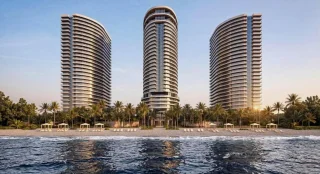 Swissôtel Kobuleti Beach Resort: $300M Investment in Kobuleti
 Georgia Plans to Build 600 km of Highways in 5–7 Years: Is Local Business Ready for Large-Scale Projects?
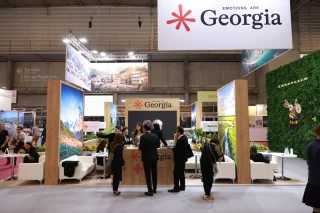 IBTM World Barcelona 2026: Georgia at the International Business Tourism Exhibition
 Spanish Home Sales Drop 13.4% in September
 Passenger Traffic at Georgian Airports Rose by 6.1%: Key Trends in Q3 Statistics
Branded Residences 2026: Capital Moves to Resorts

Branded residences are expanding well beyond London, New York, Miami and Dubai. Knight Frank’s new Residence Report 2026/27 highlights a clear resort shift: fewer than four in ten schemes were outside major cities a decade ago, while more than half are now located in coastal, island and mountain destinations. Around 1,088 developments could be operational globally by the end of 2026, with the total approaching 1,800 by 2031. Georgia is particularly well placed within this trend. International tourism remains near record levels, Batumi’s short-term apartment stock is expanding rapidly and internationally branded hospitality property remains a considerably smaller segment.
The market has almost tripled in a decade
Knight Frank assessed more than 200 brands and nearly 1,800 operational and pipeline schemes across 90 countries.
The number of operating projects increased from 354 in 2015 to 903 by the end of 2025. Around 1,088 could be operational by the end of 2026, while the scheme count is projected to rise by more than 60% over the following five years. A further roughly 200 disclosed projects are not yet included in the detailed scheme-level dataset.
The larger change is geographical. Fewer than 40% of developments were outside major cities in 2016. Today, more than half are located in coastal, island and mountain destinations.
Knight Frank The Residence Report 2026/27
Resort markets are catching up with global cities
London, New York, Paris, Miami and Dubai remain leading luxury residential markets. The resort shift is being driven by broader property portfolios rather than an urban decline.
The average residential portfolio of ultra-high-net-worth individuals has increased from 2.9 to 3.8 homes in less than a decade. International buyers are increasingly adding a lifestyle property outside major cities, particularly when it can be occupied immediately and managed professionally.
Pricing reflects that demand. Marbella’s upper range now broadly matches Madrid, while Comporta has reached values comparable with some established urban markets.
Resorts allow developers to build the entire product
Scarcity of suitable development sites is increasingly constraining large luxury schemes in European gateway cities.
Resort locations allow developers to create pools, wellness facilities, restaurants, clubs, sports infrastructure and hotel services as part of the masterplan rather than fitting them into an existing urban building.
Knight Frank points to Porto Heli in Greece, where Six Senses and Four Seasons are developing resort projects, and Comporta in Portugal, where restrictions on coastal development keep quality supply limited. Europe now accounts for around 17% of the global branded residence pipeline.
Hotel brands still lead the market
Hotel groups are behind around 70% of operational branded residence schemes. Their share falls to approximately 60% when pipeline projects are included, as automotive, fashion and lifestyle brands expand.
Hospitality brands have a practical advantage in resort markets. They already have operating systems, staff, distribution, reservation platforms and loyalty audiences.
International Investment has also noted that branded residences are moving beyond a narrow luxury-housing niche, with service quality and the operating model becoming increasingly important to long-term value.
International Investment on the evolution of branded residences
The Middle East shows the scale of the shift
The Middle East accounts for 29% of the global branded residence pipeline. Dubai remains the leading city market, but resort locations are expanding quickly.
Ras Al Khaimah provides one of the clearest examples. Al Marjan Island is attracting developments linked to JW Marriott, Waldorf Astoria, Nobu, Mondrian, Aston Martin and Missoni, combining private residences with hotels, restaurants and resort infrastructure.
The model shows how an international brand can help create a destination rather than merely differentiate one building.
Georgia is entering the same cycle
Georgia recorded 5.52 million international tourist visits in 2025, an increase of 8.4%, while international travel revenue reached $4.69 billion. Visits from the EU and UK rose 23.4% year on year in H1 2026 to a record 249,201.
Georgian National Tourism Administration statistics
A broader international visitor base increases demand for recognisable service standards, global reservation systems, wellness, dining and full resort infrastructure.
Batumi has far more apartments than branded hotel stock
Galt & Taggart estimated approximately 18,000–20,000 short-term rental apartments in Batumi at the end of 2024. The total could reach 35,000–40,000 by 2029.
Branded hotel supply is much smaller. Batumi had 2,966 rooms in 2024, with approximately 3,764 expected in 2026 and 4,079 in the current pipeline for 2027–2029.
The difference is significant. Thousands of similar studios and apartments compete within the same short-stay market, while internationally branded hotel property remains a much narrower segment.
Galt & Taggart Batumi real estate research
Gonio offers room for integrated resorts
Central Batumi and Gonio support different development formats.
Dense urban districts favour apartment-led projects. Gonio allows developers to create larger destinations that combine accommodation with pools, restaurants, wellness, medical, family, sport and business facilities.
This matches the direction identified by Knight Frank: buyers are increasingly looking for a residence that sits inside a complete resort rather than a stand-alone home with a branded name.
Wyndham Grand Batumi Gonio follows the global model
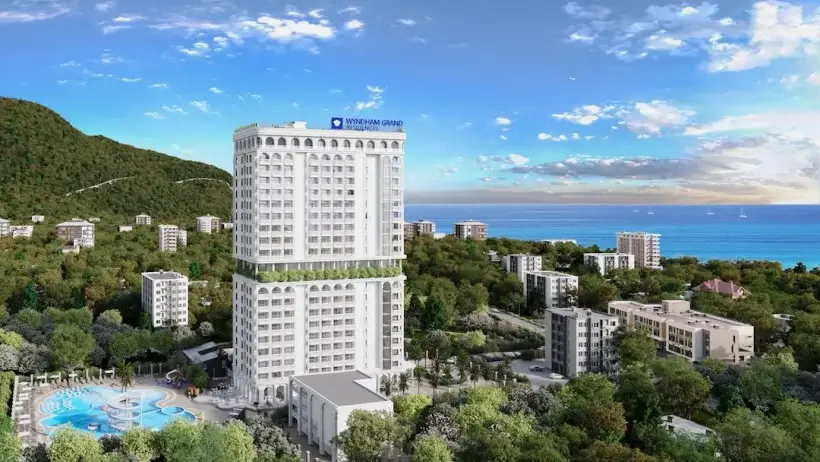
Wyndham Grand Batumi Gonio is one of Georgia’s largest examples of this format.
The development combines hotel rooms, penthouses, townhouses and villas under full ownership, with Wyndham Grand branding and Aimbridge Hospitality as the professional management company. Its resort infrastructure includes more than 100 facilities across 27,115 sq m.
The property is integrated into a hotel operating model, with guest services, pricing and daily management handled centrally.
This structure closely reflects the resort trend identified in Knight Frank’s global dаta: buyers increasingly value professional hospitality, infrastructure and ease of ownership alongside the brand itself.
Resort infrastructure is becoming part of the asset
Wyndham Grand Batumi Gonio includes dining, pools, spa and wellness, family, sport, medical and business infrastructure.
The development won the 2026 RE Awards category for hotel-project infrastructure, where the assessment highlighted its combination of family, wellness, events and long-stay formats within one resort ecosystem.
This also fits another theme in Knight Frank’s report. Wellness is moving from a supporting amenity into the structure of luxury residential projects, including medical services, recovery, personalised health and longer-stay concepts.
The operating model is part of the proposition
Branded resort property increasingly combines ownership with a defined operating model.
Wyndham Grand Batumi Gonio offers a contractual 10% annual guaranteed-return option or hotel-management income with stated potential of up to 16%. The official terms also include a 30% initial payment and interest-free instalments for up to 60 months.
International Investment has separately analysed how the guaranteed-income model is structured within the wider hotel concept.
International Investment analysis of Wyndham Grand Batumi Gonio
For Georgia, the format stands out because the mass short-term apartment sector is already large while centrally managed international hospitality property remains far more limited.
Georgia competes on market stage as well as price
Georgia’s advantage is not simply lower pricing than Dubai, Marbella or Mallorca.
Its branded hospitality market is at an earlier stage. Batumi already has a large investment-apartment sector and Georgia’s tourism indicators are near historic highs, while international branded resort supply remains comparatively limited.
This gives investors a different way to access tourism demand: through property inside a professional hotel system rather than a stand-alone rental unit.
International Investment has also positioned Georgia as a dedicated market for hotel investment property, linking demand to tourism growth, professional management and the development of international hotel projects.
Property can also support a residence strategy. Since March 2026, qualifying non-agricultural real estate valued above $150,000 equivalent can provide a basis for short-term residence, subject to programme requirements.
Buyers are paying for how the property works
With nearly 1,800 operational and pipeline schemes worldwide, a brand name alone is becoming less distinctive.
Buyers increasingly compare professional management, infrastructure, wellness, ease of ownership, personal-use options and the quality of the destination itself.
That explains why the next wave of branded residences is expanding into Marbella, Comporta, Porto Heli, Ras Al Khaimah and other lifestyle markets. Resort destinations allow developers to create the complete product rather than simply attach hospitality services to an urban residential building.
As International Investment experts report, the move towards resort branded residences does not represent a retreat from urban luxury property. It reflects a new geography of growth. Wealthy buyers are expanding their property portfolios and increasingly favour developments where ownership is combined with hospitality services and a complete resort environment. Georgia has a particularly clear opening in this segment: Batumi already has tens of thousands of investment apartments, while internationally branded hospitality remains much more limited. Wyndham Grand Batumi Gonio shows how the global model is taking shape on the Black Sea coast through an international hotel brand, professional management, private ownership and large-scale resort infrastructure.
FAQ: branded residences in 2026
What are branded residences?
They are privately owned properties associated with a recognised hotel, automotive, fashion or lifestyle brand. Hotel-branded projects typically combine ownership with hospitality services and professional management.
How large is the global branded residence market?
Knight Frank tracks nearly 1,800 operational and pipeline schemes in 90 countries. Around 1,088 projects could be operational by the end of 2026.
Why are branded residences expanding into resorts?
Resort locations provide more room for integrated hospitality, wellness, leisure and family infrastructure, while internationally mobile buyers increasingly own multiple homes outside major cities.
What share of schemes are now outside major cities?
More than half are located in coastal, island or mountain destinations, compared with fewer than 40% in 2016.
Do hotel brands still dominate?
Yes. Hotel brands account for around 70% of operational projects, although automotive, fashion and lifestyle brands are expanding rapidly.
Why is Georgia relevant to the trend?
Georgia combines record tourism indicators with relatively limited internationally branded hospitality supply, particularly compared with Batumi’s large short-term rental apartment market.
How many short-term rental apartments are there in Batumi?
Galt & Taggart estimated approximately 18,000–20,000 units at the end of 2024, potentially rising to 35,000–40,000 by 2029.
How many branded hotel rooms are there in Batumi?
Approximately 3,764 rooms are expected in 2026, with the current pipeline reaching around 4,079 for 2027–2029.
What is Wyndham Grand Batumi Gonio?
It is a large Wyndham Grand resort development in Gonio near Batumi, offering hotel rooms, penthouses, townhouses and villas under full ownership and professional management by Aimbridge Hospitality.
What income model does Wyndham Grand Batumi Gonio offer?
The project offers a contractual 10% annual guaranteed-return option or hotel-management income with stated potential of up to 16%.