







 Covivio Hotels Revenue Grows 4.7% as European Markets Split
 Lithuanian Apartment Prices Accelerate Across Major Cities
 Georgia's Tourism Revenue Hits Record High
 Norway's Sovereign Fund Commits €1.5bn to European Warehouses
 Market Rout of October 2026: Can Branded Hotels Protect Capital?
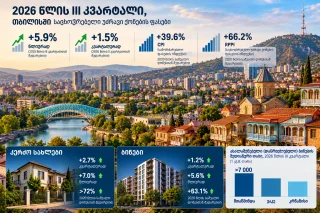 Residential Property Prices in Tbilisi Rise by 5.9% Year-on-Year
Finland's Housing Market: Home Prices Fall Faster Than Anywhere Else in the EU

Unsplash
In the second quarter of 2026, home prices in Finland fell by 2.7% compared with the same period of 2025. This was the steepest decline among EU countries, while prices across the bloc rose by an average of 4.7%, according to Eurostat. Buyer activity remains subdued despite the prolonged decline in apartment prices.
Property Prices in Finland
Comparison with the EU
In the third quarter of 2025, property prices in Finland fell by 2.7% compared with the same period of 2024, followed by a 2.6% decline in the fourth quarter. In January–March 2026, prices were 2% lower than a year earlier, and in April–June they were down 2.7%. On a quarter-on-quarter basis, however, the index edged up by 0.3%.
Luxembourg and France were the only other EU countries in the comparison to record annual price declines. Portugal, Bulgaria and Lithuania registered the strongest increases. The figures are presented in the table below.
Changes in house prices in Q2 2026 compared with Q2 2025
|
Country / region |
Price change |
|
Finland |
−2.7% |
|
Luxembourg |
−2.2% |
|
France |
−0.8% |
|
Euro area |
+4.0% |
|
EU |
+4.7% |
|
Spain |
+12.1% |
|
Lithuania |
+14.3% |
|
Bulgaria |
+15.5% |
|
Portugal |
+16.5% |
Housing Market Segments
Sales of existing apartments through real estate agents fell by 15.7% in April–June compared with the same period of 2025, even though prices declined by 3.9%. One-room apartments recorded the steepest drop (−6.9%), followed by two-room units (−4.5%) and family-sized apartments (−4.1%).
In the existing detached-house market, the number of transactions fell by 7.3%, while prices declined by 3.6%. These homes became 4.8% cheaper in major cities and 3.2% cheaper elsewhere.
Sales of apartments in new-build developments fell by 28.6%, and prices dropped by 1.7%. In Greater Helsinki, prices declined by 5%, while outside the capital region they rose by 1%. New detached houses, meanwhile, became 1.8% more expensive.
Home Sales in Finnish Cities
In the second quarter of 2026, existing apartments became cheaper in most of the cities covered. The sharpest declines were recorded in Mikkeli and Hämeenlinna, while prices rose in Rovaniemi and Kokkola. The detailed figures are shown below.
Existing-apartment prices: Q2 2026 compared with Q2 2025
|
City |
Price change |
|
Mikkeli |
−9.4% |
|
Hämeenlinna |
−8.1% |
|
Vantaa |
−4.9% |
|
Helsinki |
−4.3% |
|
Tampere |
−3.3% |
|
Oulu |
−0.9% |
|
Kokkola |
+0.7% |
|
Rovaniemi |
+6.0% |
In August, prices in Helsinki fell by 3.7% and in Turku by 3.3%. Oulu was an exception, recording growth of 2%. Outside the six largest cities, property prices declined by 3.8%, compared with 2.9% within those cities.
Mortgages in Finland: Interest Rates and Lending Terms
In August 2026, the average interest rate on new mortgages in Finland was 3.35%. Banks issued €1.13 billion in housing loans during the month, €20 million more than in the same period of 2025. Of this amount, €112 million was intended for property purchases for rental purposes. The outstanding mortgage portfolio reached €105.4 billion, down 0.3% over twelve months.
The maximum mortgage term was extended from 30 to 40 years in June 2026. By July, the average term of new agreements had approached 25 years, the longest on record. Yet lending volumes that month were 6% below their year-earlier level. Longer repayment periods have so far failed to produce a substantial recovery in mortgage lending.
Most new housing loans in Finland have variable interest rates, so changes in market rates affect borrowers' payments relatively quickly. Combined with cautious buyer sentiment, this makes housing demand especially sensitive to financing costs and economic expectations.
Rental Housing in Finland: Rents Barely Increase
Rents for non-subsidised housing in Finland rose by just 0.1% in the second quarter of 2026 compared with the same period of 2025. In the capital region, rates fell by 0.3%, while elsewhere they increased by 0.4%. The biggest rises were recorded in Rovaniemi (+2%), Vaasa (+1.3%) and Joensuu (+1.1%), while rents fell in Porvoo (−1.9%), Kerava (−1.6%) and Vantaa (−1.2%).
Average market rents in Helsinki were the highest among the cities shown, while Oulu had the lowest. Monthly rents per sq. m are listed in the table.
Average monthly rents in Q2 2026
|
City |
€ per sq. m / month |
|
Helsinki |
21.34 |
|
Espoo and Kauniainen |
18.82 |
|
Vantaa |
17.80 |
|
Tampere |
16.94 |
|
Turku |
15.63 |
|
Oulu |
14.20 |
State-subsidised rental housing in Finland became more expensive over the year, with rents rising by 2% in Greater Helsinki and 1.7% in other regions. According to CBRE, investment in Finland's residential rental market reached approximately €90 million in the second quarter, with foreign capital accounting for 48%. Greater Helsinki attracted 94% of the investment. Prime yields were estimated at 4.5% in the capital region and 5.1% in Turku and Tampere.
Residential Construction in Finland
From August 2025 through July 2026, permits were issued for the construction of 15,537 apartments, 16% fewer than during the preceding twelve months. Over the same period, 20,031 homes were completed, an increase of 1%. Developers are starting fewer projects, but buildings begun earlier are still reaching completion.
In July, the total permitted volume of new construction, measured in cubic metres, increased by 16% compared with the same month of 2025. However, the figure for residential buildings fell by 12%. The overall rise was driven mainly by information and communications technology facilities, including data centres.
Regional trends also differ. In Uusimaa, 9,226 apartments were completed over the twelve months to July, nearly half of the national total. The number of completed homes increased in nine regions, while the total volume of construction projects started across the country declined by 7%.
Why Are Home Prices Falling in Finland?
The reasons behind the decline in home prices in Finland include higher interest rates and an oversupply of small apartments built during the era of cheap borrowing, according to the Bank of Finland. As financing conditions changed, investor demand weakened and many completed properties proved difficult to sell. The problem is particularly evident in the compact-apartment segment.
Developers also face pressure from rising material, labour and land costs. The central bank notes that discounts on completed new-build properties reduce developers' profits and limit their capacity to launch new projects. A prolonged market downturn also increases risks for highly leveraged companies and investors.
In August 2026, Finland's trend unemployment rate stood at 10.1%, Statistics Finland reported. Employment was nevertheless 34,000 higher than in the same month of 2025. Uncertainty about jobs and future incomes continues to restrain demand for mortgages and major purchases.
Outlook for Finland's Property Market
The Bank of Finland expects a gradual recovery in residential construction but does not foresee a return to the peak volumes of 2018–2022. International Investment analysts note that the current price correction makes Finland's market more appealing to people purchasing a home to live in than to those planning to resell an apartment after a few years. Even at a lower purchase price, an owner in a smaller city may face limited demand when selling later.
For Russian citizens, buying property in Finland has become significantly more difficult: restrictions have applied since July 2025, although they do not cover every form of property ownership. These barriers encourage interest in other destinations and reduce Finland's appeal as an investment market.
For private investors from other countries, the combination of purchase prices and relatively low rental yields is also unattractive. The presence of large international funds does not change this assessment, as they operate with very different levels of capital and costs.
Frequently Asked Questions About Property in Finland
How did property prices in Finland change in 2026?
In the second quarter of 2026, prices fell by 2.7% compared with the same period of 2025. Over the same period, average home prices across the EU increased by 4.7%.
Why is property in Finland becoming cheaper?
The main reasons are the after-effects of higher interest rates, an oversupply of small apartments and weaker investor demand. Uncertainty over employment and income is also discouraging purchases.
Which has fallen more in price: existing homes or new builds?
In the second quarter of 2026, existing apartments became 3.9% cheaper, compared with a 1.7% decline for new builds. Transactions through real estate agents fell by 15.7% and 28.6%, respectively, compared with the same period of 2025.
Which Finnish cities saw the largest apartment-price declines?
In the second quarter of 2026, Mikkeli (−9.4%) and Hämeenlinna (−8.1%) recorded the steepest drops among the cities covered, compared with the same period of 2025. Prices rose in Rovaniemi (+6%) and Kokkola (+0.7%).
How much does it cost to rent an apartment in Finland?
In the second quarter of 2026, average market rents were €21.34 per sq. m per month in Helsinki, €16.94 in Tampere and €14.20 in Oulu. These figures refer to housing without government subsidies.
What mortgage terms are available in Finland?
In August 2026, the average interest rate on new housing loans was 3.35%. Since June, the maximum repayment term has been extended from 30 to 40 years, and variable-rate mortgages remain common.
Can Russian citizens buy property in Finland?
Restrictions on property purchases by Russian citizens have applied since July 2025. They do not cover all forms of apartment ownership; eligibility depends on how the property is legally held and the buyer's status.
Is investing in Finnish property profitable?
Lower purchase prices do not necessarily guarantee high returns. In the second quarter of 2026, market rents increased by only 0.1% compared with the same period of 2025, while weak demand can make properties harder to resell.