










Romania Tightens Migrant Worker Legalization
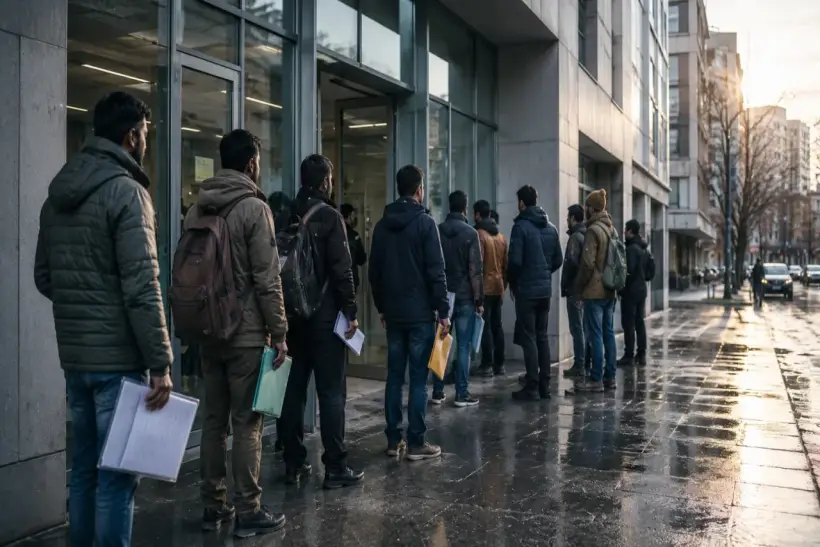
Romania has opened a new path for migrant workers to regularize their status, but activists and workers fear the procedure could become a tool for faster deportations. Against the backdrop of labor shortages, a 90,000-person foreign worker quota for 2026 and tighter controls on employers, the authorities are trying to close legal gaps that have long surrounded labor recruitment from Asia and other regions.
Migrant Workers Face Deportation Risks in Romania
Romania is trying to solve two problems at once: retain foreign workers needed by construction, logistics, retail, delivery, hospitality and manufacturing, while tightening control over those who have lost their legal basis to stay. The new regularization mechanism was meant to help people who fell into legal uncertainty after dismissal, employer changes, document delays or disputes with recruitment intermediaries.
Balkan Insight reported that activists and migrants see the program as a potential trap. According to the outlet, workers who approach immigration authorities to legalize their stay may discover that a return order has already been issued against them, turning the procedure from regularization into deportation. In one reported case, a 19-year-old Sri Lankan man went to the immigration office in Cluj-Napoca hoping to resolve his status, but was later sent from Romania via Istanbul back to Sri Lanka.
A return order is an administrative decision requiring a foreign national to leave the country. For a migrant who does not understand the legal consequences of such a document, or who has not received adequate translation and legal advice, an attempt to regularize status can become the moment when the state is able to enforce removal.
A New Program Promises Legal Status Until Year-End
The reform follows the accumulation in Romania of foreign workers who arrived through labor channels but later lost their link to the initial employer. Some continued working informally, some tried to find a new company, and others remained dependent on recruitment agencies. For the state, this created undeclared work, unpaid taxes, vulnerable workers and weak control over intermediaries.
The Business Standard wrote that the new amnesty gives Bangladeshi workers and other foreign nationals a chance to legalize their stay until December 31, 2026, provided they meet the required conditions. In this context, amnesty does not mean immunity in a criminal-law sense, but a temporary administrative route allowing a person to restore lawful residence.
The central problem is that the amnesty does not cancel return orders that have already been issued. If a worker arrives at an immigration office unaware of such a decision, or without understanding its legal force, he may no longer be treated primarily as an applicant for regularization but as a person subject to removal. That gap between the stated aim of the program and its practical effect has triggered concern among groups working with migrants.
Romania Rewrites Foreign Hiring Rules
The legal basis of the reform is Government Emergency Ordinance No. 32/2026, which entered into force on April 27, 2026. The act changed the rules governing access to Romania’s labor market for nationals of countries outside the European Union, the European Economic Area and Switzerland. It affects employers, recruitment agencies, long-stay visa procedures, residence extensions and document controls.
Vialto Partners says the ordinance introduces a more controlled and compliance-driven approach to hiring foreign nationals, including a list of shortage occupations to be updated by the Labor Ministry every six months or whenever needed. That list matters for employers because it defines where the state recognizes a shortage of local labor and permits the recruitment of foreign workers.
For employers, the reform means more obligations. Companies must comply with registration requirements, prove the legality of employment, work with authorized intermediaries and account for new restrictions on changing employers. For workers, the changes could improve protection from abusive agencies, but they also make dependence on formal procedures stronger.
The Foreign Worker Quota Falls to 90,000
Romania’s Labor Ministry said the government approved a quota of 90,000 newly admitted foreign workers for 2026. The stated goal is to cover staff shortages in several sectors. The figure is lower than in recent years, when the limit was around 100,000 permits, even though employers continue to report labor shortages.
The lower quota reflects a shift in the political balance. Romania’s economy still needs foreign labor, but the authorities want to show that inflows will be more tightly managed. This is happening as migration policy tightens across Europe and new European Union rules on asylum and migration management come into effect.
For business, the risk is that stricter administration could slow hiring in the sectors that struggle most to fill vacancies. For workers, the risk is greater: losing one employer can quickly become a loss of legal status, especially if a person is tied to debts incurred through intermediaries or financed the journey through loans.
Digital Filing Does Not Remove Legal Risk
Romania’s General Inspectorate for Immigration is expanding online applications, allowing applicants to upload supporting documents before appearing at a public counter. Administratively, this should reduce queues and speed up checks. But digitization does not solve the main problem: a migrant must understand exactly what legal status he has at the time of filing.
If a return order already exists in the system, an online interface does not by itself guarantee a safe route to advice. Without translation, legal help and clear notification, a worker may not distinguish a routine request for additional documents from a decision that triggers departure from the country.
That is why activists are demanding transparency. The issue is not only whether the state has the right to deport people without lawful residence. The issue is whether a program presented as legalization can be applied in a way that makes applicants walk into a removal process.
Employers and Agencies Face Tighter Oversight
Romania’s labor migration model depends heavily on agencies that recruit workers abroad, manage paperwork and connect migrants with employers. This system has long carried risks: inflated fees, debt dependency, promised wages that differ from real conditions, and difficulty changing employers after arrival.
The new regulation aims to close these gaps through authorization and monitoring of intermediaries. Agencies must operate under stricter rules, while employers face more responsibility for legal hiring. At the same time, restrictions on changing employers can have a mixed effect. They may reduce chaotic job-switching, but they can also deepen a migrant’s dependence on the original employer or intermediary.
For workers from Sri Lanka, Bangladesh, Nepal, Pakistan, India, Turkey and other countries, Romania remains attractive as a European Union labor market with strong demand for low- and medium-skilled work. But the cost of entry is often high: people take loans, pay intermediaries and expect to repay the debt over several years of work. Deportation in the first months can mean not only loss of status but a debt crisis for an entire family.
The European Context Increases Pressure on Bucharest
Romania joined the Schengen area with land borders on January 1, 2025, increasing the importance of migration controls. The authorities need to show European Union partners that the country can manage the entry, stay and employment of third-country nationals. At the same time, the domestic labor market needs flexibility because local workers are lacking in high-turnover, lower-paid sectors.
This conflict between economic need and political control is becoming central to Romanian migration policy. Businesses need workers, the state needs verifiable procedures, society wants assurance that the labor market is not slipping into informality, and migrants need predictable status.
The problem is that predictability remains the weakest link. If a legalization program is perceived as a deportation risk, many workers will avoid contact with the state. That could produce the opposite of the intended result: people may move deeper into informal employment, while oversight becomes weaker.
Romania is trying to legalize, restrict and discipline labor migration at the same time. But if migrants do not trust the procedures, the reform may increase the vulnerability of those it was supposed to bring out of the shadows. As experts at International Investment report, the critical risk of the new system is that the fight against irregular stay may undermine the legalization mechanism itself: if applicants cannot be sure that going to an immigration office will not end in removal, the state will get less transparency, businesses will get fewer workers, and migrants will become even more dependent on intermediaries.
FAQ
What has Romania changed for migrant workers?
Romania introduced new rules for foreign workers through Government Emergency Ordinance No. 32/2026. The reform strengthens oversight of employers and agencies, changes visa and permit procedures, and creates a route for some workers to regularize their status.
Why are migrants worried about the legalization program?
The concern is that a worker may seek regularization but discover that a return order has already been issued. In that case, the process may end in deportation rather than legal status.
What is a return order?
A return order is an administrative decision requiring a foreign national to leave the country. If it already exists, contact with immigration authorities may lead to enforcement.
How many foreign workers will Romania admit in 2026?
The government approved a quota of 90,000 newly admitted foreign workers for 2026. The quota is intended to address labor shortages in several sectors.
Which sectors in Romania rely on foreign workers?
The strongest demand is in construction, logistics, retail, delivery, hospitality, food services, agriculture and manufacturing.
Why does this matter for the European Union?
Romania has been part of the Schengen area with land borders since 2025, making migration control and third-country worker management an issue of both domestic policy and European trust.