







 US Introduces Visa Bonds of Up to $20,000 for Tourists From 50 Countries
 Portugal Secures €1.5 Billion for Social Housing
 Mortgage Lending in Georgia Increased by Nearly 50%
 Irish Homes Are 17% Overvalued as Supply Lags
 Buses from Latvia to Russia and Belarus May Be Cancelled
 Egypt’s Economy Accelerates to 5.1%
Serbia Brings Homes Into Legal Order
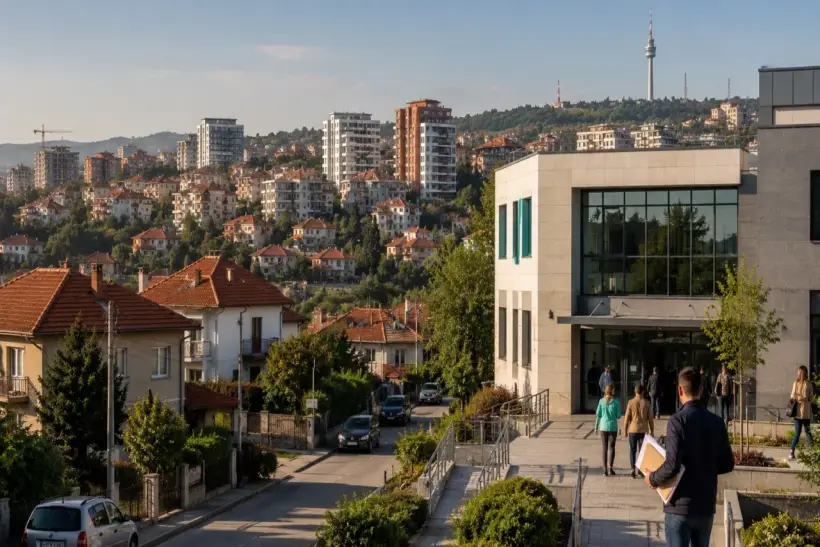
Serbia has launched one of its largest property-registration reforms in years, as the “Svoj na svome” programme seeks to bring hundreds of thousands of homes, apartments, garages and auxiliary buildings out of legal uncertainty, improving market transparency and strengthening confidence among buyers, banks and investors.
Serbia accelerates the registration of disputed property
Belgrade — Serbia is trying to close one of the Balkans’ most persistent structural gaps in real estate: a large stock of homes and auxiliary buildings has existed for years without complete documentation, full cadastral registration or clear ownership status. The government’s “Svoj na svome” programme, roughly meaning “secure on one’s own property,” is designed to simplify registration and strengthen legal certainty in the housing market.
This is not a minor administrative adjustment. It affects household wealth, bank lending, inheritance, infrastructure connections and property valuation. For the market, the issue is critical because a property without proper registration is harder to sell, transfer, mortgage or include in an investment project.
Colliers said in its May 2026 review that the initiative represents a digital step toward resolving informal construction and strengthening property rights. The company noted that the programme was launched in 2025 to simplify the legalization and registration of residential properties that were previously unregistered or built without complete documentation.
Hundreds of thousands of applications reveal the scale
Demand for registration was strong from the start. Serbia’s Republic Geodetic Authority reported that since applications opened on December 8, 2025, more than 420,000 requests for property-right registration had been submitted by late December under the “Svoj na svome” process. More than 80% of applications related to houses and auxiliary buildings, while the share exceeded 90% when apartments and other separate residential units were included.
That structure shows the programme is aimed primarily at private households rather than large commercial assets. For many families, the issue concerns homes they already occupy but which lack sufficient legal certainty for full market use. In such cases, ownership exists in practice but remains incomplete in law.
The official programme portal says the main application deadline expired at midnight on February 8, 2026, while people who missed the deadline for objective reasons may still apply until October 24, 2026. It also states that applications and status tracking are to be handled electronically with support from local authorities.
The cadaster becomes the core of the reform
A cadaster is a public system that records real estate, ownership rights and related property data. For a real estate market, it performs a basic function similar to a shareholder register in capital markets: it shows who owns an asset, where it is located and what restrictions may apply.
In Serbia, weak or incomplete registration has long reduced market transparency. Buyers could face unclear ownership history, banks could struggle to secure collateral, municipalities could operate with an incomplete tax base and investors could face prolonged disputes over land, buildings and infrastructure.
The “Svoj na svome” programme changes that logic. Once a property is registered, it becomes easier to sell, inherit, renovate, connect to utilities and use as collateral for a loan. For households, this marks a shift from factual possession to legally recognized ownership.
Digitalization lowers the administrative barrier
The reform relies heavily on electronic procedures. Applications could be filed through digital channels as well as through municipalities and post offices. This matters in Serbia, where many problematic properties are located in suburban and rural areas and owners do not always have access to complex legal support.
According to Serbian media citing the geodetic authority, around 700 support points and more than 4,500 staff were involved across the country, including postal workers and local-government employees. About half of all applications were filed online, with some submitted by mobile phone.
For the state, the digital procedure has two advantages. First, it accelerates data collection and reduces reliance on paper-based administration. Second, it creates a fuller information base for urban planning, taxation and infrastructure investment.
The housing market gains cleaner data
The more properties are registered, the more accurate the market becomes. That matters not only for households but also for valuers, banks, developers, insurers and institutional investors. Institutional investors are professional capital holders such as funds, banks, insurers and asset managers that invest under formal rules.
Serbia’s housing market remains active but uneven. The Statistical Office of the Republic of Serbia says 35,380 dwellings were completed in 2024, while 2,634 building permits were issued in March 2026. Building permits are a leading indicator: they point to future construction activity but do not guarantee that all projects will be completed on schedule.
Against a backdrop of construction activity and sustained interest in Belgrade, Novi Sad and other urban markets, legal clarity is becoming an important pricing factor. Registered property is usually more liquid, meaning it is easier to sell at a transparent market price. Incomplete documentation narrows the buyer base and limits access to bank financing.
Banks and mortgages depend on legal certainty
The programme matters for banks because mortgage lending requires reliable collateral. A mortgage is a loan secured by real estate, and the lender must be confident that the asset legally exists, belongs to the borrower and can serve as security. If ownership is not properly registered, a bank may refuse financing or demand additional guarantees.
The official programme portal lists easier and more favourable access to mortgage credit among the expected benefits. That could expand household access to finance, especially where a family already possesses a home in practice but could not use it in the banking system.
For the market, this means a potential increase in the number of properties suitable for credit-backed transactions. Over time, it could increase housing turnover, simplify family transfers, support renovation of older stock and raise the value of assets that previously traded at a discount because of legal risk.
Municipalities may expand their tax base
Legalization and registration also carry fiscal importance. Once a property enters official records, municipalities gain a more accurate basis for taxation, utility planning and infrastructure development. This is particularly important in areas where informal construction expanded faster than roads, networks, schools and public services.
The impact on local budgets, however, will depend on implementation quality. Registration does not build water systems, roads or sewage networks by itself. It creates the legal and informational basis on which authorities can plan investments and allocate costs.
For investors, this is also significant. A transparent cadaster lowers the risk of buying land or buildings with unclear histories and makes it easier to assess areas suitable for residential, retail or infrastructure development.
Lawyers warn about fast-track risks
Accelerated registration does not remove all concerns. MMD Advokati noted that the new law is intended to resolve a long-standing illegal-construction problem, but practical difficulties may arise from limited administrative capacity, the large number of applications and the design of appeal procedures.
A particularly sensitive issue concerns buildings constructed on land owned by others, in protected natural or cultural zones, on public-purpose land or in other excluded categories. In such cases, registration may not be possible, and buildings may face transfer to the state or demolition.
There is also a broader urban-planning risk. If governments repeatedly legalize buildings after they have been constructed, parts of the market may assume that future illegal construction can also be regularized later. The reform’s success will therefore depend not only on how many confirmations are issued but also on whether authorities can stop new illegal building.
Investors need rules, not only registration
For foreign buyers and professional investors, the programme creates a more understandable environment but does not remove the need for legal due diligence. Checks on ownership, construction history, land rights, infrastructure access and compliance with planning rules remain essential.
The strongest positive impact is likely in the residential sector, where many properties have long sat between factual possession and full registration. In commercial real estate, the effect may be more limited because institutional transactions already require strict documentation.
For developers, the programme may create opportunities in redevelopment zones. If rights over older houses, garages and auxiliary buildings become clearer, it becomes easier to consolidate plots, negotiate with owners and plan renewal projects. But without infrastructure investment and strict planning controls, the process could increase pressure on already strained districts.
Serbia addresses an old problem with a new system
The main difference between this reform and earlier efforts is the emphasis on digital records, mass applications and simplified procedures. For a country where illegal and incompletely registered construction accumulated over decades, this marks a shift from selective legalization toward systematic inventory.
But success cannot be measured only by the number of applications. The more important questions are how many properties receive durable legal records, how many disputes are resolved without undermining citizens’ rights, how much more accurate the cadaster becomes and whether the state can prevent the same problem from recurring.
According to experts at International Investment, “Svoj na svome” may become an important step toward a more mature Serbian real estate market, but its weak point is the risk of replacing urban-planning reform with mass registration of past violations. If registration is combined with a transparent cadaster, a strict ban on new illegal construction and infrastructure investment, the market will gain more liquid assets and stronger investor confidence; otherwise, Serbia may simply move an old problem into a new digital register.
What is the “Svoj na svome” programme?
“Svoj na svome” is a Serbian government programme for registering property rights over homes, apartments, garages and auxiliary buildings with incomplete or problematic documentation.
Why does the programme matter for Serbia’s real estate market?
It improves cadastral transparency, reduces legal risks in transactions, supports inheritance and sales, makes mortgage lending easier and expands the official municipal tax base.
How many applications were submitted?
More than 420,000 applications had been submitted by late December 2025, while authorities reported more than 100,000 confirmations by spring 2026.
Can any illegally built property be registered?
No. Properties built on land owned by others, in protected natural or cultural zones, on public-purpose land or in excluded categories may not qualify for registration.
How does the programme affect mortgages?
Once a property is properly recorded in the cadaster, it becomes easier to use it as collateral for a loan. That can improve access to mortgage financing and increase market liquidity.
What risks remain?
The main risks are administrative overload, disputed land rights, appeal-procedure concerns, infrastructure pressure and the danger that future illegal builders may expect another legalization round.