







 Australia’s Spring Auctions Rise but Remain Well Below 2025
 Number of Foreigners Holding Turkish Residence Permits Exceeds 1.27 Million
 Demand from Russian Tourists for Holidays in Georgia Rises by 20–25%
 Montenegro Property Buying Costs in 2026
 Four in Ten Companies Would Not Choose Slovakia
 Gulf Countries Prepare Unified Tourist Visa
Indonesia Cuts Airfare Tax to Offset Fuel Surcharges
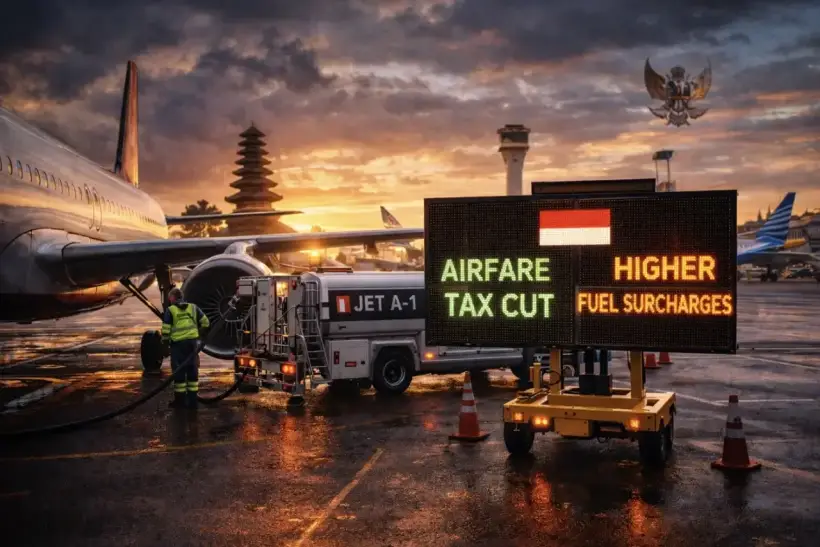
Indonesia is using tax relief to soften higher airline fuel charges
Indonesia is moving to reduce the tax burden on airfares in an effort to cushion the impact of higher fuel surcharges after a sharp jump in aviation fuel prices. According to Bloomberg-linked reporting and regional business coverage, the government is prepared to let airlines raise fares by as much as 13% while offsetting part of that increase through a tax measure designed to keep ticket prices more affordable. Coordinating Economic Minister Airlangga Hartarto said the policy would remain in place for the next two months and then be reviewed depending on how the Middle East crisis evolves.
This is not a full fare freeze. It is a balancing exercise between airline economics and passenger affordability. Even before the latest decision, the Indonesia National Air Carriers Association had been urging the government to lift both fuel surcharges and airfare ceilings, arguing that airlines could not absorb the shock from higher jet fuel prices after Pertamina reset domestic aviation fuel prices from April 1. Reports from Channel NewsAsia and Antara said the industry initially sought a 15% increase in both the surcharge and the fare ceiling, then pushed for further adjustment as fuel prices rose more sharply than expected.
Jet fuel prices in Indonesia surged from April
The tax move is a direct response to a domestic aviation fuel shock. Sector and news reports indicate that from April 1, 2026, domestic jet fuel prices in Indonesia increased by roughly 70% on average compared with March, with even larger jumps at some airports. Soekarno-Hatta airport was cited as an example where the increase exceeded 72%. For airlines, that means a sudden rise in one of the most important cost items in flight operations.
The shock matters especially in Indonesia because domestic aviation plays a structural role in movement across the archipelago. Unlike countries with dense land transport networks, Indonesia relies more heavily on domestic flights for business travel, tourism and basic inter-island mobility. That means fuel costs turn quickly into a macroeconomic and political issue rather than remaining just an airline-sector problem. The government had already shown that sensitivity by deciding against raising subsidized retail fuel prices more broadly for fear of hurting growth and social stability.
The relief mechanism builds on Indonesia’s VAT policy
The tax instrument at the center of the response is closely linked to value-added tax on domestic economy-class air tickets. Earlier in the year, during the Eid travel period, the government had already introduced a full government-borne 11% VAT incentive for domestic economy airfares. Official and tax-related explanations said the relief applied to both the base fare and the fuel surcharge, though not to optional extras such as baggage or seat selection. That arrangement was formalized in Finance Ministry regulation PMK 4/2026.
That is why the new measure appears less like a completely new intervention and more like an extension of a known policy approach. Jakarta is using the tax system to reduce the final price paid by passengers without forcing airlines to absorb the full fuel shock through margins. The difference is that the earlier VAT relief was tied to the Eid holiday period, whereas the new move is framed as a direct response to rising fuel surcharges and is expected to stay in place for at least two months.
The government is trying to keep domestic travel affordable
Jakarta’s logic is to prevent a sharp rise in ticket prices while still allowing airlines some room to pass through costs. The Business Times reported that the government had prepared mitigation measures so fares remain affordable even as airlines are allowed to raise prices within a limited range. That reflects a broader policy balance: the state is not blocking fare increases entirely, but is trying to dampen part of the impact through tax support.
This also fits Indonesia’s wider crisis-management line. Last week Airlangga Hartarto said the government was monitoring tax and fuel-relief steps taken by neighboring countries but had not yet decided on broad tax incentives in the energy field. Aviation now appears to be one of the first sectors where a targeted tax adjustment is being deployed quickly in response to a specific operating-cost shock.
Why the move matters for airlines, passengers and tourism
For Indonesia, airfares are not just a consumer price issue but part of national connectivity and tourism infrastructure. A sharp rise in ticket prices affects domestic movement, inter-island trips, hotel demand and tourism-heavy destinations including Bali. Regional coverage has already noted that higher fuel surcharges and airfare ceilings would affect not just local passengers but also international tourists who travel onward within Indonesia across multiple islands.
That makes the new measure important well beyond the airline sector. If the government can keep fare inflation within a manageable range, it may reduce the risk of weaker domestic travel demand in the second quarter. If the fuel shock lasts longer, however, the tax cushion may prove insufficient, and the policy debate could return to either more expensive fares or additional support for carriers. That matters especially as the broader oil shock is already complicating Indonesia’s budget outlook.
What it means for airlines and the budget
For airlines, the measure offers partial relief from political pressure. Carriers want permission to lift fares and surcharges because they cannot fully absorb the higher cost of jet fuel within the previous pricing structure. For the government, the trade-off runs in the other direction: the more it suppresses final ticket prices through tax relief, the more budget revenue it gives up. That is one reason the measure is currently limited to two months and explicitly subject to review.
As International Investment experts report, Indonesia’s approach shows Jakarta opting for a compromise model: not freezing fares outright, but not allowing the entire jet fuel shock to pass immediately to passengers either. For the market, that is a sign the government is willing to protect domestic mobility and tourism through temporary tax measures. For airlines, it offers a chance to partially restore route economics. For the budget, it is another reminder that the energy crisis is now reaching deep into transport and tax policy.
FAQ
What did Indonesia decide on airfares?
The government plans to reduce the tax burden on air tickets to cushion higher fuel surcharges while allowing airlines some limited fare increases.
Why are Indonesian airfares rising?
The main reason is a sharp increase in jet fuel prices after Pertamina adjusted domestic aviation fuel prices from April 1, 2026. The increase averaged around 70%.
Which tax mechanism is being used?
Indonesia had already used a government-borne 11% VAT incentive on domestic economy airfares during Eid, and that model appears to be the basis for the new cushioning measure.
How long will the measure last?
Airlangga Hartarto said the policy would apply for two months and then be reviewed.
Why is the move important for tourism?
Because domestic air travel is critical for Indonesia’s inter-island tourism economy, and higher fares could hit passenger demand and resort destinations.