







 Vietnam Mortgage Surge Pushes Homes Out of Reach
 Lithuanian Apartment Prices Accelerate Across Major Cities
 London Flats Lose Value Ahead of Leasehold Reform
 Construction of the Batumi–Sarpi Highway Begins in Georgia
 Baltic Property Investment Accelerates in 2026
 Hong Kong and Singapore Renew Their Expat Rivalry
Mexico Sets New Tourism Record in First Half
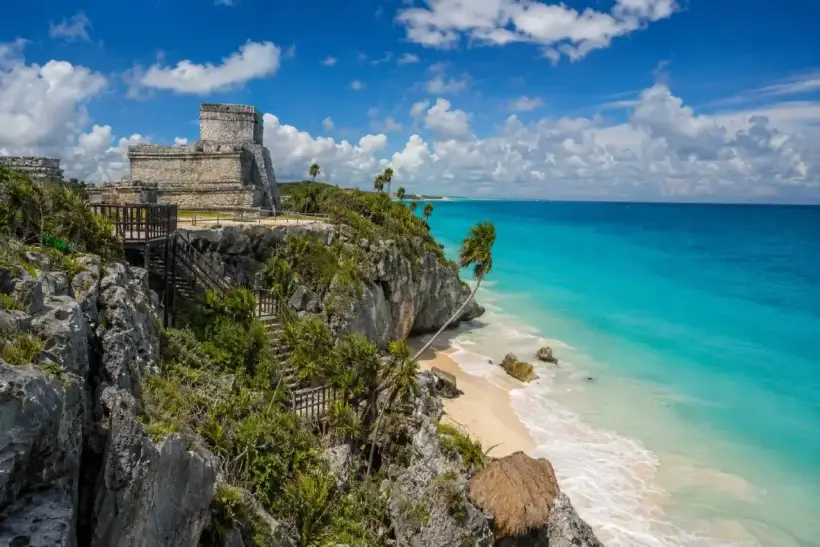
Mexico recorded a first-half record of 51.1 million international traveller entries between January and June 2026, 7.7% more than in the same period a year earlier. International tourists staying at least one night reached 24.5 million, up 4.6%, while international traveller spending exceeded $18.78 billion and increased by only 0.5%. The widening gap between total entries, overnight tourist growth and expenditure is the central feature of Mexico's 2026 tourism dаta: visitor volumes are expanding substantially faster than the money generated by inbound travel.
Mexico reaches a new tourism high
The 51.1 million headline number covers all international travellers entering Mexico rather than overnight tourists alone. That distinction is essential because the total includes people who leave without staying overnight, including many border visitors and cruise excursionists.
Travel Daily News, which reported the figures behind the original story, also cited 24.5 million international overnight tourists and $18.78 billion in tourism receipts. It said roughly 53.6 million Mexican domestic travellers stayed in hotels during the first half.
The 7.7% increase in international entries therefore cannot be applied directly to hotel demand. Overnight international tourist arrivals increased 4.6%, while international traveller expenditure rose only 0.5%. In percentage terms, total entries expanded roughly 15 times faster than spending.
For comparison, Mexico recorded 98.2 million international visitors during all of 2025, up 13.6%. Overnight international tourist arrivals reached 47.8 million, an increase of 6.1%, while international visitor spending climbed 6.2% to $34.992 billion.
June showed slower growth in overnight tourism
June provides a more detailed picture. Mexico's National Institute of Statistics and Geography defines an international tourist as a foreign resident who stays at least one night in Mexico and an international excursionist as a visitor who does not stay overnight.
Mexico registered 8,189,014 incoming international travellers in June 2026, 2.1% more than a year earlier. Of these, 4,112,469, or 50.2%, were overnight international tourists. Their numbers increased only 1.1%. Another 4,076,545, or 49.8%, were international excursionists, up 3.2%.
Within the tourist category, arrivals outside the border-tourism segment fell 3.2% to 2,206,897. Air arrivals in that category declined 5.3% to 1,751,818.
Border tourists moved in the opposite direction, increasing 6.5% to 1,905,572.
Maritime excursionists were among the fastest-growing groups. Mexico registered 843,417 of them in June, 21.5% more than a year earlier. Border excursionists declined 0.7% to 3,233,128.
Visitor spending outpaced June arrival growth
Financial indicators were considerably stronger than June visitor growth.
Inbound international travellers spent $2.9125 billion during the month, an increase of 5.9%. Overnight international tourists accounted for $2.6535 billion, up 6.3%, while international excursionists spent $259 million, an increase of 1.5%.
Average expenditure per international traveller rose 3.7% to $355.70. Overnight tourists spent an average of $645.20.
The highest-spending category was tourists arriving by air outside the border segment, whose average expenditure reached $1,283.80, up 9.6%.
That created a significant divergence: the number of travellers in this high-value air segment fell 5.3%, but their total spending still increased 3.8% to $2.249 billion because average expenditure rose sharply.
The United States dominates Mexico's key inbound market
The US remains the central source of Mexico's international tourism demand.
Of the 2.207 million tourists outside the border category in June, 1,527,011 were US residents, representing 69.2% of the segment.
South America and the Caribbean accounted for 13.8%, Canada for 5.7%, Central America for 4.5%, Europe for 3.5% and Asia for 2%.
Leisure, recreation and holidays represented 66.3% of trips. Visiting relatives and friends accounted for 26.1%, while professional and business travel represented 4.7%.
Airline data for January through May nevertheless showed some diversification. Passenger traffic carried by Canadian airlines to Mexico increased 10%, Central and South American airline traffic rose 6.2%, and European airline traffic increased 0.5%.
The World Cup shifted traffic toward host cities
The 2026 football World Cup had a visible effect on June air traffic in Mexico City, Guadalajara and Monterrey, the country's three host cities.
Migration statistics published by Mexico's Tourism Ministry show foreign tourist arrivals at Mexico City's main international airport rising 10.6% from June 2025. Guadalajara increased 6.2%, Monterrey 42.2% and Felipe Ángeles International Airport 53%.
A total of 1,602,621 foreign tourists were recorded entering Mexico by air during June. The United States accounted for 1,174,871 arrivals, Canada for 84,954 and Colombia for 72,465. Together, the three markets represented about 83% of the total.
The strongest annual increases were recorded for Japan at 131.7%, Colombia at 74.4%, South Korea at 46.7%, Brazil at 29.4%, Guatemala at 28.5% and Germany at 6.4%.
These migration figures should not be directly equated with the 1,751,818 non-border air tourists measured by the International Travellers Survey. The datasets are based on different registration systems and statistical definitions.
Cruise tourism is growing faster than hotel demand
Cruises have become one of the strongest contributors to the growth in Mexico's international visitor totals.
The government's Aug. 13 tourism presentation reported 6.6 million cruise visitors in the first half, 15.2% more than a year earlier. Cruise visitor spending reached $575 million, up 18.7%.
A separate administrative port series produces slightly different figures. Data based on records from Mexico's Navy Secretariat show approximately 6.5 million cruise passengers and 1,839 ship calls during the first six months. Passenger traffic increased 17.1%, ship calls rose 12.2%, and average passengers per vessel increased 4.3%, from 3,406 to 3,554.
Pacific ports handled 2,257,884 passengers, an annual increase of 36.4%.
The difference between the 6.5 million and 6.6 million totals, as well as between the 17.1% and 15.2% growth rates, reflects separate statistical series. Administrative port movements and international traveller statistics use different methodologies and should be compared within their respective datasets rather than merged.
Hotel occupancy is not matching border-entry growth
Mexico's hotel indicators underline the difference between headline international visitor growth and accommodation demand.
The latest monthly DataTur monitoring report covering 70 tourism centres puts average hotel occupancy at 58.4% for January through May 2026, down from 59.8% in the same period of 2025.
Beach destinations recorded occupancy of 67.1%, compared with 69.3% a year earlier, a decline of 2.2 percentage points. Urban destinations fell from 51.7% to 50.8%.
Among major monitored resort markets, average occupancy during the five months reached 87.1% in Playacar, 77.7% in Cabo San Lucas, 76.3% in Nuevo Nayarit, 75.5% in Cancún and 73.2% in Bahías de Huatulco.
The figures show that strong growth in international entries can coexist with lower average hotel occupancy because the composition of visitor traffic is changing.
Tourism employment exceeds five million
Tourism remains one of Mexico's largest sources of employment.
The number of people employed in tourism-related activities reached 5.022 million in the first quarter of 2026, 51,573 more than a year earlier. The annual increase was about 1%, and tourism accounted for 9.3% of the relevant national employment measure.
The methodology covers both paid employees and self-employed workers. The series is smoothed using the average of the latest four quarters, while indirect and induced employment is excluded.
Mexico expands international tourism promotion
The government has restored dedicated federal funding for international tourism promotion in 2026, with an initial 100 million pesos allocated for the period from June through December. The strategy is intended partly to strengthen Mexico in priority source markets and attract visitors associated with higher spending.
A major event in the second half will be the inaugural ITB Americas tourism trade show in Guadalajara from Nov. 10 to Nov. 12, 2026. Organizer Messe Berlin describes it as a business-to-business event covering North, Central and South America and the Caribbean.
Mexican authorities expect more than 5,000 attendees, about 300 hosted professional buyers and more than 40 international industry leaders and experts. The projected tourism-related economic impact exceeds 240 million pesos, including close to 20 million pesos for the hotel industry.
As International Investment experts report, Mexico's first-half record is best judged by the composition of demand rather than the headline 51.1 million international entries alone. Total traveller entries increased 7.7%, overnight tourists rose 4.6%, and inbound traveller spending increased just 0.5%. The 5.3% June decline in air arrivals outside the border-tourism segment is particularly important because those travellers spent more than $1,280 per person on average. At the same time, rapid cruise and border growth lifts visitor totals without generating an equivalent number of hotel nights. For hotel and resort-property investors, occupancy, length of stay, air arrivals and expenditure per tourist remain more informative indicators than border-crossing records.
FAQ: Mexico Tourism in 2026
How many international travellers entered Mexico in the first half of 2026?
Mexico recorded approximately 51.1 million international traveller entries between January and June, up 7.7% from the same period of 2025 and a first-half record.
How many international tourists stayed overnight in Mexico?
About 24.5 million international tourists spent at least one night in the country, an increase of 4.6% year on year.
How much did international travellers spend in Mexico?
Inbound traveller spending exceeded $18.78 billion during the first six months. The annual increase was about 0.5%, significantly below the growth rate in total visitor entries.
Which country is Mexico's largest international tourism market?
The United States remains by far the largest source market. US residents accounted for 69.2% of tourists outside the border-tourism segment in June.
Is Mexico's hotel occupancy increasing in 2026?
Not across the monitored market. Average occupancy in 70 tourism centres was 58.4% from January through May, compared with 59.8% a year earlier. Beach-destination occupancy declined 2.2 percentage points to 67.1%.
Why does 7.7% visitor growth not mean hotel demand increased 7.7%?
Almost half of the international travellers registered in June did not stay overnight. At the same time, non-border air tourist arrivals fell 5.3%, while maritime excursionists increased 21.5%.