







 Covivio Hotels Revenue Grows 4.7% as European Markets Split
 Lithuanian Apartment Prices Accelerate Across Major Cities
 Georgia's Tourism Revenue Hits Record High
 Norway's Sovereign Fund Commits €1.5bn to European Warehouses
 Market Rout of October 2026: Can Branded Hotels Protect Capital?
 Residential Property Prices in Tbilisi Rise by 5.9% Year-on-Year
European Tourists Look North as Nordic Travel Grows
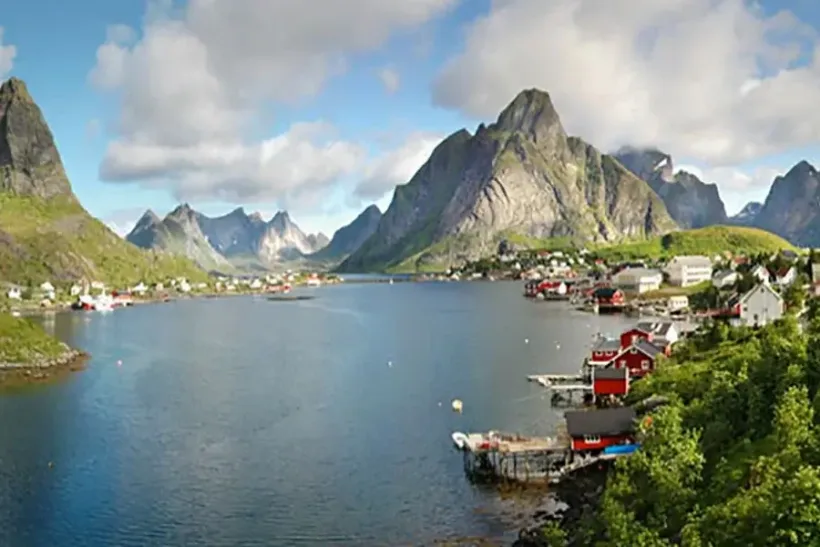
Tzuyen / Wikimedia Commons
Northern Europe was Europe's fastest-growing tourism subregion in the first half of 2026. International arrivals rose by about 10% and guest nights by 8.4%, compared with European averages of 5% and 4.8%. Hotel operators in Stockholm and Copenhagen, Norway's coastal destinations and Finland's Arctic resorts are benefiting from new demand. Yet the figures do not show a mass retreat from Spain, Italy or Greece.
The European Travel Commission's latest data point to a broadening of Europe's tourism map. Cooler summers, nature-based trips and new flight connections can support northern destinations, but property investors need occupancy, room revenue and operating costs rather than visitor counts alone.
Northern Europe outpaces the continental average
The ETC's Q2 2026 report recorded approximately 10% growth in international tourist arrivals to Northern Europe and 8.4% in overnight stays for the first half of the year. Europe overall posted 5% and 4.8%, while Central and Eastern Europe recorded 5.2% arrivals growth and 6.9% in nights. These are H1 figures, not full-year results.
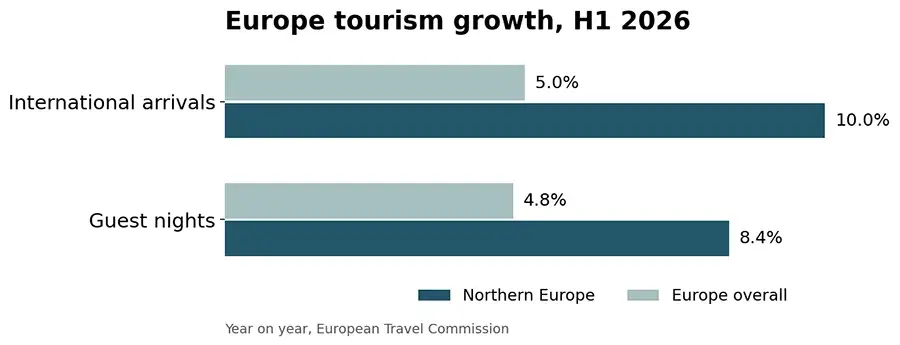
Arrivals growing faster than nights do not establish that tourists are staying longer. ETC's reporting population is also different from the national accommodation measures that include domestic visitors.
Cooler weather is one factor, not the whole story
Northern destinations offer long daylight hours, fjords, lakes and outdoor travel at milder summer temperatures. Extreme heat and overcrowding can influence decisions, but flight costs, currency, accessibility and safety also matter. European Commission modelling suggests northern coastal regions could gain summer demand under strong warming scenarios. Those scenarios are not forecasts for next summer.
Norway's hotels outperform other accommodation types
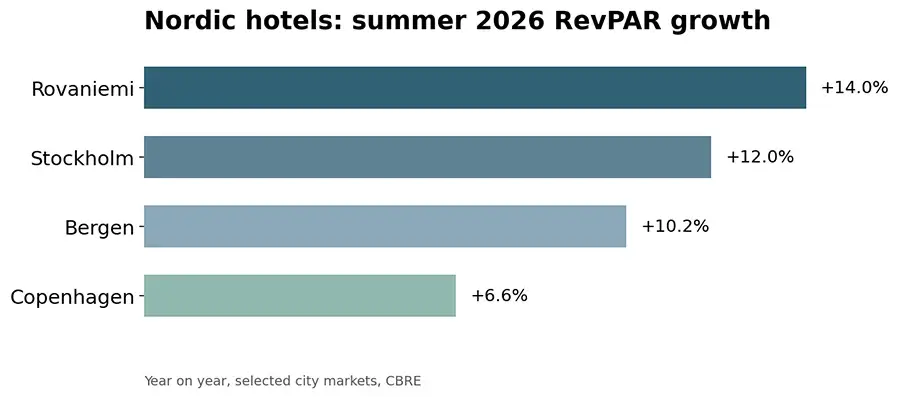
Norwegian commercial accommodation recorded 40.6 million nights in 2025, including 14.2 million foreign nights. In August 2026, foreign hotel guest nights rose 10.4%, while foreign nights across all commercial accommodation rose only 2.6%. Bergen hotels achieved 10.2% summer RevPAR growth; new supply made Tromsø more competitive.
Sweden breaks another summer record
Sweden registered 31.2 million commercial guest nights in June–August 2026, up 3.6%. Foreign visitors accounted for 9.8 million nights, a 6.2% increase. In Stockholm, summer RevPAR rose 12% and average daily rates increased 7.4%. These city-level financial metrics should not be mistaken for nationwide growth in visitor numbers.
Finland combines high winter prices with uneven summer demand
Lapland hotel rooms averaged €261 in January 2026 compared with €140 nationwide. Across Finland, total accommodation nights were broadly unchanged in August at 2.38 million, including 780,000 foreign nights. Rovaniemi's summer RevPAR rose 14%, but Helsinki, Turku and Tampere performed more weakly. A high Arctic peak-season rate does not guarantee year-round profitability.
Denmark combines Copenhagen and coastal holidays
Denmark recorded about 26.08 million guest nights in H1 2026, up roughly 2%, with foreign demand providing most of the increase. Copenhagen hotels reported summer occupancy of 88.2% and RevPAR growth of 6.6%. New figures for August nevertheless show a 5% annual decline in total Danish guest nights, while hotel stays increased. Its urban hotel market has different demand drivers from coastal holiday homes and rural resorts.
Iceland is a useful warning against generalisation
Iceland's hotels registered roughly 653,000 guest nights in August 2026, a 2.5% decline, and an eight-month fall of 0.3%. Yet guest nights across all forms of accommodation increased 3.3% that month. A fall in hotel nights cannot therefore be described as a decline across Iceland's whole tourism industry.
Comparable signals, different periods
|
Market |
Period |
Measure |
|
Northern Europe |
H1 2026 |
Arrivals +10%; nights +8.4% |
|
Norway |
August |
Foreign hotel nights +10.4% |
|
Sweden |
Jun–Aug |
Foreign guest nights +6.2% |
|
Denmark |
H1 2026 |
All nights about +2% |
|
Finland |
August |
All nights broadly flat |
|
Iceland |
August |
Hotel nights −2.5% |
Southern Europe is not losing its tourism base
In the ETC reporting sample, Greece's international arrivals grew 38% in H1 2026, Italy's 21% and Malta's 16%. Spain remains a major tourism destination with extensive air links and hotel capacity. Individual country growth rates are not directly interchangeable with the aggregate northern subregional measure.
Climate may shift some Mediterranean trips towards spring or autumn rather than send visitors to a different country. The evidence points to a more diversified European tourism market, not the disappearance of southern holidays.
Nordic hotel investment remains selective
CBRE reports €751 million in Nordic hotel transactions across 22 deals between January and August 2026. On a comparable basis excluding a large Midstar portfolio sale in 2025, investment volume increased 5%. For buyers, a strong season is not enough: labour costs, land availability, new hotel supply, annual occupancy and operating margins determine project returns.
Northern growth expands the investment map
Nordic cities can combine leisure and business guests, while Arctic destinations depend more heavily on seasonal travel. Bergen, Copenhagen, Stockholm and Rovaniemi each show a different mix of demand and supply. The opportunity is not simply to build hotels farther north, but to identify locations where sustainable demand can support investment beyond peak-season room rates.
FAQ
How fast is Northern European tourism growing in 2026?
The ETC reports approximately 10% growth in international arrivals and 8.4% in nights in H1 2026, compared with 5% and 4.8% for Europe overall.
Are visitors abandoning Spain, Italy and Greece?
No. Mediterranean destinations retain large visitor markets and several reported strong H1 growth.
Which Nordic markets are covered?
Norway, Sweden, Finland, Denmark and Iceland, using dated national accommodation data and CBRE hotel indicators.
Are all Nordic hotel markets expanding?
No. Finland's August nights were broadly flat and Iceland's hotel nights declined, even as other northern markets achieved records.
How much capital is flowing into Nordic hotels?
CBRE counted €751 million across 22 hotel deals from January to August 2026.
What should hotel investors assess?
Year-round occupancy, RevPAR, seasonality, labour and construction costs, air access, competitive supply and potential planning restrictions.