







 Europe Property Investment Reaches €171.9bn
 Rental Income Tax in Italy Could Fall to 1%
 Accor Plans €1.6bn Ennismore Stake Buyout
 Batumi New Boulevard Beach Nourishment: New 2.5 Million GEL Tender and the Coastal Protection Challenge
 Inner London House Prices Fall 7.2%, Sharpest Since 2009
 Swissôtel Kobuleti Beach Resort: $300M Investment in Kobuleti
Spain Hotel RevPAR Rises 9% in October

Spain's hotels generated 9% more revenue per available room in October 2026 than a year earlier, according to preliminary figures released by the national statistics office INE on 23 November. RevPAR reached €93.9, the average daily room rate (ADR) was €130.4, and overnight stays exceeded 34.7 million. Room revenue indicators grew substantially faster than the number of nights sold, which increased by 1.6%.
Room rates and revenue follow different paths
INE's hotel release combines occupancy survey results, the Hotel Price Index and hotel revenue indicators. ADR is average revenue per occupied room. RevPAR spreads room revenue over available inventory, incorporating the effect of rooms left unsold. Both help operators understand performance, but they answer different questions.
ADR increased 7.9% year on year to €130.4. RevPAR rose 9% to €93.9, while the Hotel Price Index gained 7.4%. The price index has its own methodology and should not be used as a substitute for ADR. Nor does RevPAR measure a property owner's net return: staffing, utilities, maintenance, distribution costs and operator contracts sit beyond the statistic.
Domestic and international demand
Spanish hotels recorded more than 34.7 million overnight stays in October, up 1.6% from the same month of 2025. Domestic nights rose by 2.7%, and non-resident nights increased by 1.2%. Over the first ten months, overnight stays were 1.5% higher year on year, with a modest 0.3% increase for Spanish residents and 2.1% growth among non-residents.
The Balearic Islands accounted for 27.2% of foreign-resident nights, followed by the Canary Islands at 22.5% and Catalonia at 16.2%. UK and German travellers generated 25.9% and 19.8% of non-resident hotel nights respectively. These distinctions matter for hotel investors because a national average conceals quite different destination calendars and source-market exposures.
Location and hotel category
The occupancy rate measured against offered bed places reached 61.8%. The Canary Islands led the autonomous communities at 74.8%; southern Gran Canaria registered 77.5%. Among the tourist points identified by INE, Estepona led on both ADR (€281.4) and RevPAR (€215.6).
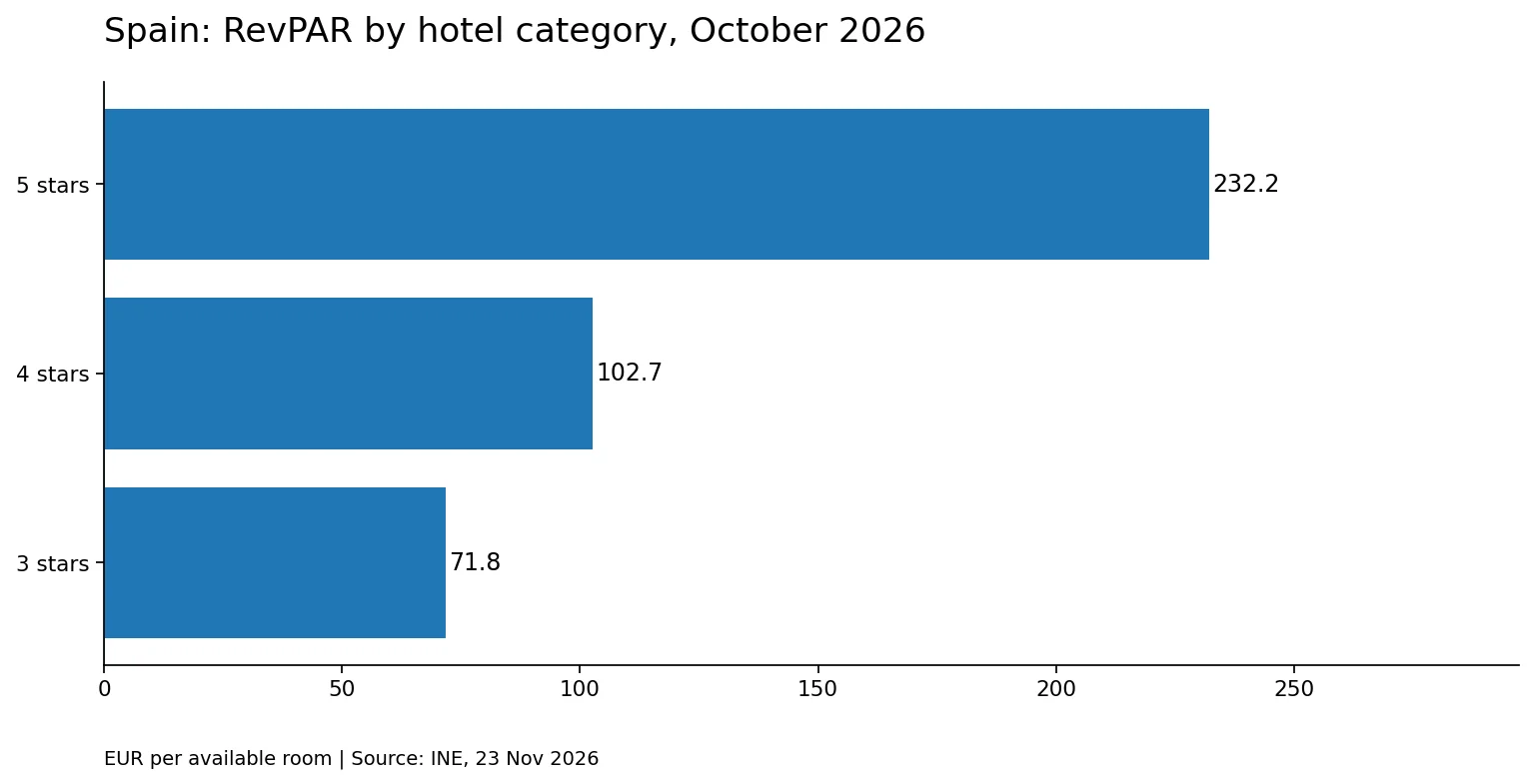
At the luxury end, five-star hotels achieved ADR of €312.1 and RevPAR of €232.2. The corresponding figures were €131.5 and €102.7 at four-star hotels, compared with €99.6 and €71.8 for three-star properties. Investors comparing assets need category and destination benchmarks alongside expenses and management assumptions.
What the results mean for hotel investment
Spain's hotels are generating higher room revenue despite much slower growth in overnight demand. That offers an encouraging operating signal, particularly for destinations with pricing power. However, national RevPAR cannot be dropped into a net-yield forecast for an individual asset. Acquisition prices, labour costs, renovation budgets, seasonality and management fees determine whether stronger hotel revenue reaches owners.
International Investment has already covered September's €14.488 billion in foreign visitor spending, an 8.1% annual increase. That measure includes spending beyond accommodation. The new October hotel statistics specifically quantify the room-revenue side of the market.
FAQ
What does the 9% rise in RevPAR mean?
In October 2026, Spanish hotels generated 9% more room revenue per available room than a year earlier. Average RevPAR was €93.9.
How does RevPAR differ from ADR?
ADR measures average revenue per occupied room, while RevPAR includes all available rooms, including those left unsold. ADR reached €130.4 in October.
How much did overnight stays increase?
Spanish hotels recorded more than 34.7 million overnight stays, up 1.6% from October 2025. Resident nights rose 2.7%, while non-resident nights increased 1.2%.
Is RevPAR the same as an investor’s return?
No. RevPAR measures room revenue before expenses and does not show an owner’s net income. An investment assessment also needs acquisition costs, operating expenses, management terms and capital expenditure.