







 How Ukraine’s New-Build Housing Market Has Changed Over Four Years
 European Prime Rents Rise as Property Yields Turn Higher
 The Most Expensive Airlines in Europe in 2026
 Housing Prices in Italy Reach a Two-Year High
 Travellers Increasingly Choose Cooler Scandinavia
 Serbia Property Sales Decline as Transaction Value Rises
Turkey Faces Harder Tourism Season
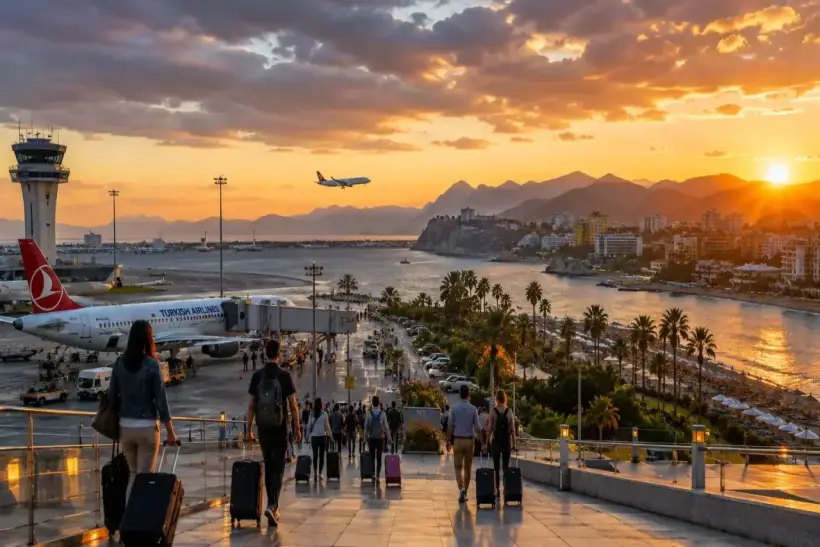
Turkey entered 2026 with higher tourism revenue and a modest increase in visitor numbers, but the second quarter is emerging as the industry’s main stress test. The Iran war has already changed traveller behaviour, pushing more bookings closer to departure dates and forcing hotels and tour operators to prepare for a summer season with greater uncertainty.
Tourism revenue rose in the first quarter
Turkey’s tourism industry started the year with positive headline numbers. According to the Turkish Statistical Institute, tourism income rose 4.2% year on year in January–March 2026 to $9.896 billion. Visitor spending accounted for $9.694 billion of that total, while transit passengers contributed $201.9 million. Individual expenditures reached $8.47 billion and package-tour spending stood at $1.225 billion.
The number of departing visitors, a statistical category covering foreigners and Turkish citizens permanently living abroad, increased 1.5% to 9.258 million. Turkish citizens residing abroad represented 25.7% of that flow, or 2.38 million visits. Average nightly spending by visitors was $102, while the Turkish diaspora spent $72 per night.
March improved, but risks remain
Reuters reported that foreign arrivals in March rose by about 5% year on year to 2.46 million, but officials and market participants expect a more difficult second quarter because of the Iran war. According to Arab News, Culture and Tourism Minister Mehmet Nuri Ersoy said a “difficult second quarter” lies ahead, with the negative effects of the war likely to be felt more strongly; he also linked recovery to a lasting ceasefire and noted the growing importance of last-minute bookings.
The March data matter because it was the first full month after the war began, but they do not capture the full effect on the summer season. Turkish tourism depends heavily on early bookings, air connectivity, insurance conditions and perceptions of safety in Europe, Russia, the Middle East and the Gulf. A positive first quarter therefore does not guarantee a smooth peak season.
Germany, Russia and Iran remain core markets
Turkey’s visitor base remains concentrated. Türkiye Today, citing official data, reported that the largest first-quarter source markets included Germany with 678,000 visitors, Russia with 651,000, Bulgaria with 539,000, Iran with 527,000 and the United Kingdom with 314,000. That explains why a regional conflict creates a double risk for Turkey: the country depends both on European demand and on flows from nearby markets.
The most sensitive segments are destinations relying on organised holidays and flight routes exposed to unstable air corridors. For Antalya, Istanbul, the Aegean coast and Cappadocia, the key issue is no longer only the number of tourists, but booking depth, airfares and travellers’ willingness to confirm trips in advance.
Revenue growth is driven by spending
Revenue growth in the first quarter outpaced visitor growth. That means Turkey is still protecting tourism income through spending on food, accommodation, transport, medical services and cultural travel. Anadolu Agency, citing the Turkish Statistical Institute, reported that food and beverages accounted for 27% of tourism income, international transport for 15.8% and accommodation for 13%. Accommodation spending rose 21.2% year on year, health-related spending increased 18.4% and food and beverage expenses climbed 13.7%.
Leisure, entertainment, sports and culture remained the main travel purpose, accounting for 55.3% of visitors. Visiting relatives and friends made up 26.8%, while shopping represented 8.2%. This mix helps Turkey because the country is not dependent only on beach tourism, but a combination of resorts, cultural travel, medical services and diaspora visits does not fully shield it from external shocks.
The war is changing travel behaviour
The Iran war has increased uncertainty across the eastern Mediterranean and the Middle East. The Financial Times reported that the conflict has intensified pressure on Turkey’s economic stabilisation programme: the country imports about three quarters of its energy needs, while energy-market disruption is worsening inflation expectations and the trade balance. For tourism, that matters through jet fuel, airfares, insurance and hotel operating costs.
For travellers, the risk is not only about safety inside Turkey. It also concerns flight routes, possible schedule changes, insurance exclusions and the psychological perception of the wider region. For tour operators, the effect is lower visibility on occupancy, a shorter sales window and a greater need to stimulate demand close to departure dates.
Turkey is defending a strong 2025 base
The industry entered 2026 after a strong year. The Culture and Tourism Ministry said Turkey closed 2025 with 64 million visitors and $65.2 billion in tourism revenue. Against that base, the first quarter of 2026 looks resilient but not exceptional: growth is positive, yet not large enough to fully offset possible summer losses if the geopolitical environment deteriorates.
If bookings remain last-minute, Turkish businesses will need to rely more heavily on pricing, domestic demand and source markets where risk perception is lower. But discounts are not a complete solution. With higher costs for energy, wages, food and financing, hotels may face margin pressure even if occupancy stays relatively high.
What it means for property investors
For investors in hotels, serviced apartments, resort property and tourism-linked real estate in Turkey, the main 2026 indicator is not only visitor volume but revenue per guest. The first quarter showed that Turkey can still lift income with only modest visitor growth. The second quarter will test a model built on mass tourism, aviation access and the country’s reputation as a safe regional destination.
Projects relying on a short peak season and organised tourist flows are the most exposed. Assets serving several segments — family holidays, longer stays, medical tourism, domestic demand and diaspora travel — look more resilient. For resort property, rental yields in 2026 may depend more on management flexibility and distribution channels than on headline visitor growth.
As reported by experts at International Investment, the first-quarter data should not create the illusion of a risk-free season: Turkey retains a strong tourism brand and a large revenue base, but the Iran war turns the second quarter into a stress test for the whole model. The critical question is whether the country can preserve revenue per visitor without excessive discounting if travellers keep delaying decisions and aviation and insurance remain more expensive because of regional risk.
How much did Turkey earn from tourism in the first quarter of 2026?
Turkey earned $9.896 billion from tourism in January–March 2026, up 4.2% from the same period a year earlier.
How many visitors did Turkey record in the first quarter of 2026?
Turkey recorded 9.258 million departing visitors in the first quarter, including foreigners and Turkish citizens permanently living abroad.
Why is the second quarter difficult for Turkish tourism?
The main reason is the Iran war, which has increased uncertainty, changed booking behaviour, raised the share of last-minute reservations and created risks for aviation.
Which markets are important for Turkish tourism?
Germany, Russia, Bulgaria, Iran and the United Kingdom were among the largest first-quarter source markets. This makes Turkey dependent on both European and regional demand.
Could holidays in Turkey become cheaper?
Prices may move in both directions. Hotels and tour operators may use discounts to support demand, but higher costs for energy, flights and insurance could limit price cuts.
What does this mean for real estate investors in Turkey?
Investors should look beyond total tourist arrivals and assess revenue per guest, seasonality, sales channels and exposure to organised tourism. In 2026, flexible management is likely to matter more than headline growth.