







 China Nears a Decision on Fresh Stimulus
 Fines for Illegal Rentals in Spain Reach €800,000
 Australia’s Spring Auctions Rise but Remain Well Below 2025
 Number of Foreigners Holding Turkish Residence Permits Exceeds 1.27 Million
 Demand from Russian Tourists for Holidays in Georgia Rises by 20–25%
 Montenegro Property Buying Costs in 2026
Alpine Homes Keep Getting Pricier
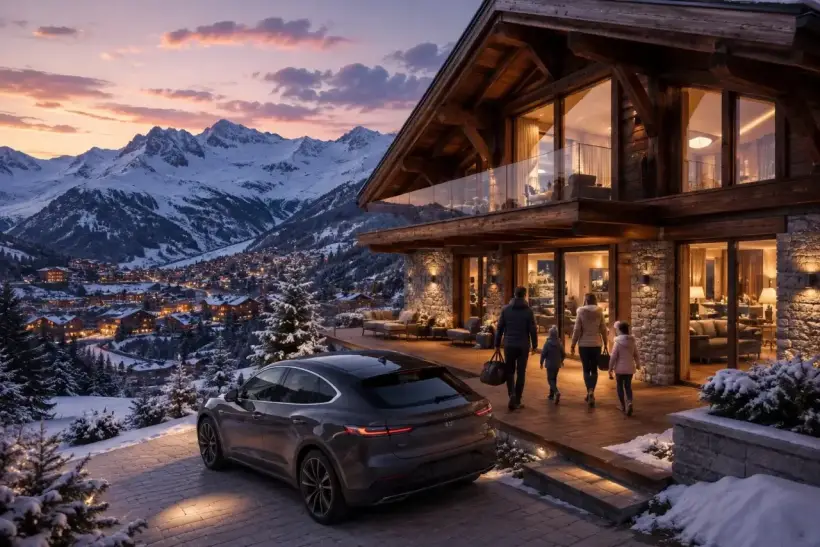
Alpine holiday homes remain one of Europe’s most resilient premium real estate segments: prices rose by nearly 4% in 2025 despite an already expensive base, climate risks and political debate over second homes. Buyers are paying not only for square metres, but for scarcity, safety, status and the ability to retreat from overheated cities into the mountains.
The Alpine market accelerates after a pause
Prices for Alpine holiday homes rose by almost 4% in 2025, accelerating from the previous year. This is not a return to the 2021–2023 boom, when cheap money, pandemic-era lifestyle shifts and remote work sharply lifted demand for second homes. But it confirms that the upper end of the Alpine market remains resilient even after higher rates and real estate repricing across Europe.
The market’s defining feature is limited supply. In the best Alpine resorts, it is almost impossible to create new housing quickly: mountain topography, environmental rules, local regulations, second-home restrictions, scarce land and resistance to overdevelopment all constrain construction. Even a moderate rise in demand can therefore move prices.
For wealthy buyers, an Alpine home is no longer only a holiday property. It is a family residence, a capital-preservation asset, a status symbol, a potential retirement base and a place to work remotely from a safe jurisdiction. This layered demand explains why prices keep rising even though the entry ticket is already extremely high.
Switzerland holds the price crown
The five most expensive Alpine holiday-home markets are all in Switzerland. Gstaad leads the ranking, with upscale properties priced at around CHF 25,000 per sq. m. Engadin/St. Moritz ranks second at about CHF 24,000 per sq. m. Verbier, Andermatt and Zermatt complete the top five, with prices starting around CHF 21,000 per sq. m.
Switzerland’s leadership is not only about scenery. Buyers pay for a stable currency, high security, strong infrastructure, healthcare, private schools, transport access, tax predictability and the country’s reputation as a safe haven for capital. For international buyers, these factors are often as important as ski slopes.
Gstaad is particularly revealing. It is not the largest resort, but it is one of the most exclusive. Its high price reflects not only property quality but also scarcity. In such locations, the market does not follow conventional logic: even at high prices, sellers are scarce, and buyers are often not dependent on mortgage finance.
Italy and Switzerland show the strongest momentum
In 2025, Switzerland and Italy posted the strongest price growth among the top destinations, at nearly 6% each. For Switzerland, this extends an existing trend: tight supply, strong domestic demand, a growing number of wealthy households and international interest continue to support values even in mature resorts.
The Italian Alps look different. Prices are generally lower than in Switzerland, which means the market still has catch-up potential. Cortina d’Ampezzo became the most expensive Italian destination in UBS’s surveyed markets, at about CHF 12,000 per sq. m, or roughly EUR 13,000. The 2026 Milan-Cortina Winter Olympics add another driver by increasing attention to the region, infrastructure and future tourism demand.
Austria recorded growth of just over 3%, partly offsetting earlier declines. Kitzbühel remains the most expensive Austrian destination, with premium homes priced around CHF 15,000 per sq. m, or roughly EUR 16,000. French resorts grew more slowly: in top destinations, prices rose by about 1%, pointing to a more mature market and greater buyer caution after the previous price cycle.
Courchevel remains the most expensive outside Switzerland
In France, Courchevel remains the key price benchmark. Upscale Alpine homes there are valued at around CHF 18,500 per sq. m, or about EUR 20,000. That makes Courchevel the most expensive Alpine destination outside Switzerland.
The French market benefits from deep tourism infrastructure, large ski areas and strong international branding. But in 2025, price growth was weaker than in Switzerland and Italy. For buyers, this may mean more moderate appreciation, though not necessarily affordability: the best properties in Courchevel, Megève, Val d’Isère and Chamonix remain markets for wealthy clients.
France is also more exposed to debates about climate and resort altitude. The lower a resort is located, the greater the long-term risk of unreliable snow. This does not eliminate demand, but it changes the selection criteria: buyers increasingly assess not only views, size and finishes, but also altitude, year-round appeal, transport and summer activities.
Remote work and hot cities support demand
Alpine homes have benefited from a new geography of wealth. Remote work allows affluent buyers to spend more time in the mountains, making a second home more than an asset used for only a few weeks a year. This changes the economics of ownership: the more frequently a family uses the property, the easier it is to justify a high price.
Another factor is summer heat in cities. More frequent heatwaves make mountain regions attractive not only in winter but also in summer. The Alps are increasingly seen as a cool alternative to overheated metropolitan areas and Mediterranean destinations facing growing pressure on infrastructure, water and energy.
This matters especially for older buyers and families with children. Rising life expectancy and the desire to spend retirement in a safe, clean and well-serviced environment support demand for mountain residences. In Switzerland, an additional motive is the ability to later use a second home as a primary residence and potentially benefit from tax advantages in certain cantons.
Limited supply matters more than rates
Lower financing costs in 2025 supported demand, but the Alpine market is not simply a mortgage-cycle story. In the premium segment, many buyers have substantial equity and are less rate-sensitive than the mainstream housing market. Monetary conditions therefore matter less than in ordinary urban apartment markets.
Supply is more important. In Swiss mountain regions, the pool of wealthy potential buyers has grown much faster than housing stock in recent years. If the number of high-income households increases while new homes remain scarce, prices can keep rising even in a more cautious economy.
That helps explain why regulatory measures may have limited impact. Tougher rules for foreign buyers, second-home taxes or construction restrictions can change the composition of demand, but when supply is chronically tight, they do not necessarily bring down prices in the best locations.
Climate risk becomes part of pricing
Climate change creates a double effect for Alpine property. On one hand, warmer winters and declining snow reliability can weaken the appeal of some resorts, especially at lower altitudes. On the other hand, hotter summers increase demand for mountain residences as climate retreats.
For buyers, this means more complex due diligence. It is no longer enough to buy a beautiful chalet next to a slope. Altitude, artificial snowmaking, tourism diversification, summer infrastructure, transport access, water resources and the resilience of the local economy all matter.
For investors, climate risk is gradually becoming a liquidity factor. Assets in high-altitude, year-round destinations may preserve their premium, while resorts that depend almost entirely on winter tourism and sit at lower elevations may face greater demand volatility.
Second homes become a political issue
Rising holiday-home prices are increasing social tension in mountain regions. Local residents face expensive rents and shortages of housing for hotel, restaurant, school, transport and healthcare workers. If a resort becomes dominated by second homes, it may look wealthy on paper while lacking the people needed for daily operations.
Switzerland already has restrictions on second homes in municipalities where their share is high. Other countries are also looking at taxes, quotas, short-term rental limits and usage requirements. That makes the Alpine market not only an investment story but a political one.
For owners, this means rising regulatory risk. Even if asset values rise, future rules may limit rentals, raise taxes or make purchases harder for foreigners. Investment appeal increasingly depends not only on the resort, but also on the legal regime of the country and municipality.
The Alps remain a status market
Despite the risks, Alpine real estate remains one of Europe’s most prestigious property segments. A buyer in Gstaad, St. Moritz, Verbier, Courchevel or Kitzbühel is not only buying a home. They are buying access to an exclusive social environment, infrastructure, landscape and a limited club of owners.
That is why prices at the top end can appear detached from ordinary rental-yield logic. For many buyers, yield is not the main motive. Capital preservation, privacy, inheritance planning, lifestyle and guaranteed access during peak periods matter more.
That does not remove the financial calculation. Alpine homes are expensive to operate: maintenance, heating, insurance, taxes, property management, repairs and seasonal preparation can significantly increase the real cost of ownership. But for the target buyer group, these costs are often viewed as the price of access to a rare asset.
What happens to prices next
UBS expects prices to continue rising in the coming quarters, particularly in Switzerland and Italy. The most likely scenario is continued mid-single-digit annualized growth, but with strong differentiation between resorts. The best high-altitude locations with limited supply and strong infrastructure will remain the most resilient.
France and Austria may grow more moderately, especially where prices are already high and buyers have become more cautious. Still, individual properties in unique locations will continue to attract demand regardless of average market dynamics.
The main risk is not a sudden collapse in demand, but gradual divergence. Resorts with year-round economies, strong transport, high altitude and powerful brands are likely to keep rising. Weaker destinations may come under pressure from climate risk, seasonality, regulation and insufficient infrastructure.
As experts at International Investment report, Alpine real estate remains a rare market where supply scarcity is stronger than macroeconomic caution. But the nearly 4% price rise in 2025 should not be read as a universal buy signal. The best resorts are becoming more expensive and more liquid, while weaker locations are becoming more vulnerable to climate, taxes and seasonality. For investors, the key question is no longer simply “Alps or not,” but whether a specific resort can function year-round and preserve demand without the illusion of eternal snow.