







 China Nears a Decision on Fresh Stimulus
 Fines for Illegal Rentals in Spain Reach €800,000
 Australia’s Spring Auctions Rise but Remain Well Below 2025
 Number of Foreigners Holding Turkish Residence Permits Exceeds 1.27 Million
 Demand from Russian Tourists for Holidays in Georgia Rises by 20–25%
 Montenegro Property Buying Costs in 2026
Al Maktoum Helped Ease Pressure on DXB
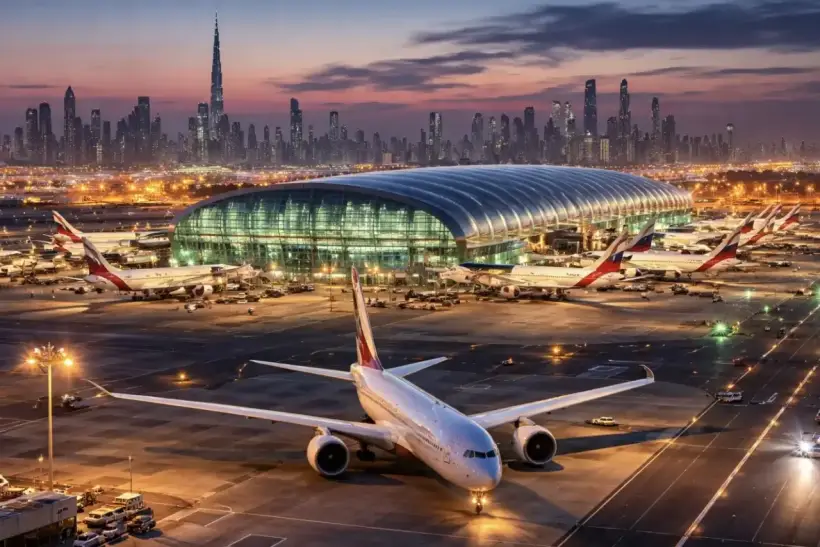
DXB began recovering after a fresh aviation shock
Dubai International Airport started moving back toward more stable operations on March 16, 2026 after a major disruption linked to an incident near fuel infrastructure close to DXB. Dubai Airports officially said that both DXB and DWC were affected by delays and cancellations because of a temporary airspace-related measure and advised passengers to check directly with airlines. At the same time, several major publications reported that the temporary halt was triggered by a drone-related incident, forcing Dubai’s aviation system to redistribute some traffic between its two airports.
That matters because DXB is one of the world’s most important international transfer hubs. Any interruption at the airport quickly spreads across intercontinental connections, airline schedules and regional travel flows. This is why recovery was not just about restarting flights at DXB itself, but also about using Al Maktoum International, or DWC, to absorb pressure and keep the wider network functioning.
The disruption forced diversions across the network
Business Insider and other reports said that 65 flights were diverted to 34 airports during the disruption, while some aircraft turned back to their departure points before reaching Dubai. The Financial Times reported that after the drone strike near the airport, Emirates had to reroute several services, including flights from Manchester, Edinburgh and Dublin, while part of the traffic was sent to Al Maktoum. The Wall Street Journal also reported that Dubai authorities confirmed the resumption of some flights after the temporary suspension.
The episode showed how important Dubai’s dual-airport model has become. While DXB remained under pressure from restrictions and accumulated delays, DWC helped reduce the scale of the disruption. For passengers, that meant some routes could be preserved or restored faster than if all traffic had remained concentrated at DXB alone. In a city where aviation is part of global infrastructure rather than just a local transport service, that kind of operational flexibility has major value.
Al Maktoum acted as a strategic relief valve
Al Maktoum International played a much more visible role in this crisis than it usually does. The National reported that some inbound flights were routed there when DXB operations were disrupted. In practice, that meant DWC served as a relief valve, easing the burden on the country’s main passenger hub. For Dubai’s aviation strategy, this was an important real-world test: backup infrastructure proved to be more than a secondary asset and became an active crisis-management tool.
That is especially significant because the UAE’s aviation system in March 2026 is already operating in a more unstable regional environment. Narrow flight corridors, route changes and frequent operational revisions mean that any spare capacity becomes strategically important. Using DWC during this disruption therefore looks less like a temporary workaround and more like evidence that Dubai is preparing its airport system for a more turbulent geopolitical backdrop.
Why DXB’s recovery matters for tourism and business
Stable operations at DXB are critical for Dubai’s tourism, hospitality, trade and business ecosystem. The airport handles the main flow of foreign tourists, transit passengers and corporate travelers. Even a short disruption can affect hotel occupancy, airline operations, ground transport and the broader service chain built around international arrivals. That is why the phased recovery of flights and the redistribution of traffic to DWC were not only technical steps but economically important ones for the emirate as a whole.
Financial markets and corporate travel planners also watch such events closely. What matters is not only whether flights resume, but how quickly the biggest hubs can normalize operations and how effectively they use backup infrastructure. In Dubai’s case, the March episode showed that even after an external security incident, the system could both restart operations and transfer part of the burden to a second airport. That helps reduce reputational damage and supports confidence in Dubai as an international transport center.
Dubai’s airport system passed a major resilience test
The events of March 16 were not just a local disruption story. They also served as a broader reminder that global aviation is increasingly exposed to infrastructure-related security shocks. Even one incident near a critical airport asset can trigger a chain of diversions, returns and delays across international networks. In that context, DXB’s ability to restart part of its schedule quickly, and DWC’s role in taking on additional pressure, becomes an important marker of the resilience of Dubai’s wider airport architecture.
As experts at International Investment note, the March disruption at DXB showed that aviation resilience is no longer defined only by the scale of the main hub, but also by the quality of its backup infrastructure. For Dubai, the use of Al Maktoum during the crisis provided a strong indication that the emirate can cushion shocks to its primary airport and restore international passenger flows faster even under rising geopolitical strain.