







read also
 Vietnam Mortgage Surge Pushes Homes Out of Reach
 Lithuanian Apartment Prices Accelerate Across Major Cities
 London Flats Lose Value Ahead of Leasehold Reform
 Construction of the Batumi–Sarpi Highway Begins in Georgia
 Baltic Property Investment Accelerates in 2026
 Hong Kong and Singapore Renew Their Expat Rivalry
Growth of Georgia’s GDP in 2026 to Again Outpace South Caucasus Countries: World Bank Forecast

Photo: pro
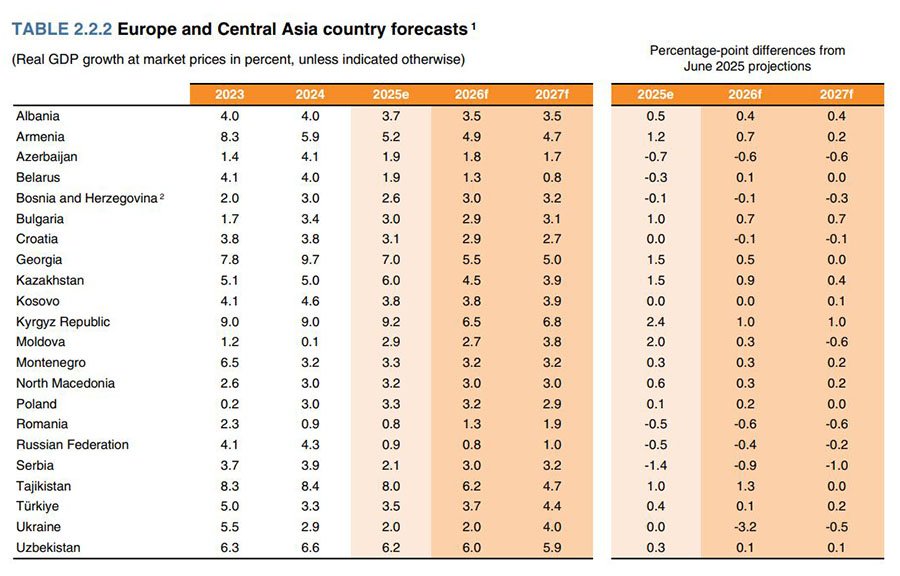
The World Bank forecasts that Georgia will record the highest economic growth rate in the South Caucasus. In its new Global Economic Prospects 2026 report, the country is named the regional leader in GDP dynamics. This assessment comes amid a broader slowdown and downward revisions of forecasts for many other countries.
Global outlook
In 2025, the global economy demonstrated greater resilience to a series of shocks than expected after the pandemic. Despite rising trade barriers and a high level of uncertainty, global GDP increased by 2.7%, in line with forecasts made at the beginning of the year. Inflation eased, interest rates began to decline, and investment activity partially recovered. In per-capita terms, global GDP in 2025 was about 10% higher than its pre-pandemic level, marking the strongest recovery in the past six decades.
At the same time, long-term global growth has weakened noticeably. After the pandemic, the world economy shifted to a trajectory insufficient to significantly reduce extreme poverty or generate jobs at scale. According to estimates, the average growth rate in the 2020s will be the lowest since the 1960s. The gap between countries has widened: advanced economies have surpassed pre-pandemic income levels per capita, while around a quarter of developing countries and more than a third of low-income economies remain below levels seen five years ago.
Most of the increase in global GDP per capita since 2019 has been driven by advanced economies. By the end of 2025, the average figure for developing countries stood at around $6,500, representing only a small share of the level in high-income economies. In low-income countries, the gap is even more pronounced.
South Caucasus
Against this backdrop, Georgia stands out, with international institutions consistently revising its forecasts upward. The World Bank raised its GDP growth projection for Georgia in 2026 by 0.5 percentage points, to 5.5%, the highest rate in the region. Economic growth in Armenia is expected at 4.9%, while Azerbaijan’s economy is projected to expand by 1.8%, reflecting a possible decline in hydrocarbon production and lower global oil prices. Overall economic growth in the South Caucasus is forecast to slow to 3.3% in 2026 and 3.1% in 2027.
Kazakhstan is expected to grow by 4.5%, Turkey by 3.7%, Ukraine by 2%, and Russia by just 0.8%. In Georgia and Armenia, economists also expect private consumption to slow as economic activity normalises after a period of rapid growth. Declining remittance inflows and export revenues may put pressure on current account balances.
Georgia’s economy
Georgia’s Prime Minister Irakli Kobakhidze noted that the country’s economic results in 2025 exceeded initial expectations. For the first time, the size of the economy reached approximately GEL 104 billion. GDP per capita surpassed $10,000, while in purchasing power parity terms it exceeded $30,000. Revenues of both the consolidated and state budgets were executed at more than 100%, and external debt declined to 34% of GDP from over 60% in 2020. International reserves, according to government estimates, exceeded $6 billion by year-end. The outlook for 2026 remains favourable, with authorities planning to continue large-scale development programmes.
Georgia’s Parliament approved the state budget law for 2026. Real economic growth next year is projected at 5%, with a medium-term forecast of 5.3%, while nominal GDP is estimated at GEL 114.1 billion. Average annual inflation is expected at 3.3%, in line with the target. The budget deficit will amount to 2.5% of GDP, and government debt is set to decline to 33.5%.
Paata Kvizinadze, Chair of the Budget Committee, pointed to an improvement in the country’s macroeconomic position. According to his assessment, in 2026 Georgia will rank among Europe’s leaders in terms of budget deficit and government debt indicators, and could take first place by economic growth rates.
Analysts at International Investment note that the combination of strong growth, moderate inflation, and declining debt burden is shaping a resilient macroeconomic position for Georgia amid a slowing global economy. Maintaining fiscal discipline and investment activity is expected to allow the country to remain one of the most dynamically developing markets in 2026 as well.