







 China Nears a Decision on Fresh Stimulus
 Fines for Illegal Rentals in Spain Reach €800,000
 Australia’s Spring Auctions Rise but Remain Well Below 2025
 Number of Foreigners Holding Turkish Residence Permits Exceeds 1.27 Million
 Demand from Russian Tourists for Holidays in Georgia Rises by 20–25%
 Montenegro Property Buying Costs in 2026
Hormuz fears shift pressure toward Malacca
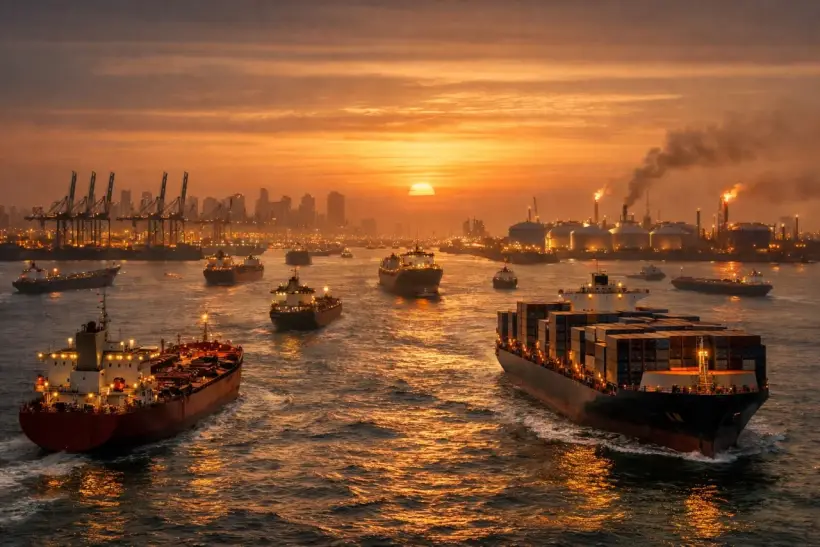
The risk of disruption in the Strait of Hormuz has quickly intensified attention on the Straits of Malacca and Singapore, the crucial shipping corridor through which Asian economies receive oil, gas and part of their container trade. According to the US Energy Information Administration, about 23.2 million barrels a day of oil moved through Malacca in the first half of 2025, making it the world’s largest maritime oil chokepoint, while Hormuz carried about 20 million barrels a day in 2024, or roughly one-fifth of global petroleum liquids consumption.
Why the Hormuz crisis immediately drew in Singapore
Bloomberg’s framing points to a broader market shift: traders are no longer treating Hormuz as only a local Middle East problem. Once the main outlet for Persian Gulf energy is threatened, attention automatically moves to the next critical leg of the route — the Straits of Malacca and Singapore, through which much of that Middle Eastern crude and liquefied natural gas continues into East and Southeast Asia. That is why tension around Iran rapidly became a concern for Singapore, Malaysia, Indonesia, China, Japan and global shipping operators.
In practical terms, the logic is straightforward. If flows through Hormuz are constrained, Asia loses part of its normal energy intake, and the remaining routes and transshipment hubs become even more sensitive. In that setting, Malacca stops being just another waypoint and becomes the channel through which extra pressure is transmitted into freight rates, insurance, bunkering and vessel scheduling.
Why Malacca is one of the world’s most important sea lanes
The US Energy Information Administration says the Strait of Malacca is the main oil chokepoint for Asia and Oceania and the largest maritime oil chokepoint in the world by transit volume. In the first half of 2025, it handled an estimated 23.2 million barrels a day, equal to 29% of total maritime oil flows. The same source emphasizes its central role in moving Middle Eastern oil toward China, Japan, South Korea and the rest of Asia.
Its importance goes far beyond oil. UNCTAD says maritime chokepoints have become increasingly critical to global trade resilience after disruptions in the Red Sea and the Panama Canal. For Asia, Malacca and Singapore are not only energy routes but also container lanes, raw-material channels, industrial supply lines and part of food trade flows. That is why any additional risk in the area quickly becomes a broader trade story rather than a narrow energy one.
What exactly is worrying the market now
The market’s fear is not that Malacca itself has been closed. The deeper concern is that the global logistics system is being forced to depend on two ultra-sensitive chokepoints at once. If Hormuz tightens supply at the Persian Gulf exit, Malacca magnifies the effect at the Asian delivery end. That means any disruption can raise not only the price of crude itself, but also the cost of shipping, insurance and delivery times. Bloomberg had already noted in earlier coverage that even the threat of a Hormuz blockade could lift oil prices and widen the crisis into the high seas.
Associated Press reported that after the US announced a blockade of Iranian ports, US crude rose more than 8% and Brent about 7%. Even if those moves were partly driven by expectations rather than outright physical shortage, they show how sensitive markets are to any risk around Persian Gulf shipping. Once that nervousness extends to Malacca, Asia faces not only a supply issue but also a logistics vulnerability issue.
Why Singapore is central to the story
Singapore is not merely a point beside the strait. It is one of the world’s leading shipping, transshipment and bunkering hubs. The Maritime and Port Authority of Singapore said the country posted record results in 2025, with vessel arrival tonnage reaching 3.11 billion gross tons, container throughput hitting 41.12 million TEUs and bunker sales climbing to a record 56.77 million tonnes. That means any tension near Singapore directly touches a massive share of global shipping activity.
This matters especially for fuel markets. Singapore remains the world’s largest bunkering hub. When Middle East risks raise oil prices and supply uncertainty, the strain on such a node increases because shipping lines, traders and operators start watching inventories, fuel pricing, queues and turnaround times far more closely.
How vulnerable the Malacca and Singapore Straits already are
Even without a Middle East crisis, this corridor has long been viewed as fragile. The EIA notes that the Malacca and Singapore Straits face piracy, navigational hazards and extremely dense traffic, and says attacks on ships increased after 2023, especially around Singapore. The International Maritime Organization separately supports a dedicated cooperation mechanism for navigational safety in the Straits of Malacca and Singapore, which underlines their strategic sensitivity.
In other words, the route was already crowded and exposed before the Hormuz shock. The Iran-related tension simply adds another layer. The issue does not have to be a full shutdown. More inspections, delays, operator caution, higher insurance costs and rerouting pressure can all be enough to lift transport costs and reduce delivery predictability. That is the kind of shock that may not look dramatic on a single day but accumulates quickly through prices and logistics.
What this means for Asia and world trade
For Asia, the core problem is that too much critical import dependence is concentrated on one chain of routes. If Hormuz constrains the exit of oil and gas from the Gulf, Malacca becomes the bottleneck for onward delivery into Asian economies. That is especially important for China, Japan, South Korea and parts of Southeast Asia, all of which rely heavily on seaborne energy imports.
For global trade, the effect is wider. Higher oil prices feed directly into transport costs, raise aviation and marine fuel bills, and any tension near Singapore also spills into container shipping. With UNCTAD already warning about the impact of simultaneous disruptions in the Red Sea and Panama Canal, another layer of risk around Malacca reinforces the sense that global commerce has become overexposed to a handful of overburdened maritime chokepoints.
As International Investment experts report, the Hormuz-Malacca story shows that global trade is increasingly pricing risk not through one conflict point alone but through chains of interconnected chokepoints. For Singapore, that means greater strategic importance in both fuel and container logistics. For Asia, it is a reminder that a distant Middle East crisis can almost immediately raise the cost of energy and shipping across the Pacific-facing economies.
FAQ
What is the Strait of Malacca and why does it matter?
It is one of the most important sea passages between the Indian and Pacific Oceans. Around 23.2 million barrels a day of oil moved through it in the first half of 2025.
Why did events in Hormuz affect Singapore?
Because cargoes from the Persian Gulf headed for Asia continue through the Straits of Malacca and Singapore. A crisis at one end of the route quickly raises pressure on the next critical segment.
Is Singapore really that important to shipping?
Yes. In 2025 it handled 41.12 million TEUs and sold a record 56.77 million tonnes of bunker fuel, confirming its position as one of the world’s leading maritime hubs.
Has the Strait of Malacca been closed?
No. There is no confirmed closure. The issue is heightened tension, strategic anxiety and the risk of more expensive shipping and insurance, not an actual blockade of Malacca itself.
Why do markets react so strongly to shipping straits?
Because they carry huge shares of global energy and trade flows. Even partial disruptions or threats can rapidly affect oil prices, freight, insurance and supply chains.